Every retail shop owner in India knows the last 20 minutes of the day: counting the drawer, matching it against the register, and hoping the numbers agree. When they don't, someone stays back to find a ₹200 gap that could be a missed bill, a wrong change, or a UPI payment logged twice. Billing software that reconciles automatically removes this guesswork.
Why manual cash reconciliation breaks down
Most small shops still close the day on a notebook or a spreadsheet: total cash sales from memory, minus expenses paid from the drawer, compared to what's physically counted. This works until volume grows past a handful of bills a day. Common failure points:
- Split payments (part cash, part UPI/card) get recorded inconsistently across staff.
- Returns and refunds paid in cash aren't deducted from the expected drawer total.
- Owner-drawn cash for supplier payments isn't logged, so the shortfall looks like theft or billing error.
- Multiple cashiers on one drawer make it impossible to trace who caused a mismatch.
How automatic reconciliation works in RichPOS
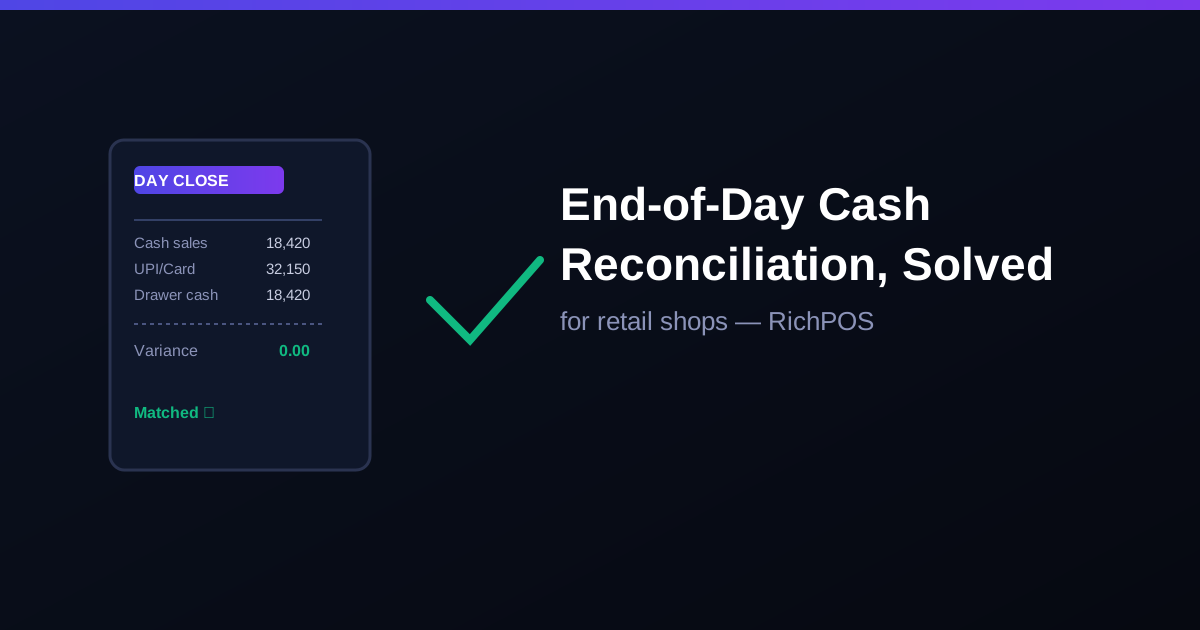
RichPOS logs every bill against its payment mode (cash, UPI, card, credit) at the time of sale — not at day-close. When you run day-close, the system does the matching for you:
| Step | What RichPOS does |
|---|---|
| 1. Expected cash | Sums cash-mode bills, minus cash refunds, minus any logged cash withdrawals |
| 2. Counted cash | Cashier enters physical drawer count at close |
| 3. Variance | System shows the difference instantly — ₹0 if matched, flagged amount if not |
| 4. Digital modes | UPI/card totals cross-checked against gateway settlement, separate from cash variance |
A same-day variance is easy to trace back to the last few bills. A variance discovered a week later, during GST reporting, is nearly impossible to explain.
What to check if the drawer doesn't match
- Re-open the day's bill list filtered by cash payment mode and re-count against the printed receipts.
- Check for any bill edited or cancelled after printing — a cancelled cash bill still counted in the drawer.
- Confirm change given matches the bill amount, not a rounded figure.
- Check if a cash expense (tea, courier, small supplier payment) was paid from the drawer but not logged.
Multi-store shops need this more, not less
A single-store shop can eyeball a small mismatch. A 3-store chain closing each night needs every store's reconciliation rolled up the same way, the same evening, so the owner sees one clean number instead of three different notebooks. RichPOS's multi-store dashboard shows each outlet's expected-vs-counted cash side by side.
Bottom line: reconciliation should happen automatically at day-close, not be reconstructed later from memory. See how RichPOS handles GST reporting and plan pricing for your shop, or call +91 90333 31255 for a walkthrough.
Figures above are illustrative examples, not RichPOS transaction data.