On this page · 10 sections
- E-invoice rules by turnover, at a glance
- Who must generate e-invoices in 2026
- Does e-invoicing apply to walk-in retail customers?
- The 30-day rule for ₹10 crore+ businesses
- What happens if you skip it
- Do credit notes and debit notes need an IRN?
- Can an e-invoice be cancelled?
- Does RichPOS generate e-invoices (IRN)?
- 2026 compliance checklist for retailers
- Frequently asked questions
Updated 25 October 2026 · By Ashok Sachdev · Sources: Notifications 13/2020 and 10/2023-Central Tax, GSTN e-invoice advisory of 5 November 2024
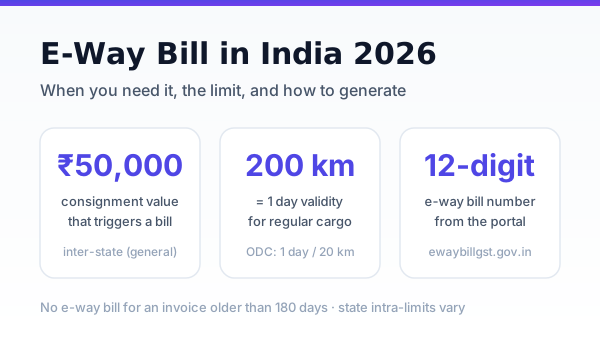
The GST e-invoice limit for FY 2026-27 is ₹5 crore aggregate annual turnover: if your AATO crossed ₹5 crore in any financial year from 2017-18 onwards, every B2B invoice and export invoice needs an IRN and QR code from the Invoice Registration Portal. Businesses with AATO of ₹10 crore or more must also report each invoice to the IRP within 30 days of its date.
If your shop's turnover crossed ₹5 crore in any year since 2017-18, GST e-invoicing is not optional. Every B2B invoice needs an IRN and QR code from the government portal before it counts as a valid tax invoice, and without one your buyer cannot claim input tax credit on that bill.
Many retailers learn this only when a business customer rejects a bill or a GST notice asks why IRNs are missing. Below are the current rule, who it applies to, and what to check in your own billing set-up.
E-invoice rules by turnover, at a glance
| Aggregate annual turnover (AATO), any year from 2017-18 | E-invoice (IRN) needed? | 30-day reporting limit? |
|---|
| Never above ₹5 crore | No. Print a normal tax invoice. | Not applicable |
| Above ₹5 crore, below ₹10 crore | Yes, for B2B invoices, B2B credit and debit notes, and exports. Not for walk-in (B2C) bills. | No hard cut-off |
| ₹10 crore or more | Yes, same documents as above | Yes: report within 30 days of the document date (since 1 April 2025), or the IRP rejects it |
IRNs are generated on the government's e-invoice portal (IRP), directly or through software connected to it.
Who must generate e-invoices in 2026
The threshold has been ₹5 crore Aggregate Annual Turnover (AATO) since 1 August 2023, and it hasn't moved since. But the trap is in how AATO is calculated: it's not just this year's turnover. If your business crossed ₹5 crore in any financial year from 2017-18 onward, you're in the e-invoicing net permanently — even if turnover has since dropped below ₹5 crore.
This catches shops that crossed ₹5 crore once, say in a strong festive year, and then went back below it. The rule looks at every year since 2017-18, not only the last one.
Worked example: a shop's turnover was ₹3.2 crore in FY 2021-22, ₹5.4 crore in FY 2022-23 and ₹4.6 crore in FY 2024-25. Because one preceding year (2022-23) crossed ₹5 crore, the shop must e-invoice its B2B invoices in 2026, even though last year's turnover was lower. AATO counts all GSTINs on the same PAN across India, so add up every branch registration before you decide you are below the line.
Does e-invoicing apply to walk-in retail customers?
No. E-invoicing applies to B2B invoices (supplies to GST-registered buyers) and to exports, not to bills for unregistered walk-in customers. A shop above ₹5 crore AATO still prints a normal tax invoice for B2C sales; only bills to GST-registered buyers and export invoices need an IRN.
The 30-day rule for ₹10 crore+ businesses
Since 1 April 2025, retailers with AATO of ₹10 crore or more face a stricter deadline: invoices, credit notes, and debit notes must be reported to the Invoice Registration Portal (IRP) within 30 days of the invoice date. Miss the window and the portal refuses to issue an IRN, so the invoice cannot be reported at all.
Below ₹10 crore, you still must e-invoice above the ₹5 crore threshold, but the 30-day hard cutoff doesn't apply to you (yet).
What happens if you skip it
- An invoice without a valid IRN and QR code is treated as not a valid tax invoice under GST law.
- Your buyer cannot claim input tax credit on it, so business customers will push back on such bills.
- For ₹10 crore+ businesses, invoices older than 30 days can't get an IRN at all, no exceptions.
Do credit notes and debit notes need an IRN?
Yes. If a B2B invoice needed an IRN, the credit note or debit note you issue against it must be reported on the IRP too. The GSTN advisory of 5 November 2024 applies the 30-day limit to "all document types (Invoices/Credit Notes/Debit Notes) for which an IRN is to be generated". So when a registered buyer returns goods, generate the IRN for the credit note within the same window, or the return cannot be reported.
Can an e-invoice be cancelled?
Yes, but only on the IRP within 24 hours of generating the IRN, and only in full. After 24 hours the IRN stays; correct the sale with a credit note (which needs its own IRN) or amend the details in GSTR-1. See how to cancel or amend a GST invoice.
Does RichPOS generate e-invoices (IRN)?
No. RichPOS does not connect to the Invoice Registration Portal, so it does not generate an IRN or the signed QR code. If your turnover makes e-invoicing mandatory, generate the IRN on the IRP (or through your GST Suvidha Provider) for each B2B invoice. RichPOS still gives you the GST-ready sales register and HSN-wise summary your CA needs for GSTR-1. See GST reports in RichPOS and GST billing software for retail.
If you are still choosing a system, ask every vendor directly whether it generates IRNs itself, and see the billing software checklist.
2026 compliance checklist for retailers
- Check your AATO history since FY 2017-18, not just current-year turnover.
- If you've ever crossed ₹5 crore, make sure an IRN is generated for every B2B invoice and export invoice.
- If you're at ₹10 crore+, set a hard internal rule: no invoice sits unreported past day 25.
- Make sure your GST reporting workflow reconciles IRNs against your sales register monthly.
- If you are above ₹5 crore, decide who will generate IRNs on the IRP for every B2B invoice. Your billing software may not do it for you, so check before you buy.
Sources: Notification 13/2020-Central Tax, 21 March 2020, as amended by Notification 70/2020-Central Tax, 30 September 2020 (B2B supplies and exports; "any preceding financial year from 2017-18 onwards"); Notification 10/2023-Central Tax, 10 May 2023 (₹5 crore from 1 August 2023); GST e-Invoice Portal: 30-day reporting limit for AATO ₹10 crore and above (GSTN advisory, 5 November 2024, effective 1 April 2025); CGST Act section 2(6) (aggregate turnover across all GSTINs on one PAN). Checked 15 October 2026; confirm your own position with your CA.
Want to see this working before your next GST filing? Compare RichPOS against other Indian POS software or check RichPOS pricing.
FAQ
Frequently asked questions
What is the GST e-invoicing turnover limit in 2026?
₹5 crore Aggregate Annual Turnover. This threshold has been unchanged since 1 August 2023.
My turnover was above ₹5 crore two years ago but is lower now. Do I still need to e-invoice?
Yes. Once your AATO crosses ₹5 crore in any financial year from 2017-18 onward, e-invoicing applies permanently, regardless of later turnover.
What is the 30-day e-invoice rule?
Businesses with AATO of ₹10 crore or more must report invoices to the IRP within 30 days of the invoice date, effective 1 April 2025. Reporting later blocks IRN generation entirely.
What happens if an invoice doesn't have an IRN?
It isn't a valid tax invoice under GST law, and the buyer cannot claim Input Tax Credit on it.
Do walk-in (B2C) retail bills need an e-invoice?
No. E-invoicing covers invoices to GST-registered buyers (B2B) and exports, not bills to unregistered walk-in customers.
Does RichPOS generate e-invoices (IRN)?
No. RichPOS does not connect to the Invoice Registration Portal, so it does not generate the IRN or signed QR code. Generate IRNs on the IRP or through a GST Suvidha Provider, and use RichPOS's
GST reports for the sales register and HSN summary your CA needs.
What is the e-invoice limit for FY 2026-27?
₹5 crore aggregate annual turnover in any financial year from 2017-18 onwards, the limit in force since 1 August 2023 under Notification 10/2023-Central Tax. We found no notification changing it for FY 2026-27 as of October 2026; check the CBIC notifications page before relying on this for a new year.
Need a quick figure? Use the free GST calculator to add or remove GST.
ASWritten by Ashok SachdevFounder, RichPOS Software, Ahmedabad. We build RichPOS for Indian shops and write these guides from what shop owners ask us every day. Facts on tax rates and prices are dated; confirm GST matters with your CA. Questions? WhatsApp us.
Make GST bills in seconds with RichPOS
Billing, stock, WhatsApp bills and GST reports in one app. Free 30-day trial with no card, then ₹99/month for 3 months and ₹199/month after.