On this page · 7 sections
- GST on gold: the rates at a glance
- The 3%-vs-5% trap: composite supply explained
- Old gold exchange: who pays GST?
- How a jeweller must bill it in 2026
- 5 checks before you bill a gold sale
- Frequently asked questions
- The bottom line
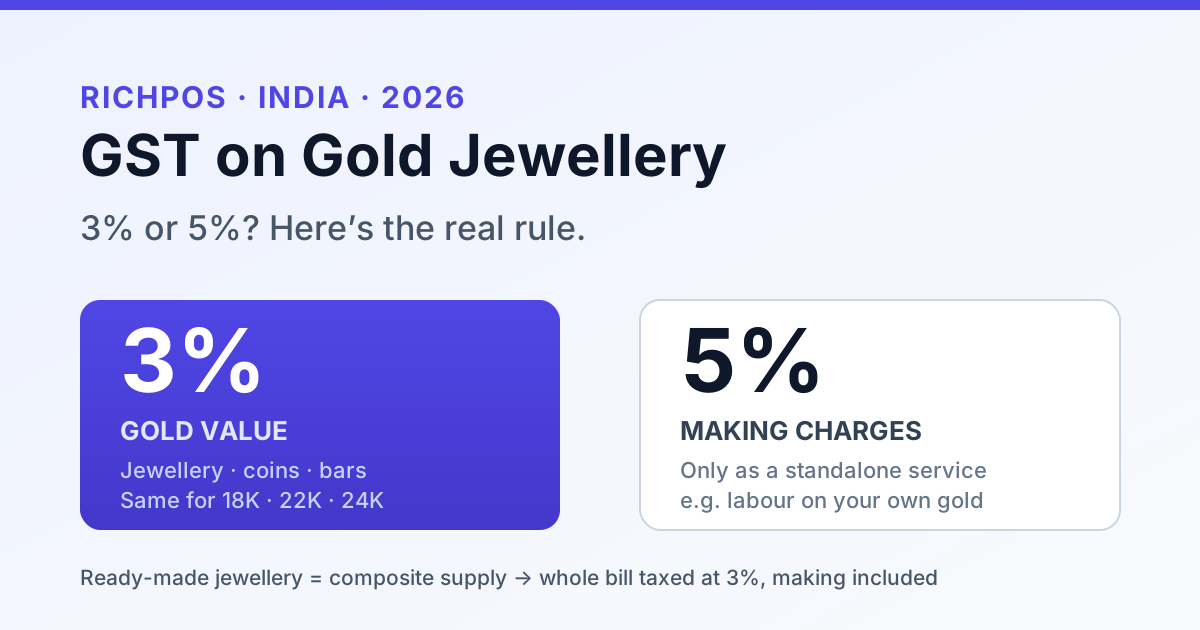
GST on gold in India is 3% on the gold value and 5% on making charges — but when you buy ready-made jewellery off the shelf, the whole bill (gold + making + stones) is taxed at just 3%. That single rule is why two jewellers can charge you different GST on what looks like the same ring. This guide breaks down exactly when 3% applies, when 5% kicks in, and how a jeweller must bill it in 2026 to stay compliant.
Only need the rate and HSN? See GST rate and HSN for gold jewellery. This guide covers how to bill it.
GST on gold: the rates at a glance
Three numbers cover almost every gold transaction in India:
| Component | GST rate | HSN |
|---|
| Gold jewellery (gold value) | 3% (1.5% CGST + 1.5% SGST) | 7113 |
| Making / labour charges (billed separately as a service) | 5% | 9988 |
| Ready-made jewellery sold off the shelf | 3% on the whole bill | 7113 |
| Gold bars and other unwrought gold | 3% | 7108 |
| Gold coins | 3% | 7118 |
The 3% entries are Schedule IV of Notification 9/2025-Central Tax (Rate), 17 September 2025: S. No. 5 (gold, 7108), 10 (jewellery, 7113) and 15 (coin, 7118).
The 3% rate is uniform across every state and every purity — 18K, 22K and 24K are all taxed the same. Customs import duty on gold is separate from GST and does not appear on your retail bill.
The 3%-vs-5% trap: composite supply explained
Here is the part that confuses almost everyone. When you walk into a showroom and buy a finished, ready-made ornament, GST law treats it as a composite supply: the gold is the "principal supply" and the craftsmanship is bundled with it. Because the principal supply is gold, the entire invoice — net gold value, stones and making charges — is taxed at a single 3%. You do not pay 5% on the making portion of a ready-made piece.
The 5% rate applies in a different situation: when making is a standalone service. Classic example — you bring your own gold to a jeweller and pay only for turning it into a bangle. Now there is no sale of gold, only a job-work/making service, so that labour charge is taxed at 5%.
Same making charge, two different GST rates — the difference is whether gold is being sold to you (composite, 3% on everything) or whether you are only paying for labour on gold you already own (service, 5%).
Old gold exchange: who pays GST?
Exchanging old jewellery for new is routine, and the GST treatment is simpler than people fear. When an individual hands over old gold, they charge no GST: a sale by an unregistered person is not a taxable supply. The jeweller still charges 3% GST on the full value of the new piece, because the usual reading is that the old gold is part payment, not a discount. Some jewellers bill only the difference; no CBIC clarification supports that, so agree the treatment with your CA.
How a jeweller must bill it in 2026
Even when the rate is a uniform 3% on a composite sale, a lumped "all-in" invoice breaks GST invoicing rules. A compliant gold invoice must itemise:
- Net gold value (weight × the day's rate)
- Old gold taken in exchange, shown as part payment, not as a discount
- Making charges shown as a separate line
- Stone / diamond value if applicable
- CGST and SGST split out (or IGST for an inter-state sale)
- BIS hallmark details: since 1 April 2023 hallmarked gold jewellery may be sold only with a 6-digit HUID, and BIS asks that the bill show each article's description, net weight of precious metal, purity and the hallmarking charge. Many jewellers also print the HUID on each line.
See our GST invoice format guide for the exact fields.
5 checks before you bill a gold sale
- Is it a sale or just making? Ready-made sale → 3% on the whole bill. Labour only on the customer's gold → 5% on making.
- Itemise the invoice — gold value, making, stones, CGST, SGST separately, never a single clubbed figure.
- Show the hallmark details on the bill: description, net weight, purity and hallmarking charge. Many jewellers add the HUID.
- Treat old gold as part payment. The usual view is 3% on the new piece's full value; agree the treatment with your CA.
- Check your e-invoicing duty — businesses above the ₹5 crore turnover threshold must generate e-invoices; gold retailers are not exempt. See the 2026 GST rates guide for current thresholds.
The bottom line
For nearly every showroom purchase in India, gold GST is simply 3% on the total bill. The 5% making-charge rate only bites when making is sold as a pure service. Jewellers stay clean by itemising every invoice, showing the hallmark details, and treating old gold as part payment. Need the HSN and rate on one page? See GST on gold and silver jewellery, or use the free GST calculator.
Sources: Notification 9/2025-Central Tax (Rate), 17 September 2025, Schedule IV; PIB, 4 March 2023 (HUID-only sale after 31 March 2023); BIS hallmarking FAQ (what the bill must show). Making charges as a standalone job-work service: heading 9988. Rates checked against CBIC notifications on 22 October 2026. Verify thresholds and exchange treatment with your CA before filing.
FAQ
Frequently asked questions
Is GST on gold 3% or 5%?
Both, depending on what is being supplied. Gold value is 3% and making charges are 5%. But a ready-made ornament sold off the shelf is a composite supply taxed wholly at 3% — you only pay 5% when making is billed as a standalone service on gold you already own.
Do I pay GST when I sell my old gold to a jeweller?
No. If you are an ordinary individual and not a registered dealer, selling or exchanging your old gold is not a taxable supply, so you charge no GST. On an exchange, the jeweller still charges 3% on the full value of the new piece and treats your old gold as part payment; confirm the treatment with your CA.
Does the 3% GST rate change with gold purity?
No. The 3% rate is the same for 18K, 22K and 24K, and the same in every state. Purity changes the gold's price, not the GST rate.
Is making charge always taxed at 5%?
No. Making charge is taxed at 5% only when it is a separate service — for example, labour on gold you supplied. When you buy a finished ornament, the making charge is part of a composite supply and is taxed at 3% along with the gold.
Need a quick figure? Use the free GST calculator to add or remove GST.
ASWritten by Ashok SachdevFounder, RichPOS Software, Ahmedabad. We build RichPOS for Indian shops and write these guides from what shop owners ask us every day. Facts on tax rates and prices are dated; confirm GST matters with your CA. Questions? WhatsApp us.
Make GST bills in seconds with RichPOS
Billing, stock, WhatsApp bills and GST reports in one app. Free 30-day trial with no card, then ₹99/month for 3 months and ₹199/month after.