On this page · 8 sections
- Why open a kirana store in 2026?
- How much does it cost to open a grocery store in India?
- Which licences do you need to open a grocery store?
- What profit margin does a grocery store make?
- A simple month-one plan
- Paper register vs POS: start right
- Frequently asked questions
- The takeaway
To open a grocery or kirana store in India you need capital for rent deposit, shelving, opening stock, a stamped weighing scale and billing; two core licences (a state Shops & Establishment registration and an FSSAI registration); and GST registration once turnover crosses the limit. Costs depend on city, size and stock depth, so get local quotes. What decides whether you keep a profit is stock control and credit discipline — not your location.
Why open a kirana store in 2026?
Because people still buy daily groceries close to home, and the paperwork is lighter than before. From 1 April 2026, FSSAI's Basic Registration covers turnover up to ₹1.5 crore, so most new kiranas fit the simplest food-safety slab. UPI at the counter, WhatsApp orders and billing software are now normal even in small kiranas.
The opportunity is real, but so is the failure rate. The difference between a shop that makes money and one that quietly bleeds cash comes down to four decisions: capital, location, licensing, and systems. This guide walks through each.
How much does it cost to open a grocery store in India?
Startup capital depends on city, shop size and how much stock you open with. Here is where the money goes; get local quotes for each line:
| Cost head | Notes |
|---|
| Rent deposit (2–6 months) | Biggest variable; depends on city and footfall |
| Shelving, racks, counter | One-time; buy sturdy, skip fancy |
| Opening inventory | Largest recurring-style cost; scale to shelf space |
| Weighing scale, fridge, fixtures | Electronic scale is mandatory and stamped |
| Billing + barcode setup | POS software, scanner, printer |
| Licences & registration | FSSAI Basic is just ₹100/year |
| Working-capital buffer | Cover 1–2 months of bills before profit |
The single biggest mistake first-timers make is spending the entire budget on opening inventory and keeping zero working-capital buffer. Hold back one to two months of running costs — rent, electricity, restocking — so a slow opening month does not sink you.
Which licences do you need to open a grocery store?
A typical kirana needs two registrations: a state Shops & Establishment registration and an FSSAI Basic Registration. Add GST registration once turnover crosses ₹40 lakh (₹20 lakh in some states):
- Shops & Establishment registration — a state-level registration you must obtain within 30 days of opening. It governs working hours and staff conditions; cost and process vary by state.
- FSSAI registration — because you sell food. The big 2026 change: under FSSAI’s order effective 1 April 2026, the Basic Registration slab now covers annual turnover all the way up to ₹1.5 crore (up from ₹12 lakh), and registrations now carry perpetual validity — no more renewal cycle. Basic Registration costs about ₹100 a year; check the FoSCoS portal for any yearly fee or filing that still applies. So almost every new kirana qualifies for the simplest FSSAI slab.
- GST registration — required once turnover crosses ₹40 lakh (₹20 lakh in some states). Below that it is optional, but many owners register anyway to buy from distributors on proper invoices.
Depending on your municipality you may also need a local trade licence. For the full state-by-state breakdown, documents, and costs, see our guide to retail shop licences and registrations in India.
What profit margin does a grocery store make?
Grocery is a thin-margin, high-volume business, and margin varies sharply by category — branded staples usually earn the least, loose goods and personal care more. Work out your own margin per category from your purchase and selling prices with the free profit margin calculator.
Net profit is what is left after rent, electricity, salaries and wastage; track it monthly with the profit and loss calculator. A better result isn’t about a better location — it’s about stock control, pushing higher-margin loose and personal-care lines, and not leaking cash through informal customer credit.
A simple month-one plan
- Lock the location and licences. Sign the shop, apply for Shops & Establishment registration and FSSAI Basic Registration. Register for GST if you’ll buy on distributor invoices.
- Stock to your shelf, not your budget. Start with fast-moving staples and top FMCG brands your locality actually buys. Don’t over-order slow lines — that’s frozen cash from day one.
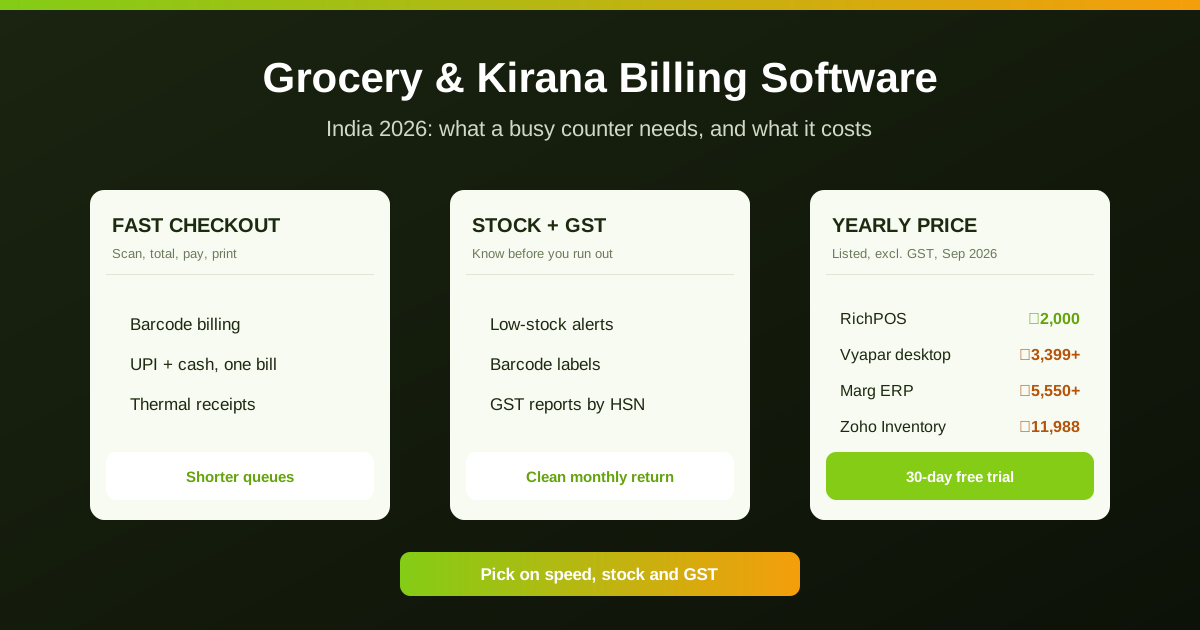
- Set up billing and barcodes before you open. A basic POS with barcode scanning, such as RichPOS for kirana and grocery stores, gives you live stock, GST-ready bills, and reorder alerts from the first sale.
- Accept digital payments. UPI is non-negotiable in 2026 — see how to accept UPI payments in your retail shop.
- Track your four inventory numbers weekly. Turnover, reorder point, safety stock, dead-stock share. Our inventory management guide for retail shops has the formulas and a worked example.
Paper register vs POS: start right
Many new owners run the first year on a paper register to save money, then spend the second year untangling it. The cost gap is small; the visibility gap is huge.
| Task | Paper register | POS with inventory |
|---|
| Stock of any item | Physical count | Live, on screen |
| Reorder reminders | You remember (or don’t) | Auto-flagged |
| GST bills & returns | Re-entered by hand | Auto-generated |
| Daily sales & profit | Manual tally | One report |
| Customer credit (udhaar) | Diary, easily disputed | Logged per customer |
Here is how that looks in a billing app such as RichPOS: you add each item once with its HSN code and GST rate, and every bill applies it. Low-stock alerts flag items before they run out, udhaar is logged per customer with a one-click WhatsApp reminder, and labels from a label-printing scale bill loose goods by weight.
If you’re choosing software, work through our 10-point billing-software checklist before you buy. The inventory and GST modules matter far more than a flashy dashboard. Comparing tools? See our best billing software for kirana stores guide.
Related guides: Kirana Store Item List with GST Rates (2026 Checklist); दुकान का हिसाब किताब कैसे रखें? 6 खाते और रोज़ का तरीका.
The takeaway
Opening a grocery store in India in 2026 is cheaper to license and easier to digitise than it has ever been — two registrations, an FSSAI slab that now covers almost every new shop, and POS tools that make stock and GST painless. Get local quotes, keep a working-capital buffer, push your higher-margin lines, and run it on a real billing system from day one. See how RichPOS handles billing, GST, live inventory and UPI payments in one place.
Sources: FSSAI Licensing and Registration Amendment Regulations 2026 / order effective 1 April 2026 (₹1.5 crore Basic slab, perpetual validity); OnlineLegalIndia and Registrationwala (Shops & Establishment, FSSAI and GST licensing requirements).
FAQ
Frequently asked questions
How much does it cost to open a small kirana store in India?
It depends on city, size and stock depth. Budget for rent deposit, shelving, opening inventory, a stamped weighing scale, billing and a working-capital buffer, and get local quotes for each; a self-service mini-supermarket needs much more than a counter kirana.
What licence do I need to sell groceries in India?
Two core registrations: a state Shops & Establishment registration (within 30 days of opening) and an FSSAI Basic Registration (about ₹100/year, now valid up to ₹1.5 crore turnover and perpetually valid since April 2026). Add GST registration once turnover crosses ₹40 lakh (₹20 lakh in some states).
Is a grocery store profitable in India?
Yes, but on thin margins. Profit depends heavily on stock rotation, pushing higher-margin loose and personal-care goods, and controlling customer credit.
Do I need GST registration for a kirana store?
Only once your annual turnover crosses ₹40 lakh (₹20 lakh in some states). Below that it is optional — but many owners register voluntarily so they can buy stock on proper distributor invoices and claim input credit.
ASWritten by Ashok SachdevFounder, RichPOS Software, Ahmedabad. We build RichPOS for Indian shops and write these guides from what shop owners ask us every day. Facts on tax rates and prices are dated; confirm GST matters with your CA. Questions? WhatsApp us.
Make GST bills in seconds with RichPOS
Billing, stock, WhatsApp bills and GST reports in one app. Free 30-day trial with no card, then ₹99/month for 3 months and ₹199/month after.