Sometimes the price you have already includes GST — an MRP, a round figure you quote a customer, or a cash total — and you need to work backwards to find the base price and the GST inside it. That is a reverse GST calculation. This guide gives you the exact formula, a worked example, and a ready reckoner so you can extract GST from any inclusive amount for 5%, 12%, 18% and 28%.
The reverse GST formula
To pull the base (taxable) amount out of a GST-inclusive total:
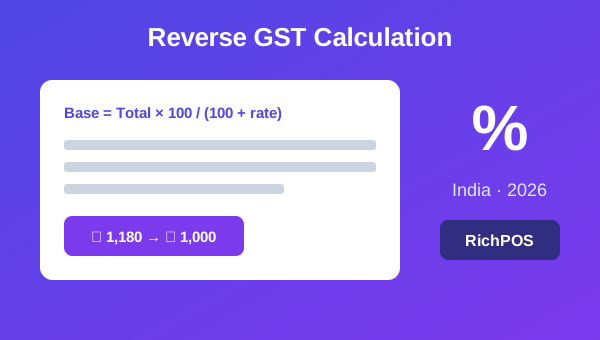
Base price = Total × 100 ÷ (100 + GST rate)
Then:
GST amount = Total − Base price
That is the whole method. Everything below is just applying it.
Worked example
A customer pays ₹1,180 all-inclusive for an item taxed at 18%.
- Base price = 1,180 × 100 ÷ 118 = ₹1,000
- GST amount = 1,180 − 1,000 = ₹180
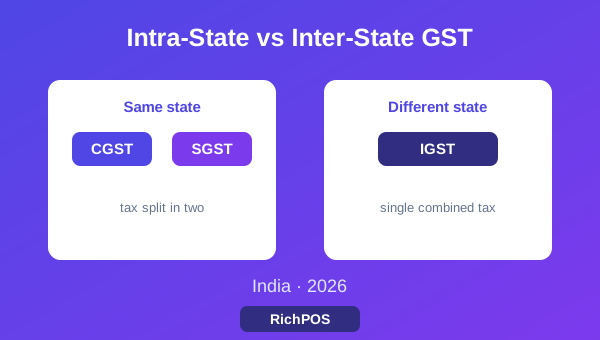
- For an intra-state sale, that ₹180 splits into CGST ₹90 + SGST ₹90.
Not sure whether to split into CGST + SGST or charge IGST? See intra-state vs inter-state GST.
Reverse GST ready reckoner
To find the base price, multiply the inclusive total by the factor below (or divide by the divisor):
| GST rate | Divide total by | Base as % of total | GST as % of total |
|---|---|---|---|
| 5% | 1.05 | 95.24% | 4.76% |
| 12% | 1.12 | 89.29% | 10.71% |
| 18% | 1.18 | 84.75% | 15.25% |
| 28% | 1.28 | 78.13% | 21.88% |
Example at 5%: a ₹525 inclusive total → base = 525 ÷ 1.05 = ₹500, GST = ₹25.
Forward vs reverse GST
Forward GST adds tax on top of a base price: Total = Base × (1 + rate÷100). Reverse GST does the opposite — it strips the tax out of a total that already includes it. Use forward when you price before tax; use reverse when you start from an MRP or an all-in figure.
When retailers need reverse GST
- MRP-inclusive pricing — the tag already includes tax and you need the taxable value for your records.
- Round-figure quotes — you quote ₹500 flat and must back out the GST for the invoice.
- Cash-till reconciliation — a day's inclusive takings, broken into base and tax by rate.
- GST return prep — reports need taxable value and tax separately, not just the gross.
Skip the manual maths
Doing this by hand on every bill invites errors, especially with mixed rates in one basket. A POS applies the correct rate per item, shows the tax break-up on the invoice, and totals base and GST for your returns automatically. RichPOS does this for GST-inclusive or exclusive pricing, so your invoice format and GST summaries always agree. Start a free trial and see it on a real sale.
FAQ
What is the formula for reverse GST calculation?
Base price = Total × 100 ÷ (100 + GST rate). Then GST amount = Total − Base price. For example, ₹1,180 at 18% gives a base of ₹1,000 and GST of ₹180.
How do I remove 18% GST from a total?
Divide the inclusive total by 1.18 to get the base price, then subtract that from the total to get the GST. So ₹1,180 ÷ 1.18 = ₹1,000 base, and ₹180 GST.
Is reverse GST the same as normal GST calculation?
No. Normal (forward) GST adds tax on top of a base price. Reverse GST starts from a total that already includes tax and works backwards to find the base price and the tax inside it.
How do I split reverse-calculated GST into CGST and SGST?
For an intra-state sale, divide the GST amount equally: half is CGST and half is SGST. On ₹180 GST that is ₹90 CGST + ₹90 SGST. For an inter-state sale the whole amount is IGST.
Bottom line
Reverse GST is one formula: base = total × 100 ÷ (100 + rate). Keep the ready reckoner handy for 5%, 12%, 18% and 28%, or let your POS strip the tax out on every bill automatically. See how RichPOS works or start a free trial.