If you bill customers under GST, the first thing you decide on every invoice is whether the sale is intra-state (within your state) or inter-state (to another state). That single choice decides which taxes you charge: CGST + SGST for intra-state, or IGST for inter-state. Get it wrong and your invoice — and your GST return — is wrong. This guide explains what intra-state and inter-state mean in GST, the place-of-supply rule that decides it, and clear examples for an Indian retail shop.
Intra-state meaning in GST
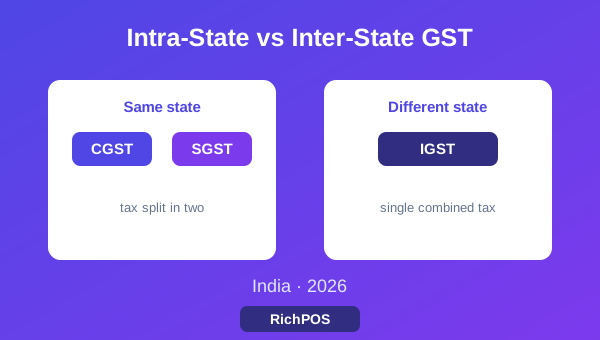
An intra-state supply is a sale where the supplier and the place of supply are in the same state or union territory. Most shop-counter sales are intra-state: a customer walks in, buys, and takes the goods in your own state. On an intra-state sale you charge two taxes that together make up the GST rate:
- CGST (Central GST) — goes to the central government.
- SGST (State GST) — goes to your state government.
The two are always equal and add up to the item's GST rate. So on an 18% item you charge 9% CGST + 9% SGST; on a 5% item, 2.5% + 2.5%.
Inter-state meaning in GST
An inter-state supply is a sale where the supplier and the place of supply are in different states or union territories. On an inter-state sale you charge a single tax:
- IGST (Integrated GST) — equal to the full GST rate of the item (e.g. 18% IGST on an 18% item). The centre later shares it with the destination state.
So IGST is not an extra tax — it is the same total rate, charged as one line instead of being split into CGST and SGST.
Intra-state vs inter-state GST at a glance
| Intra-state | Inter-state | |
|---|---|---|
| Supplier & place of supply | Same state | Different states |
| Tax charged | CGST + SGST | IGST |
| On an 18% item | 9% + 9% | 18% IGST |
| Who gets the tax | Centre + your state | Centre, shared with buyer's state |
| Typical case | Walk-in counter sale | Shipping to another state |
The rule that decides it: place of supply
Intra vs inter is not decided by where your shop is alone — it is decided by comparing your location with the place of supply. For most goods sold over the counter or delivered, the place of supply is where the goods are handed over or where their movement ends. Two quick examples:
- Shop in Maharashtra, customer takes goods in Maharashtra → place of supply is Maharashtra → intra-state → CGST + SGST.
- Shop in Maharashtra, you courier goods to a buyer in Gujarat → place of supply is Gujarat → inter-state → IGST.
Worked example
You sell a product priced at ₹1,000 (before tax) that attracts 18% GST.
- Intra-state: CGST ₹90 + SGST ₹90 = ₹180 tax. Invoice total ₹1,180, shown as two 9% lines.
- Inter-state: IGST ₹180. Invoice total is the same ₹1,180, shown as one 18% line.
The customer pays the same either way — only the tax break-up on the invoice changes. Want to reverse-engineer the base price from a tax-inclusive total instead? See our reverse GST calculation guide.
Why it matters for your invoice and returns
Charging CGST+SGST when it should be IGST (or the reverse) means re-issuing invoices and correcting your GSTR filing. The safest fix is billing software that picks the right tax automatically from the customer's state. Make sure your invoice already carries the basics — GSTIN, HSN, and the correct split — as covered in our GST invoice format guide.
How RichPOS handles it
RichPOS is a cloud POS built for Indian retail. When you set the customer's state, it decides intra vs inter-state for you and puts CGST + SGST or IGST on the invoice automatically, with the correct HSN and rate — so your bills and GST summaries stay consistent. You can start a free trial and bill a real sale to see it. New to GST software? Compare options in our best free GST billing software guide.
FAQ
What is the difference between intra-state and inter-state GST?
Intra-state GST applies when the supplier and the place of supply are in the same state, and you charge CGST + SGST. Inter-state GST applies when they are in different states, and you charge a single IGST equal to the full rate. The total tax is the same; only the break-up differs.
Is IGST higher than CGST plus SGST?
No. IGST equals the full GST rate of the item, and CGST + SGST also add up to that same rate. On an 18% item, IGST is 18% while CGST + SGST is 9% + 9% = 18%. The customer pays the same amount.
How do I know if a sale is intra-state or inter-state?
Compare your location with the place of supply — usually where the goods are delivered or handed over. Same state means intra-state (CGST + SGST); different states means inter-state (IGST).
Which GST applies to a walk-in shop sale?
A normal walk-in counter sale where the customer takes the goods in your own state is intra-state, so you charge CGST + SGST split equally to make up the item's GST rate.
Bottom line
Intra-state means same state, so you charge CGST + SGST; inter-state means different states, so you charge IGST. The total tax is identical — the place of supply just decides how the invoice shows it. Let your billing software read the customer's state and apply the right one every time. See how RichPOS works or start a free trial.