On this page · 8 sections
- What is the GST composition scheme?
- Who can opt for the composition scheme in 2026?
- How much tax do retailers pay under the scheme?
- What does a composition retailer give up?
- How does billing work under the composition scheme?
- Which returns does a composition dealer file?
- How to opt in
- Frequently asked questions
The GST composition scheme lets a small retailer with annual turnover up to ₹1.5 crore pay a flat 1% of turnover as tax instead of charging GST on every bill. You file one simple quarterly statement instead of monthly returns, but you give up two things in return: you cannot collect GST from customers, and you cannot claim input tax credit (ITC) on your purchases.
For a kirana store, a small garment shop, or a single-counter retailer, that trade-off is often worth it. Here is who qualifies in 2026, exactly what you pay, what you give up, and how to bill correctly once you opt in.
What is the GST composition scheme?
The composition scheme is a simplified GST option for small taxpayers. Instead of the normal system — charging GST on each invoice, claiming credit on purchases, and filing monthly returns — you pay a small fixed percentage of your total turnover and file far less paperwork. It is designed for businesses whose customers are mostly end consumers, where the missing input credit does not hurt.
Who can opt for the composition scheme in 2026?
A retailer or trader qualifies if annual turnover in the previous financial year stayed within the threshold and the business meets the eligibility rules.
| Condition | Rule for goods / retailers |
|---|
| Turnover limit | Up to ₹1.5 crore (₹75 lakh in special-category states) |
| Type of supply | Goods (traders, retailers, manufacturers). Restaurants also allowed at a higher rate |
| Sales area | Intra-state only — no inter-state outward sales |
| E-commerce | Allowed for intra-State sales through an e-commerce operator (since 1 October 2023); inter-State sales not allowed |
| Goods excluded | Cannot deal in items outside GST (e.g. petrol, alcohol); manufacturers of ice cream, pan masala, tobacco are barred |
If you cross ₹1.5 crore mid-year, you must exit the scheme and switch to regular GST from that point.
How much tax do retailers pay under the scheme?
Retailers and traders pay 1% of turnover (0.5% CGST + 0.5% SGST), manufacturers 1%, and restaurants 5%. The rate is charged on turnover, not on profit, and it is split equally between CGST and SGST.
| Business type | Composition rate |
|---|
| Traders and retailers | 1% of turnover (0.5% CGST + 0.5% SGST) |
| Manufacturers | 1% of turnover |
| Restaurants (non-alcohol) | 5% of turnover |
Example: a retailer with ₹80 lakh turnover pays 1% — ₹80,000 for the year — regardless of margin. Under regular GST the paperwork and rate depend on each item's slab; see our guide to the new GST rates for 2026 for how those slabs changed.
What does a composition retailer give up?
The scheme is a genuine trade-off, not a free discount. Before you opt in, weigh these:
- No input tax credit. The GST you pay to suppliers becomes a cost you cannot recover. If your purchases carry heavy GST, regular registration may work out cheaper.
- You cannot charge GST to customers. The 1% comes out of your own pocket, not added on top of the bill.
- No inter-state sales. You can only sell within your state.
- No tax invoice. You must issue a bill of supply, not a GST tax invoice — so B2B buyers who want ITC will not buy from you.
Because you cannot pass on credit, the scheme suits shops selling mainly to walk-in consumers, not to other GST-registered businesses.
How does billing work under the composition scheme?
A composition dealer issues a bill of supply instead of a tax invoice. It looks like a normal bill but shows no GST breakup, and it must carry the line “composition taxable person, not eligible to collect tax on supplies”. You are also required to display “composition taxable person” on your signboard and business premises.
Before you buy billing software as a composition dealer, ask the vendor to show you a bill-of-supply print with the mandatory declaration and no tax lines. RichPOS's GST reports give you the sales total you need for CMP-08. If you are still choosing a system, our billing software checklist for retail shops covers what to look for.
Which returns does a composition dealer file?
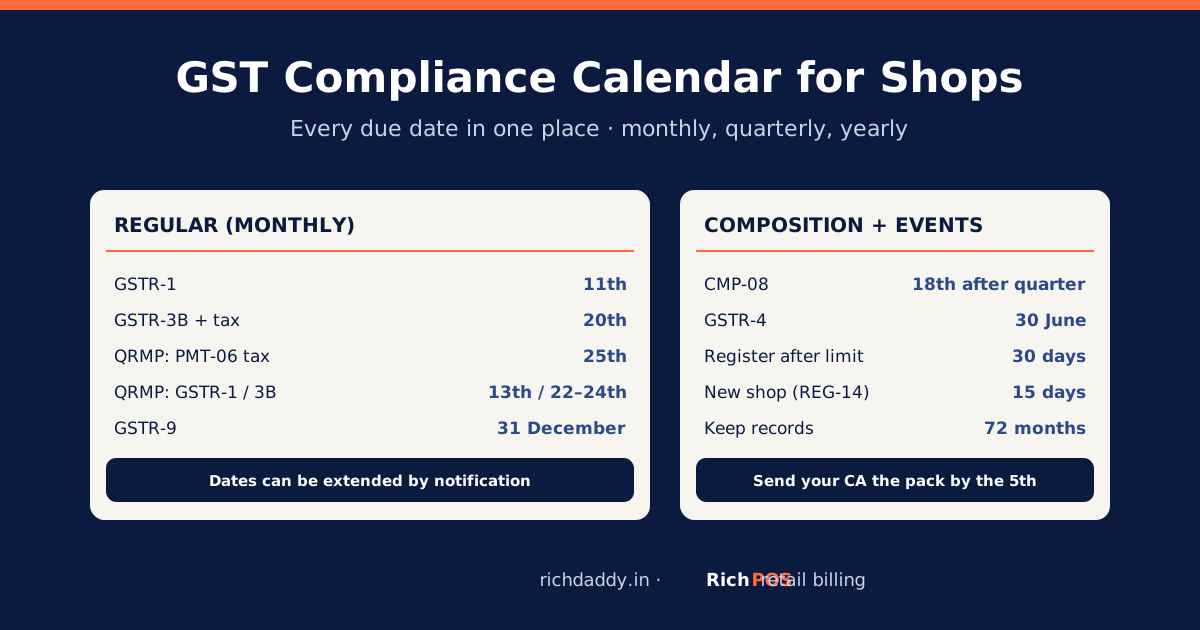
This is where the scheme saves the most effort — two kinds of filing: four quarterly CMP-08 statements and one annual GSTR-4, instead of the monthly cycle.
- CMP-08 — quarterly. A simple challan-cum-statement declaring turnover and paying the tax, due by the 18th of the month after each quarter.
- GSTR-4 — annually. A yearly return summarising the whole year, due by 30 June after the financial year ends.
Compare that with regular registration, where most retailers file GSTR-1 and GSTR-3B every month. For the regular-scheme walk-through, see our GST reporting guide for retailers, and if your turnover pushes you into e-invoicing, the e-invoicing guide for 2026.
How to opt in
To join the scheme, file form GST CMP-02 on the GST portal before the start of the financial year. New registrations can opt in at the time of registration. Once chosen, the option applies for the whole year unless your turnover crosses the limit.
Sources: Rule 7 of the CGST Rules as amended by Notification 3/2018-Central Tax, 23 January 2018 (composition rates); Notification 36/2023-Central Tax, 4 August 2023, effective 1 October 2023 (sales through e-commerce operators). Checked 15 October 2026; confirm with your CA before you opt in.
Not sure you need GST registration at all? Start with the GST registration threshold for shops. For kirana stores that sell mostly to walk-in customers, see also GST billing software.
Related guides: दुकानदार के लिए GST नियम 2026: 10 ज़रूरी बातें; कच्चा बिल vs पक्का बिल: GST में क्या फर्क और क्या जुर्माना; GST बिल कैसे बनाएं: मोबाइल और कंप्यूटर से (2026).
FAQ
Frequently asked questions
What is the turnover limit for the GST composition scheme in 2026?
For retailers and traders dealing in goods, the annual turnover limit is ₹1.5 crore. In special-category states the limit is ₹75 lakh.
What tax rate does a retailer pay under the composition scheme?
A trader or retailer pays 1% of turnover — split as 0.5% CGST and 0.5% SGST. Restaurants pay 5%. The rate is on total turnover, not on profit.
Can a composition dealer claim input tax credit?
No. A composition dealer cannot claim input tax credit on purchases and cannot collect GST from customers. The tax is paid from the dealer's own funds.
What invoice does a composition retailer issue?
A composition dealer issues a bill of supply, not a tax invoice, and cannot show any GST amount on it. The bill must carry the declaration that the dealer is a composition taxable person not eligible to collect tax.
Which returns must a composition dealer file?
A composition dealer files CMP-08 quarterly to pay tax and GSTR-4 once a year. This is far less than the monthly GSTR-1 and GSTR-3B filed under regular GST.
What does a trader with ₹35 lakh turnover pay under the composition scheme?
For a trader with ₹35 lakh of taxable sales in the year, all within the state, 1% tax is ₹35,000: ₹17,500 CGST and ₹17,500 SGST. No tax is collected from customers, so it comes out of margin, and GST on purchases cannot be claimed back. Bills are bills of supply, not tax invoices. Tax is paid through four quarterly CMP-08 statements, plus one GSTR-4 for the year. Confirm current limits with your CA.
Need a quick figure? Use the free GST calculator to add or remove GST.
ASWritten by Ashok SachdevFounder, RichPOS Software, Ahmedabad. We build RichPOS for Indian shops and write these guides from what shop owners ask us every day. Facts on tax rates and prices are dated; confirm GST matters with your CA. Questions? WhatsApp us.
Make GST bills in seconds with RichPOS
Billing, stock, WhatsApp bills and GST reports in one app. Free 30-day trial with no card, then ₹99/month for 3 months and ₹199/month after.