On this page · 9 sections
- GST rate on medicines and pharma products (2026)
- What changed in the September 2025 GST reform
- Nil-rated and exempt items
- Input tax credit (ITC) for chemists
- How to bill medicines correctly
- MRP, expiry and returns: pharmacy edge cases
- How RichPOS helps pharmacies & medical stores
- FAQ
- Bottom line
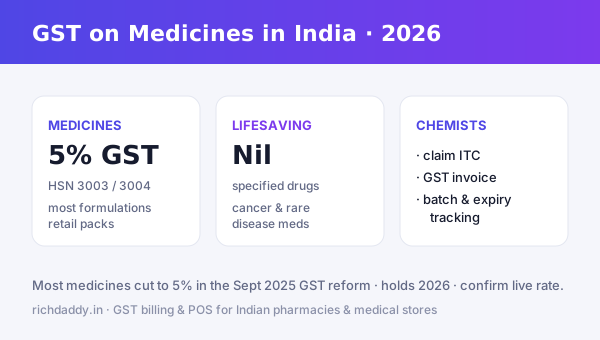
In India, GST on most medicines is 5%, charged under HSN codes 3003 and 3004 — the rate that applies to the large majority of formulations a chemist stocks. This came down from 12% in the September 2025 GST reform, and 33 lifesaving drugs moved from 12% to nil and 3 from 5% to nil, mainly for cancer, rare and severe chronic diseases. The 5% rate holds in 2026. If you run a pharmacy or medical store, this guide covers the rates, the HSN codes, input tax credit, and how to bill correctly.
GST rate on medicines and pharma products (2026)
| Item | HSN code | GST rate |
|---|
| Medicaments in retail packs / measured doses | 3004 | 5% |
| Medicaments in bulk (two or more constituents) | 3003 | 5% |
| Specified lifesaving drugs (cancer, rare disease) | 3003 / 3004 | Nil |
| Bandages, gauze, wadding, dressings | 3005 | 5% |
| Surgical dressings, sterile sutures | 3006 | 5% |
| Various medical apparatus and devices (confirm the specific item in the notification) | 9018 and others | 5% (was 18%) |
| Contraceptives, human blood | 3006 / 3002 | Nil |
Rates and HSN classification can change with GST Council notifications, and a few speciality items sit outside 5% — always confirm the current rate for a specific product before you bill. See our guide to finding the right HSN code.
At its 56th meeting the GST Council rationalised the rate structure to two main slabs — 5% and 18% — effective from 22 September 2025. As part of this, all other drugs and medicines taxed at 12% were cut to 5%, various medical apparatus and devices went from 18% to 5%, and wadding, gauze, bandages and diagnostic kits went from 12% to 5%. Thirty-three lifesaving drugs moved from 12% to nil and three from 5% to nil, mainly for cancer, rare and severe chronic diseases. For a chemist, the practical effect is that nearly all routine stock now rings up at 5% instead of 12%, and that is what applies in 2026.
Nil-rated and exempt items
A small group of products carry no GST at all. This includes specified lifesaving drugs notified by the government, human blood and its components, and contraceptives. Because the exempt list is specific and updated by notification, do not assume a product is nil just because it is "medical" — check the current notification or the HSN before you treat a sale as exempt.
If you are GST-registered, the 5% GST you pay your distributor on stock is input tax credit you can set off against the GST you collect on sales. To claim it cleanly:
- Buy only against a proper GST tax invoice showing the supplier's GSTIN.
- Make sure the purchase appears in your GSTR-2B (the supplier has filed and reported it).
- Keep purchase and sales records reconciled so credit is not lost or mismatched.
Note that stock you sell as nil-rated does not generate output GST — track exempt and taxable sales separately so your returns stay clean.
How to bill medicines correctly
A compliant sale invoice should carry your shop's GSTIN, the product description, the HSN code, taxable value, and the CGST + SGST (or IGST for inter-state) split at 5%. For an in-state sale that is 2.5% CGST + 2.5% SGST. Read our GST invoice format guide for the full field list, and if your turnover crosses the threshold, see when e-invoicing becomes mandatory.
MRP, expiry and returns: pharmacy edge cases
Three things trip up medical-store billing:
- MRP is GST-inclusive: the printed MRP already includes GST, so bill at or below MRP and let your software back-calculate the tax component rather than adding 5% on top of MRP.
- Expiry: check expiry dates at purchase entry and before billing, and return near-expiry stock to the distributor on time.
- Sales returns / expired stock: returns reverse the original GST — record them against the original invoice so your output tax and ITC reconcile.
How RichPOS helps pharmacies & medical stores
RichPOS stores the HSN code and GST rate on each item, so a strip of medicine rings up at 5% (or nil where notified) without manual calculation, and prints a GST invoice with the CGST + SGST split. Purchases, supplier ledgers and sales returns against the original bill are recorded in the same system, and GST reports by HSN export to Excel for your CA. RichPOS does not record batch numbers, so if your distributor or drug inspector needs batch-wise records, keep them in your purchase register. See inventory and barcode, our guides on opening a medical store and the best pharmacy billing software, or see pricing.
Bottom line
Most medicines are taxed at 5% GST in India in 2026 under HSN 3003 and 3004, down from 12% after the September 2025 reform, with specified lifesaving drugs at nil. Register the correct HSN and rate against each item, bill on a proper GST invoice, check expiry before you sell, and reconcile purchases so you keep your input tax credit. See how RichPOS works or check pricing to bill your pharmacy the right way.
Sources: GST Council / PIB, Recommendations of the 56th GST Council meeting, 3 September 2025; Notification 9/2025-Central Tax (Rate), 17 September 2025, effective 22 September 2025; Notification 10/2025-Central Tax (Rate), 17 September 2025 (exemptions, including human blood and its components, and contraceptives). Rates checked 15 October 2026. Rates and HSN can change by notification — confirm the current rate before billing.
FAQ
Frequently asked questions
What is the GST rate on medicines in India in 2026?
Most medicines are taxed at 5% GST under HSN codes 3003 and 3004. This rate applies after the September 2025 GST reform, which cut most medicines from 12% to 5%, and it holds in 2026. Thirty-three lifesaving drugs moved from 12% to nil and three from 5% to nil.
What is the HSN code for medicines?
Medicines in retail packs and measured doses use HSN 3004, and bulk medicaments use HSN 3003. Related items have their own codes — for example 3005 for bandages and dressings and 9018 for various medical apparatus — and many of these are also taxed at 5%; confirm the specific item.
Which medicines have nil GST?
Specified lifesaving drugs notified by the government, including certain cancer and rare-disease medicines, are nil-rated, along with human blood and contraceptives. The exempt list is specific and updated by notification, so confirm the current status of a product before treating a sale as exempt.
Can a pharmacy claim input tax credit?
Yes. A GST-registered chemist can claim the 5% GST paid on stock purchases as input tax credit and set it off against GST collected on sales, provided the purchase is on a valid tax invoice and appears in GSTR-2B.
Is GST added on top of the MRP of a medicine?
No. The printed MRP already includes GST, so you bill at or below MRP and the tax component is back-calculated from that price, not added on top of it.
Need a quick figure? Use the free GST calculator to add or remove GST.
ASWritten by Ashok SachdevFounder, RichPOS Software, Ahmedabad. We build RichPOS for Indian shops and write these guides from what shop owners ask us every day. Facts on tax rates and prices are dated; confirm GST matters with your CA. Questions? WhatsApp us.
Make GST bills in seconds with RichPOS
Billing, stock, WhatsApp bills and GST reports in one app. Free 30-day trial with no card, then ₹99/month for 3 months and ₹199/month after.