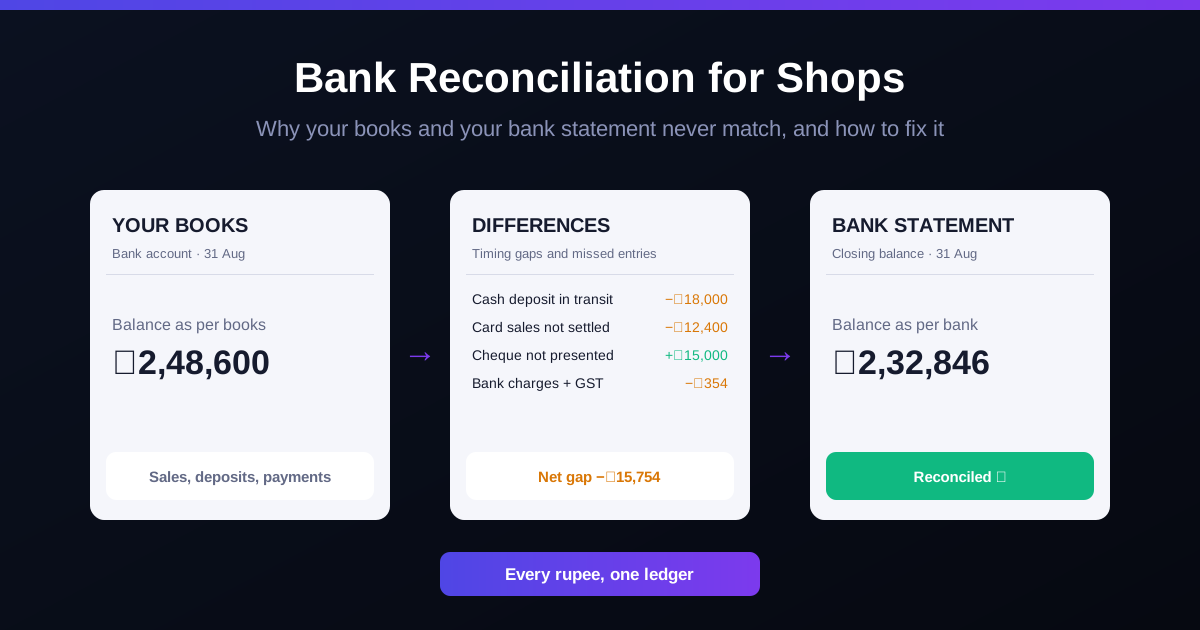
Your billing software says the shop's bank account should hold ₹2,48,600. The bank statement says ₹2,32,846. Is ₹15,754 missing, or has it just not arrived yet? Almost every shop owner in India faces this gap at month-end, and with UPI, cards, cash deposits and supplier cheques all flowing through one current account, it only gets harder to explain. Bank reconciliation is the simple monthly habit that tells you which differences are normal and which ones are real problems.
Quick answer
Bank reconciliation is matching the bank balance in your books with the balance on your bank statement for the same date. Start from the books balance, adjust for timing gaps (deposits in transit, card sales not yet settled, cheques not yet presented) and for entries you missed (bank charges, interest, direct debits). If you arrive exactly at the bank statement balance, you are reconciled. Do it at least monthly.
Why your books and your bank never match on the same day
| Difference | What happens | Effect on bank vs books |
|---|---|---|
| Cash deposited late | You record the deposit today, the bank credits it tomorrow | Bank lower |
| Card or aggregator settlement | Sales are billed today, money arrives the next working day or later, sometimes net of charges | Bank lower |
| Cheque issued to supplier | You record the payment, the supplier has not deposited it yet | Bank higher |
| Cheque received from customer | You record the receipt, the cheque has not cleared yet | Bank lower |
| Bank charges and GST on them | The bank debits SMS, cash-handling or annual charges you have not recorded | Bank lower |
| Interest or direct credits | The bank credits interest, a refund or a customer NEFT you have not recorded | Bank higher |
| Errors | A deposit entered twice, a wrong amount, a sale recorded as UPI that was paid in cash | Either way |
The first four are timing differences. They sort themselves out in a few days and need no correction. The last three are missing or wrong entries. They mean your books are wrong and must be fixed.
How to reconcile, step by step
- Pick a date and get both balances. Download the bank statement up to the month-end and note the closing balance. Take the bank account balance from your books for the same date.
- Tick off matching entries. Go through each credit and debit on the statement and tick the same entry in your books. UPI reference numbers, cheque numbers and deposit slip dates make this fast.
- List what is in your books but not in the bank. These are usually deposits in transit, unsettled card sales, and cheques not yet presented or cleared.
- List what is in the bank but not in your books. Bank charges, interest, direct credits from customers, EMI or loan debits. Record these in your books now.
- Prepare the reconciliation statement. Start from the books balance, adjust each timing difference, and check that you land exactly on the bank balance.
- Investigate anything left over. An unexplained gap is usually a missed entry, a double entry or a wrong payment mode on a bill. Fix it at the source, not with a balancing figure.
A worked example: a hardware shop in Nagpur
A hardware shop in Nagpur closes August with ₹2,48,600 in its current account as per its books. The bank statement shows ₹2,32,846 on 31 August. The owner lists the differences:
| Item | Amount |
|---|---|
| Balance as per books | ₹2,48,600 |
| Less: cash deposited on 31 Aug evening, credited 1 Sep | −₹18,000 |
| Less: card sales of 31 Aug, settled 1 Sep | −₹12,400 |
| Add: cheque issued to a pipe supplier, not yet presented | +₹15,000 |
| Less: bank charges ₹300 + 18% GST, not recorded in books | −₹354 |
| Balance as per bank statement | ₹2,32,846 |
The figures agree, so nothing is missing. The owner records the ₹354 bank charges in the books, and checks on 1–2 September that the ₹18,000 deposit and ₹12,400 card settlement did arrive. The shop, figures and charges are illustrative; your bank's charges will differ.
UPI makes it easier and harder
UPI payments to your own bank account usually arrive within seconds, so they rarely cause timing gaps. The problems come from elsewhere:
- Several QR codes: an old QR still stuck on the counter may point to a different account. See accepting UPI payments in a retail shop.
- Aggregator and soundbox settlements: if payments go through a payment aggregator, they may be settled in batches, sometimes net of charges, so one bank credit covers many bills.
- Wrong payment mode on the bill: a cashier marks a UPI sale as cash. Your cash drawer shows a shortage and your bank shows an unexplained credit. Checking the counter every evening catches this; see end-of-day cash reconciliation.
Common mistakes to avoid
- Plugging the gap: posting the difference to "suspense" or "misc" hides the real error and it comes back at year-end.
- Reconciling once a year: by March nobody remembers what a ₹6,200 credit in July was for.
- Ignoring bank charges: small debits add up across the year and should appear in your shop expenses and your profit and loss report.
- Mixing personal and shop money: personal payments from the shop's current account make every reconciliation harder. Record them as drawings.
- Forgetting stale cheques: a supplier cheque not presented for three months is usually no longer valid and needs to be reissued or reversed. See supplier payments and dues.
How RichPOS helps
- One ledger for every rupee: daily cash in and out, bank deposits and transfers between accounts and stores are recorded in one accounts ledger. See Accounts & Cash.
- Tied to sales and purchases: the ledger builds itself from every bill and purchase, so your books balance is ready when the statement arrives.
- Deposit tracking with bank reconciliation support: track deposits so the figure in RichPOS and the figure on your bank statement can be matched.
- Payment mode on every bill: cash, card, UPI and split payments are recorded per bill, which makes it easier to trace which sales should appear in the bank. See Billing & POS.
RichPOS costs ₹199/month with a 30-day free trial. See pricing.
Frequently asked questions
- What is bank reconciliation for a shop?
- Bank reconciliation means comparing the bank balance in your own books with the balance on your bank statement for the same date, and explaining every difference. Most differences are timing gaps, such as a cash deposit made late in the evening or card sales that settle the next day. Anything you cannot explain is an error or a missing entry that needs fixing.
- How often should a retail shop reconcile its bank account?
- At least once a month, when the bank statement closes. Shops with heavy UPI and card sales, or more than one current account, are better off reconciling weekly, because a small gap is easy to trace within a few days and very hard to trace after two months.
- Why does my UPI collection not match the bank credits?
- Common reasons are payments made to a different QR code or account, settlements from a payment aggregator or POS terminal that arrive in batches and net of charges, refunds, and transactions the customer thought succeeded but that were reversed. Match UPI transaction reference numbers against your bills to find the gap.
- What is a bank reconciliation statement (BRS)?
- A BRS is a short statement that starts with the balance as per your books, adds or subtracts each timing difference, and arrives at the balance as per the bank statement. If the two figures agree, your books are reconciled for that date. Keep a signed copy for each month; your CA will ask for it at year-end.
Bottom line: reconcile your shop's bank account at least monthly, separate timing gaps from real errors, and fix missing entries at the source instead of plugging the difference. Want to see cash, UPI, card and bank deposits in one ledger? Call +91 90333 31255 for a demo, or start the 30-day free trial from the pricing page.
This is general accounting guidance, not tax or audit advice; confirm your year-end reconciliation and GST treatment of bank charges with your CA.