A builder asks your electrical shop for a price on 40 LED panels. A school wants a quote for 25 steel almirahs. A regular customer wants "a bill first" so their accountant can release an advance. Each of these needs a different document, and mixing them up causes real trouble: a proforma sent as a tax invoice, a quote honoured three months later at an old price, or GST paid before the sale even happened. This guide explains quotations, proforma invoices and tax invoices for Indian shops, and when to use each.
Quick answer
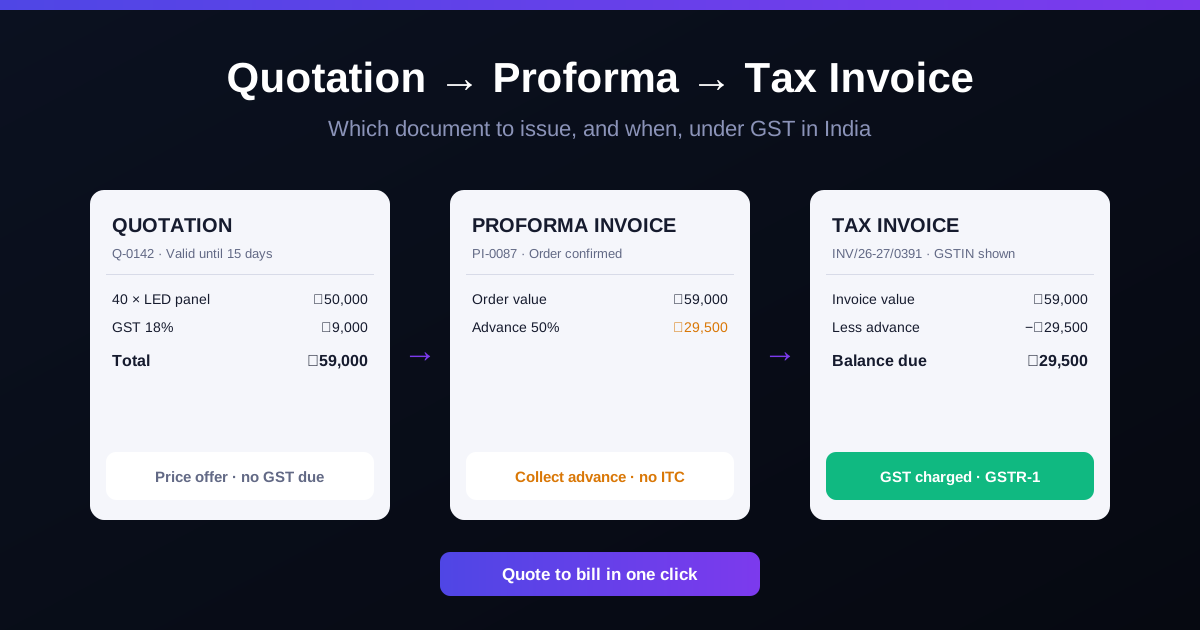
A quotation is a price offer. A proforma invoice confirms an agreed order, usually to collect an advance. A tax invoice is the legal GST document issued when the goods are supplied. Only the tax invoice creates GST liability and lets a registered buyer claim input tax credit. The usual flow is quotation, then (optionally) proforma, then tax invoice.
The three documents at a glance
| Quotation | Proforma invoice | Tax invoice | |
|---|---|---|---|
| Purpose | Offer a price | Confirm an order, request advance | Record the sale and charge GST |
| When issued | Before the customer decides | After the customer agrees, before supply | At or before delivery of goods |
| Legal status under GST | Not a GST document | Not a GST document | Required under Section 31, CGST Act |
| GST liability | None | None | Yes, reported in GSTR-1 |
| Buyer can claim input credit? | No | No | Yes, if the buyer is GST-registered |
| Numbering | Your own series | Your own series | Unique, consecutive series per financial year |
What is a quotation?
A quotation (or "quote" or "estimate") tells a customer what you will charge for specific items, in specific quantities, for a limited time. It is an offer, not a sale. Nothing moves out of stock and nothing goes into your GST returns.
A good quotation includes:
- Your shop name, address, phone and GSTIN
- A quotation number and date
- A valid until date
- The customer's name and contact details
- Each item with description, HSN code, quantity, rate and any discount
- GST shown separately at the applicable rate, so the customer sees the full landed price
- Terms: delivery time, payment terms (for example 50% advance), and whether transport is included
The validity date matters most. Purchase prices for steel, electricals, electronics and FMCG change often. Without a validity date, a customer can come back months later and expect the old rate.
What is a proforma invoice?
A proforma invoice looks like an invoice but is not one. It is commonly issued after the customer accepts your quotation, when they need a document to arrange payment: a company accounts team releasing an advance, a bank processing a loan for equipment, or an importer opening a letter of credit.
- Title it clearly as "Proforma Invoice", never "Tax Invoice".
- Use a separate number series from your tax invoices, so your GST invoice series stays unbroken.
- Show the same item, rate and GST details as the final bill will have.
The GST law does not define a proforma invoice. Issuing one does not create GST liability, it is not reported in GSTR-1, and the buyer cannot claim input tax credit against it.
What is a tax invoice?
The tax invoice is the document the GST law actually requires. Under Section 31 of the CGST Act, a registered supplier of goods issues it before or at the time the goods are removed or delivered. Rule 46 of the CGST Rules sets out what it must contain, including:
- Your name, address and GSTIN
- A consecutive serial number, unique for the financial year, of up to 16 characters
- Invoice date
- Customer name and address, plus GSTIN if the customer is registered
- HSN code, description, quantity and unit
- Taxable value, GST rate and GST amount (CGST + SGST, or IGST)
- Place of supply for inter-state sales
- Signature or digital signature
For the full format and a sample, see GST invoice format for retail shops. Whether you charge CGST + SGST or IGST depends on where the goods go; see intra-state vs inter-state GST. If a bill needs correcting after it is issued, use a credit note rather than editing the invoice.
What about advance payments?
When a customer pays an advance against a proforma invoice, record it as an advance received from that customer. For supply of goods, most regular GST taxpayers do not pay GST on advances; GST is paid when the tax invoice is issued. For services, the rules are different: a receipt voucher is issued and GST is generally payable on the advance. Composition dealers have their own rules. Check your case with your CA.
When the goods are delivered, the tax invoice is raised for the full value, and the advance is adjusted against it so the customer pays only the balance.
A worked example: an electrical shop in Indore
A builder asks an electrical shop in Indore for 40 LED panel lights. The shop sends a quotation: 40 panels at ₹1,250 each, ₹50,000 plus GST at 18% (₹9,000), total ₹59,000, valid for 15 days, 50% advance with order. The builder accepts on day 6 and their accounts team asks for a proforma invoice to release the advance. The shop issues a proforma for ₹59,000 and receives ₹29,500. On delivery, the shop issues a tax invoice for ₹59,000 from its regular GST series, adjusts the ₹29,500 advance, and collects the ₹29,500 balance. Only the tax invoice goes into GSTR-1. The figures and GST rate are illustrative; check the HSN rate for your own items.
Common mistakes to avoid
- Using the tax invoice series for proformas: it breaks your consecutive GST numbering and confuses your returns.
- Calling a proforma a "tax invoice": the buyer may try to claim input credit on a document that does not support it.
- No validity date on quotes: old prices get held against you after costs rise.
- Retyping the quote into the bill: rates, discounts or quantities change by mistake between the two documents.
How RichPOS handles quotations
- Quotations with an expiry date: create a quotation for a customer with the quotation date, items, rates, GST and a valid-until date.
- One-click convert to invoice: once the customer agrees, convert the quotation into a sales invoice without retyping, and the quotation is marked as converted so you can see which quotes turned into sales. See Billing & POS.
- Print or PDF: print the quotation on A4 or download it as a PDF to send to the customer. See thermal vs A4 invoices.
- GST & reports: once the sale is billed, it flows into your sales and GST reports.
RichPOS costs ₹199/month with a 30-day free trial. See pricing.
Frequently asked questions
- Is a quotation the same as a proforma invoice?
- No. A quotation is a price offer that the customer may or may not accept. A proforma invoice is usually sent after the customer agrees, to confirm the deal and request an advance. Neither is a tax invoice under GST, and neither creates GST liability on its own.
- Is GST payable when I issue a proforma invoice?
- No. A proforma invoice is not a tax invoice, so issuing it does not create GST liability and the buyer cannot claim input tax credit on it. GST becomes payable at the time of supply, when you issue the tax invoice. Advances can have their own rules, especially for services, so confirm with your CA.
- What must a GST tax invoice contain?
- Rule 46 of the CGST Rules lists the details, including your name, address and GSTIN, a unique serial number for the financial year, the invoice date, the customer's name and address (and GSTIN if registered), HSN code, description, quantity, taxable value, GST rate and amount, and place of supply for inter-state sales.
- How long should a quotation be valid?
- There is no legal rule. Most shops give 7 to 30 days depending on how often their purchase prices change. Always print the validity date on the quotation so an old price cannot be held against you after costs rise.
Bottom line: quote with a validity date, use a proforma only to confirm an order or collect an advance, and charge GST only on the tax invoice. Want to see quotations turn into GST bills in one click? Call +91 90333 31255 for a demo, or start the 30-day free trial from the pricing page.
GST information is general guidance based on the CGST Act and Rules; confirm what applies to your business with your CA.