Most Indian shops buy on credit. The distributor in Indore gives 30 days, the wholesaler in Sadar Bazar gives 15, and the brand's stockist wants payment on delivery. Keep all of that in your head or a diary, and sooner or later you pay one bill twice, miss a discount, or get a call about dues you thought were cleared. This guide covers how to track what you owe each supplier, how to pay against it, and the two tax rules that make late payment costly.
Quick answer
Keep one ledger per supplier, enter every bill, return and payment as it happens, note the credit days on each bill, pay the oldest due bill first, and match your ledger with the supplier's statement every month. Pay within 180 days to protect your GST input tax credit, and within 45 days for registered micro and small suppliers.
What goes into a supplier ledger
| Entry | Effect on what you owe | Keep as proof |
|---|---|---|
| Purchase bill | Increases | Supplier's tax invoice |
| Purchase return | Reduces | Debit note or supplier's credit note |
| Rate difference or discount | Reduces | Credit note from supplier |
| Payment | Reduces | UPI or bank reference, cheque number, cash receipt |
For credit and debit notes under GST, see our guide on the credit note format. Purchase orders and receiving are covered in our purchase order guide; this post picks up after the goods arrive.
A worked example
A footwear shop in Bhopal buys from a distributor on 30-day credit:
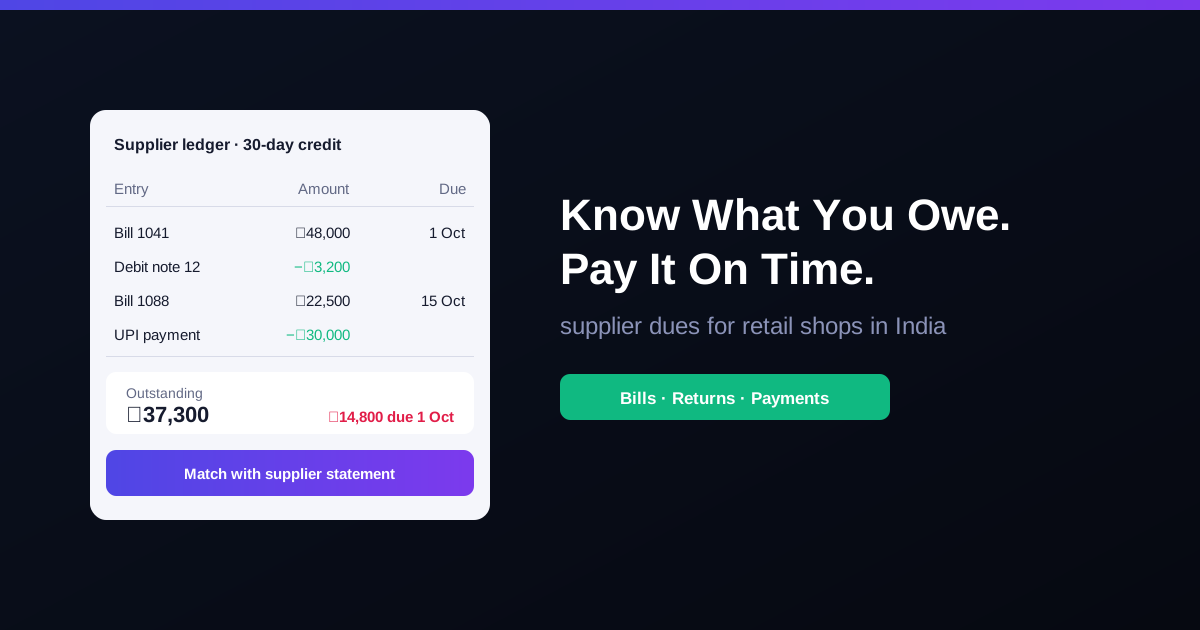
| Date | Entry | Amount | Balance | Due |
|---|---|---|---|---|
| 1 Sep | Bill 1041 | ₹48,000 | ₹48,000 | 1 Oct |
| 8 Sep | Return, debit note 12 | -₹3,200 | ₹44,800 | |
| 15 Sep | Bill 1088 | ₹22,500 | ₹67,300 | 15 Oct |
| 20 Sep | UPI payment | -₹30,000 | ₹37,300 |
The ₹30,000 payment goes against the oldest bill. Bill 1041 still has ₹14,800 due on 1 October, and bill 1088 has ₹22,500 due on 15 October. At month-end the distributor's statement shows ₹40,500. The ₹3,200 difference is the return: the distributor has not booked your debit note yet. Send them a copy instead of paying the extra.
Five habits that keep supplier dues under control
- Enter bills the day goods arrive. A bill sitting in a drawer is a due you cannot see.
- Write the credit days on every bill. The due date matters more than the bill date when you plan payments.
- Pay against specific bills. Tell the supplier which bill numbers a payment clears, and note it in your ledger. "On account" payments are where disputes start.
- Raise returns in writing. A debit note for every return, shared with the supplier, so both ledgers reduce together.
- Reconcile monthly. Ask each regular supplier for a statement and match it line by line.
GST: pay within 180 days or reverse ITC
Input tax credit on a purchase depends on you paying the supplier. If the value of the supply plus tax is not paid within 180 days from the invoice date, the ITC you claimed has to be reversed in your return, with interest, and can be claimed again after you pay. A supplier ledger with due dates makes it easy to spot bills heading past 180 days. Our GST reporting guide covers the regular returns.
Income tax: the 45-day rule for MSME suppliers
Under Section 43B(h) of the Income Tax Act, if you buy from a supplier registered as a micro or small enterprise under the MSMED Act, payment has to be made within the agreed credit period, capped at 45 days, or within 15 days if there is no written agreement. Amounts still unpaid past that limit at the year end are not allowed as an expense until the year you pay. This mainly covers manufacturers and service providers. Ask each supplier whether they are Udyam-registered as micro or small, and confirm with your CA how it applies to you.
Plan payments around your cash
List what falls due in the next 15 days across all suppliers and compare it with expected cash from sales and from customers who owe you. If money is tight, speak to the supplier before the due date, not after. For the customer side of credit, see our guide to recovering udhaar from customers.
How RichPOS helps
RichPOS purchase & suppliers keeps a supplier-wise ledger with the outstanding balance for each supplier, updated as stock is received against purchase orders. Purchase returns correct stock automatically. Accounts & cash ties every purchase and payment into one ledger, with deposit tracking and bank reconciliation support, and GST and business reports come from the same live data.
Frequently asked questions
- What is a supplier ledger?
- A supplier ledger is a running account for one supplier that lists every purchase bill, return or debit note and payment, with the balance you owe after each entry. It is the retailer's side of what the supplier calls your account.
- What happens to GST input tax credit if I do not pay a supplier within 180 days?
- If you claimed ITC on a bill and have not paid the supplier the value plus tax within 180 days from the invoice date, the credit has to be reversed with interest in your GST return. You can claim it again once you pay. Confirm the exact treatment with your CA.
- Does the 45-day MSME payment rule apply to my shop?
- Section 43B(h) of the Income Tax Act applies when you buy from a supplier registered as a micro or small enterprise under the MSMED Act, generally a manufacturer or service provider. Pay within the agreed credit period, capped at 45 days, or 15 days if there is no written agreement. Otherwise the unpaid amount is not allowed as an expense for that year. Traders registered only for priority lending are generally outside it. Check with your CA.
- Why does my balance not match the supplier's statement?
- Usually because one side has not recorded an entry yet: a debit note for a return, a payment made at month-end, a bill in transit or a discount agreed on the phone. Match entry by entry, starting from the last date both balances agreed.
Bottom line: know what you owe, to whom, and by when. One ledger per supplier, payments tied to bills, and a monthly match with the supplier's statement will save you disputes, double payments and GST reversals. RichPOS gives you supplier ledgers with GST billing from ₹199/month, with a 30-day free trial. See pricing or call +91 90333 31255.
General guidance for Indian retailers as of 2026; GST and income tax rules can change, so confirm how they apply to your business with your CA.