Every sale needs a bill, but under GST not every bill is a tax invoice. If you are on the composition scheme, or you sell items that are exempt from GST, the law asks for a different document: a bill of supply. Getting this wrong means charging tax you cannot collect, or giving buyers a credit they cannot claim. This guide explains the difference for Indian shops, with an example.
Quick answer
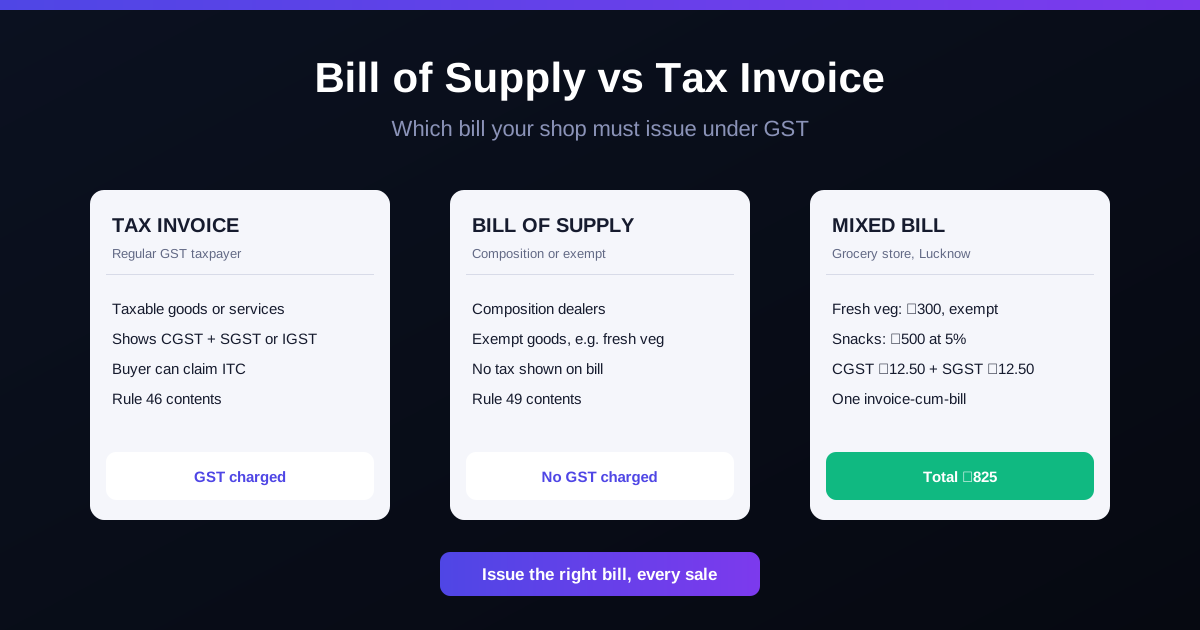
A tax invoice is issued by a regular GST-registered dealer on taxable sales and shows CGST and SGST (or IGST), which the buyer can claim as input tax credit. A bill of supply is issued when no GST is charged: by composition dealers on all sales, and by regular dealers on exempt goods or services. A shop selling both taxable and exempt items can issue one invoice-cum-bill of supply.
Tax invoice vs bill of supply at a glance
| Point | Tax invoice | Bill of supply |
|---|---|---|
| Issued by | Regular GST-registered dealer | Composition dealer, or regular dealer for exempt items |
| Used for | Taxable goods and services | Composition sales and exempt goods or services |
| GST on the bill | Yes: CGST + SGST, or IGST | No tax shown |
| Buyer's input tax credit | Allowed, if other conditions are met | Not available |
| Rule for contents | Rule 46 of the CGST Rules | Rule 49 of the CGST Rules |
When a shop must issue a bill of supply
- You are a composition dealer. Under the composition scheme, you pay a fixed percentage of turnover (1% for traders) from your own pocket and cannot charge GST to customers. Every sale goes on a bill of supply, which must say "composition taxable person, not eligible to collect tax on supplies".
- You sell exempt goods or services. Items such as fresh vegetables, fresh fruit and fresh milk carry no GST. A regular dealer selling only these to a customer issues a bill of supply, not a tax invoice.
A shop that is not registered under GST at all issues neither. A plain cash memo or bill is enough, and it must not show any GST.
What a bill of supply must show
- Your name, address and GSTIN.
- A unique serial number of up to 16 characters, in one or more series for the year.
- The date of issue.
- The customer's name, address and GSTIN, if the customer is registered.
- The HSN or SAC code of the items.
- A description and the value of the goods or services, after any discount.
- Your signature or digital signature, or that of your authorised person.
A tax invoice has the same basics plus the rate and amount of tax, the place of supply for inter-state sales, and more. See GST invoice format for the full list.
Mixed bills: taxable and exempt on one sale
Most grocery and general stores sell both kinds of item in the same basket. A regular dealer selling to an unregistered customer can issue a single invoice-cum-bill of supply that shows GST on the taxable lines and no tax on the exempt lines. In practice, many shops print a tax invoice with 0% on the exempt lines; the key point is that no tax is charged on the exempt items, and each line carries the right HSN code.
A worked example: a grocery store in Lucknow
A regular GST-registered grocery store in Lucknow sells a customer fresh vegetables and packaged snacks in one purchase within Uttar Pradesh:
| Line | Value | CGST | SGST |
|---|---|---|---|
| Fresh vegetables (exempt) | ₹300 | Nil | Nil |
| Packaged snacks (5%) | ₹500 | ₹12.50 | ₹12.50 |
| Total | ₹800 | ₹12.50 | ₹12.50 |
The customer pays ₹825 on one invoice-cum-bill of supply. If the same store were on the composition scheme, it would bill ₹800 on a bill of supply with no GST at all, and pay 1% of its taxable turnover as composition tax from its own margin. The store, items and rates are illustrative; check the current rate for each product.
Common mistakes to avoid
- Composition dealers showing GST on bills. Tax collected this way is not allowed, and must still be paid to the government.
- Charging GST on exempt items because the billing software has a default rate set for every product.
- Using "tax invoice" as the heading on a bill of supply, which confuses buyers who then try to claim credit.
- Missing HSN codes on exempt lines. They are still needed. See how to find HSN codes.
How RichPOS helps
- Fast counter billing with barcode scanning, printed on thermal or A4 printers or sent by email and WhatsApp. See Billing & POS.
- Cash, card, UPI and split payments on every bill.
- GST-ready sales and purchase reports by HSN/SAC, exported to Excel, CSV or PDF for your CA. See GST & reports.
RichPOS costs ₹199/month (₹2,000/year) with a 30-day free trial. See pricing.
Frequently asked questions
- What is a bill of supply in GST?
- A bill of supply is the document issued instead of a tax invoice when no GST can be charged on the sale. It is used by composition dealers and for exempt goods or services. It looks like an invoice but shows no CGST, SGST or IGST.
- Who has to issue a bill of supply?
- Two kinds of sellers: dealers registered under the composition scheme, for all their sales, and regular GST-registered dealers when they sell exempt goods or services, such as fresh vegetables or fresh milk.
- Can a composition dealer issue a tax invoice?
- No. A composition dealer cannot charge GST to customers, so it cannot issue a tax invoice. It issues a bill of supply that states it is a composition taxable person not eligible to collect tax, and pays its composition tax from its own turnover.
- Can the buyer claim input tax credit on a bill of supply?
- No. Because no GST is charged on a bill of supply, the buyer has no tax to claim as input tax credit. Only a tax invoice from a regular registered dealer supports an ITC claim.
- What if one bill has both taxable and exempt items?
- A regular dealer selling both to an unregistered customer can issue a single invoice-cum-bill of supply, showing GST on the taxable lines and no tax on the exempt lines. Many shops simply use a tax invoice with 0% on the exempt lines.
Bottom line: charge GST on a tax invoice only when you are a regular dealer selling taxable items; use a bill of supply for composition sales and exempt items, and an invoice-cum-bill of supply when a basket has both. Want quick, correct counter bills? Call +91 90333 31255 for a demo, or start the 30-day free trial from the pricing page.
This is general guidance, not tax advice. GST rules, rates and exemptions change by notification; confirm with your CA and the GST portal for your business.