Many Indian shops still run on cash, but the Income Tax Act puts firm limits on how much cash you can take from a customer and how much you can pay out. Break them and the penalty can equal the whole amount. This guide explains the two rules that matter most to shopkeepers, the ₹2 lakh receipt limit and the ₹10,000 payment limit, with a worked example.
Quick answer
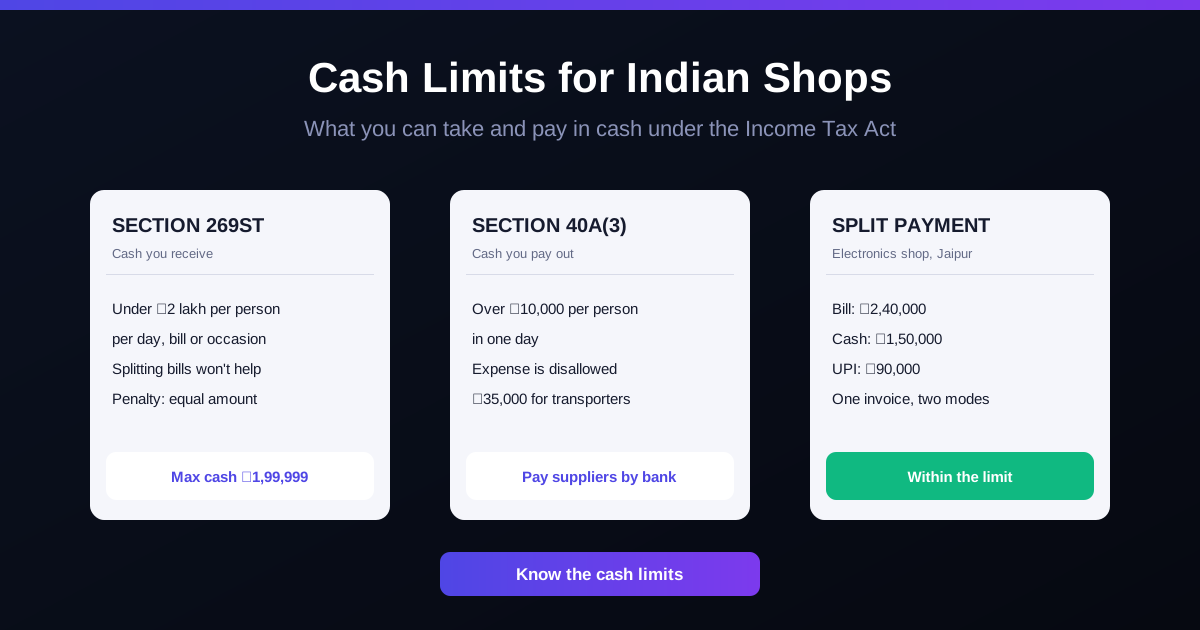
A shop cannot receive ₹2 lakh or more in cash from one person in a day, for one transaction, or for one event (Section 269ST); the penalty equals the cash received. A shop that pays more than ₹10,000 in cash to one person in a day loses the tax deduction for that expense (Section 40A(3)); the limit is ₹35,000 for transporters. Take the rest of a large bill by UPI, card or bank transfer.
Note: the Income-tax Act, 2025 replaced the 1961 Act from 1 April 2026 and renumbered its sections. This guide uses the familiar 1961 section numbers (269ST, 40A(3), 269SS) that most shopkeepers and CAs still use; ask your CA for the matching section under the new Act.
The main cash limits at a glance
| Rule | What it covers | Limit | Consequence |
|---|---|---|---|
| Section 269ST | Cash you receive from a customer | Below ₹2 lakh per person per day, per transaction or per event | Penalty equal to the amount (Section 271DA) |
| Section 40A(3) | Cash you pay for business expenses | Up to ₹10,000 per person per day (₹35,000 for transporters) | Expense disallowed for tax |
| Section 269SS | Cash loans or deposits you take | Below ₹20,000 | Penalty equal to the amount (Section 271D) |
Section 269ST: the ₹2 lakh receipt rule
The rule applies in three ways, and breaking any one of them counts:
- Per person per day. Total cash from one customer on one day must stay below ₹2 lakh.
- Per transaction. Cash for a single sale must stay below ₹2 lakh, even if it is paid over several days in instalments.
- Per event or occasion. Cash for one event, such as a wedding order, must stay below ₹2 lakh in total.
This means splitting one bill into two, or asking the customer to come back tomorrow with more cash, does not get around the rule.
Section 40A(3): the ₹10,000 payment rule
When you pay a supplier, a helper or a service provider more than ₹10,000 in cash in a single day, that amount cannot be claimed as a business expense. You still pay the money, but you pay income tax as if you had not spent it. Pay suppliers by bank transfer, UPI or account-payee cheque, and keep the supplier ledger up to date so every payment has a record.
A worked example: an electronics shop in Jaipur
A customer buys a TV and a refrigerator for ₹2,40,000 in one bill and wants to pay in cash.
| Option | Cash | Digital | Allowed? |
|---|---|---|---|
| All cash | ₹2,40,000 | ₹0 | No: penalty up to ₹2,40,000 |
| Two bills of ₹1,20,000 in cash | ₹2,40,000 | ₹0 | No: same person, same day |
| Split payment | ₹1,50,000 | ₹90,000 by UPI | Yes |
The same week, the shop pays a local fitter ₹12,000 in cash for installation work in one day. That ₹12,000 cannot be claimed as an expense. Paying it by UPI avoids the problem. The shop, amounts and payees are illustrative.
Good habits for cash-heavy shops
- Record the payment mode on every bill, so large cash sales are easy to spot and explain.
- Accept UPI and cards at the counter so customers have an easy way to pay the balance. See accepting UPI payments.
- Close the cash drawer every day and match it to your sales. See end-of-day cash reconciliation.
- Deposit cash regularly and match deposits in your bank book. See bank reconciliation.
How RichPOS helps
- Cash, card, UPI and split payments on every bill, so a ₹2,40,000 sale can be settled part cash, part UPI on one invoice. See Billing & POS.
- Cash and bank ledgers with deposit tracking and bank reconciliation support. See Accounts & cash.
- Sales and purchase reports exported to Excel, CSV or PDF for your CA. See GST & reports.
RichPOS costs ₹199/month (₹2,000/year) with a 30-day free trial. See pricing.
Frequently asked questions
- How much cash can a shop accept from one customer in India?
- Less than ₹2 lakh. Under Section 269ST of the Income Tax Act, you cannot receive ₹2 lakh or more in cash from one person in a day, in respect of a single transaction, or for transactions relating to one event or occasion. The most you can take in cash in those cases is ₹1,99,999.
- What is the penalty for accepting cash of ₹2 lakh or more?
- Under Section 271DA, the penalty is equal to the amount received in cash. If a shop takes ₹2,50,000 in cash for one bill, the penalty can be ₹2,50,000, on top of any tax due.
- Can I split a big bill into smaller bills to take more cash?
- No. The ₹2 lakh limit applies per person per day and per transaction, so splitting one sale into several bills on the same day, or for the same purchase, still breaks the rule. Take the balance by UPI, card, cheque or bank transfer.
- How much cash can a shop pay to a supplier?
- Under Section 40A(3), if you pay more than ₹10,000 in cash to one person in a day for a business expense, that expense is not allowed as a deduction. The limit is ₹35,000 for payments to transporters for plying, hiring or leasing goods carriages.
- Does GST have a separate cash limit?
- No. GST does not set its own cash limit. The cash limits come from the Income Tax Act, and they apply whether or not your shop is GST-registered.
Bottom line: keep cash from any one customer below ₹2 lakh for a day, a sale or an event, keep cash payments to any one person at ₹10,000 or less a day, and move the rest through UPI, card or bank. Want split payments and clean cash records at your counter? Call +91 90333 31255 for a demo, or start the 30-day free trial from the pricing page.
This is general guidance, not tax advice. Limits, exceptions and penalties can change; confirm with your CA for your business.