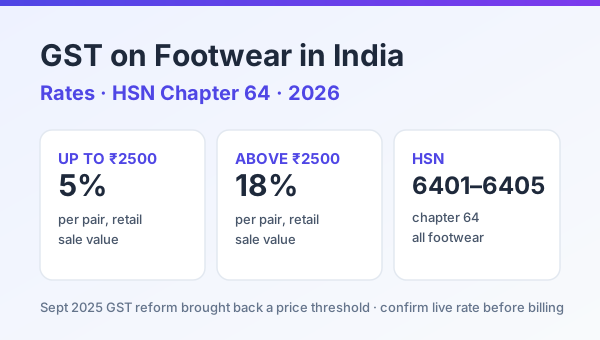
In India, GST on footwear is 5% for a pair with a retail sale value up to ₹2,500, and 18% above that — a price-based threshold that came in with the September 2025 GST reform. All footwear sits in HSN chapter 64 (codes 6401 to 6405). If you run a shoe shop or sell footwear as part of a retail store, this guide covers the rates, the HSN codes, how the threshold works, and how to bill correctly in 2026.
GST rate on footwear (2026)
| Footwear (retail sale value per pair) | HSN code | GST rate |
|---|---|---|
| Up to ₹2,500 per pair | 6401–6405 | 5% |
| Above ₹2,500 per pair | 6401–6405 | 18% |
The slab is decided by the sale value of a single pair, not the total bill. Rates and the threshold can change with GST Council notifications, so always confirm the current rate before you bill. See our guide to finding the right HSN code.
HSN codes for footwear
All footwear falls under chapter 64, split by construction:
- 6401 — waterproof footwear with rubber or plastic soles and uppers.
- 6402 — other footwear with rubber or plastic outer soles and uppers.
- 6403 — footwear with leather uppers.
- 6404 — footwear with textile uppers.
- 6405 — other footwear.
The HSN decides the classification; the price per pair decides whether it is taxed at 5% or 18%.
What changed in the September 2025 GST reform
At its 56th meeting the GST Council rationalised the rate structure to two main slabs — 5% and 18% — effective from 22 September 2025. For footwear this brought back a price threshold: cheaper footwear up to ₹2,500 a pair is taxed at 5%, and footwear above that is taxed at 18%. This replaced the earlier flat 12% that had applied to footwear, so budget and mass-market footwear now rings up cheaper, while premium footwear moves to 18%.
How the price threshold works
The threshold is applied per pair, on the retail sale value of that pair — not on the total invoice. So a customer buying three pairs at ₹900 each is billed at 5% on every pair, even though the bill totals ₹2,700, because each pair is under ₹2,500. A single pair priced at ₹3,200 is billed at 18%. Your billing software needs to look at the per-item price, not the cart total, to pick the right rate.
How to bill footwear correctly
A compliant sale invoice should carry your shop's GSTIN, the product description, the HSN code, the taxable value, and the CGST + SGST (or IGST for inter-state) split. For an in-state sale of a ₹2,500-or-under pair that is 2.5% CGST + 2.5% SGST; for a pair above ₹2,500 it is 9% + 9%. Read our GST invoice format guide for the full field list, and if your turnover crosses the threshold see when e-invoicing becomes mandatory.
Input tax credit for footwear retailers
If you are GST-registered, the GST you pay your supplier on stock is input tax credit you can set off against the GST you collect on sales. Buy only against a proper GST tax invoice showing the supplier's GSTIN, make sure the purchase appears in your GSTR-2B, and keep purchase and sales records reconciled so no credit is lost. Because footwear straddles two rates, track 5% and 18% stock separately so your returns stay clean.
How RichPOS helps footwear & shoe shops
RichPOS is built for exactly this kind of retail — it stores the HSN code and GST rate against each item, and because the rate depends on the price per pair, it applies 5% or 18% automatically at the point of sale instead of leaving you to check every item by hand. It prints a compliant GST invoice, tracks stock by size and variant, and keeps purchase and sales data ready for your returns. See our retail inventory guide or see pricing.
FAQ
What is the GST rate on footwear in India in 2026?
Footwear priced up to ₹2,500 per pair is taxed at 5% GST, and footwear above ₹2,500 per pair is taxed at 18%. This price-based threshold applies after the September 2025 GST reform and holds in 2026. All footwear uses HSN chapter 64.
What is the HSN code for footwear?
Footwear falls under HSN chapter 64 — 6401 for waterproof rubber or plastic footwear, 6402 for other rubber or plastic footwear, 6403 for leather uppers, 6404 for textile uppers, and 6405 for other footwear. The HSN classifies the product; the price per pair decides the 5% or 18% rate.
Is the ₹2500 GST threshold on the pair or the whole bill?
It is per pair, on the retail sale value of that pair, not on the total invoice. Three pairs at ₹900 each are all taxed at 5% even though the bill is ₹2,700, because each pair is under ₹2,500.
What was the GST on footwear before the 2025 reform?
Before the September 2025 reform, footwear was taxed at a flat 12% regardless of price. The reform replaced that with a 5% rate up to ₹2,500 a pair and 18% above it, making budget footwear cheaper.
Can a footwear shop claim input tax credit?
Yes. A GST-registered footwear retailer can claim the GST paid on stock purchases as input tax credit and set it off against GST collected on sales, provided the purchase is on a valid tax invoice and appears in GSTR-2B.
Bottom line
Footwear in India is taxed at 5% GST up to ₹2,500 per pair and 18% above that in 2026, under HSN chapter 64, after the September 2025 reform replaced the old flat 12%. Register the correct HSN and price-based rate against each item, bill on a proper GST invoice, and reconcile purchases so you keep your input tax credit. See how RichPOS works or check pricing to bill your footwear shop the right way.
Sources: GST Council 56th meeting rate rationalisation (effective 22 September 2025), CBIC HSN classification, 2026. Rates and the price threshold can change by notification — confirm the current rate before billing.