Short answer: Yes, a shop in India can round off a GST bill. Round the final total to the nearest rupee (50 paise and above goes up, below 50 paise goes down) and show the difference as a separate round-off line. Keep the taxable value and GST amounts exactly as calculated, to the paisa.
This guide covers where rounding is allowed, a worked example, how the round-off line works with GST, and how to record it in your books.
Where the 50 paise rule comes from
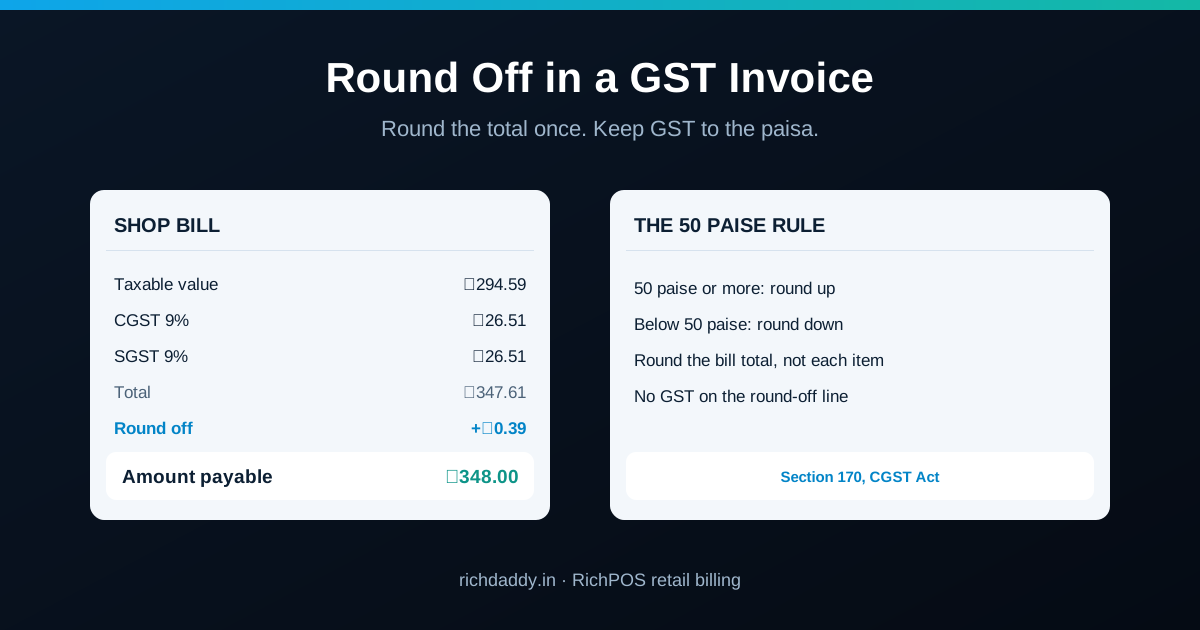
Section 170 of the CGST Act says that tax, interest, penalty, fine or any other sum payable under the Act is rounded off to the nearest rupee. A fraction of 50 paise or more becomes one rupee, and a fraction below 50 paise is ignored. This applies to the tax you pay to the government.
For the bill you give a customer, rounding the total is accepted practice. Customers pay in whole rupees, and coins below one rupee are hardly used at the counter. The safe way is to round only the final amount and show that adjustment openly.
Worked example: rounding a shop bill
| Line | Amount |
|---|---|
| Taxable value (3 items) | ₹294.59 |
| CGST at 9% | ₹26.51 |
| SGST at 9% | ₹26.51 |
| Total before rounding | ₹347.61 |
| Round off | +₹0.39 |
| Amount payable | ₹348.00 |
If the total had been ₹512.40, the round-off line would be −₹0.40 and the customer would pay ₹512.00. The GST figures do not change in either case.
Five rules for a clean round-off
- Round once, at the end. Never round each item, then round the total again.
- Show it as its own line. Print "Round off" between the tax lines and the amount payable, with a plus or minus sign.
- Keep GST to two decimals. The CGST, SGST or IGST shown on the invoice should be the calculated amount, not a rounded one.
- No GST on the round-off. It is an adjustment to the amount payable, not part of the taxable value.
- Never round above MRP. For a packaged item sold at MRP, rounding the bill up must not push the customer over the printed price. See selling above MRP rules.
Round off and your GST returns
In GSTR-1 you report each invoice's taxable value and tax as printed, without rounding. When you pay through GSTR-3B, the tax payable under each head is rounded to the nearest rupee. For example, CGST of ₹12,345.49 is paid as ₹12,345, and ₹12,345.50 is paid as ₹12,346. For how the two returns differ, read GSTR-1 vs GSTR-3B.
Recording round off in your books
Open a separate round-off ledger. Each bill's plus or minus difference is posted there, and the ledger is usually treated as indirect income or expense. Over a month, rounding up and rounding down mostly cancel out. A large balance is a sign that items are being rounded one by one, or that prices are set in a way that always rounds the same direction. Your end-of-day cash reconciliation should match the rounded amounts collected, not the unrounded totals.
Common round-off mistakes
- Rounding the taxable value or GST amount on the invoice, so the tax no longer matches the rate.
- Hiding the difference inside an item price instead of showing a round-off line.
- Typing totals by hand at a busy counter, which leads to random rounding. Billing software that rounds automatically avoids this.
- Forgetting the round-off on credit notes for returns, so refunds do not match the original bill.
For the full list of fields a bill needs, see the GST invoice format for retail shops.
Frequently asked questions
- Is round off allowed in a GST invoice?
- Yes. A shop can round the final bill total to the nearest rupee and show the difference as a separate round-off line. The taxable value and the CGST, SGST or IGST amounts should still be shown as calculated, to the paisa.
- What is the rule for rounding off to the nearest rupee?
- Under Section 170 of the CGST Act, tax, interest, penalty and fines are rounded to the nearest rupee: 50 paise or more is rounded up, and less than 50 paise is ignored. Most shops apply the same 50 paise rule to the bill total.
- Should I round off each item or only the bill total?
- Only the bill total. Rounding each line item adds up small differences across a long bill and makes your GST figures drift. Keep item prices and tax to two decimals and round once at the end.
- Is GST charged on the round-off amount?
- No. The round-off line is a small adjustment to the amount payable, not a sale of goods. It is shown after the tax lines and does not change the taxable value or the GST on the invoice.
- How is round off recorded in the books?
- Round-off amounts go to a separate round-off ledger, usually treated as an indirect income or expense. Over a month the plus and minus amounts mostly cancel out, so the net figure stays small.
- Does round off apply in GSTR-1 and GSTR-3B?
- In GSTR-1 you report the taxable value and tax as per the invoice, which are not rounded. When you pay tax through GSTR-3B, the tax amounts are rounded to the nearest rupee under the 50 paise rule.
Bottom line: Round the bill total to the nearest rupee, show it as a separate line, and leave GST untouched. RichPOS rounds every bill automatically and keeps the GST lines exact for Indian retail shops. Call +91 90333 31255 or start the 30-day free trial from the pricing page.