Every regular GST-registered shop in India files two returns again and again: GSTR-1 and GSTR-3B. They sound alike and cover the same sales, so many owners treat them as one job and leave it to the CA at the last minute. That is how mismatches, late fees and notices start. This guide explains what each return holds, when it is due, how the two connect, and how to keep them matching every month.
Quick answer
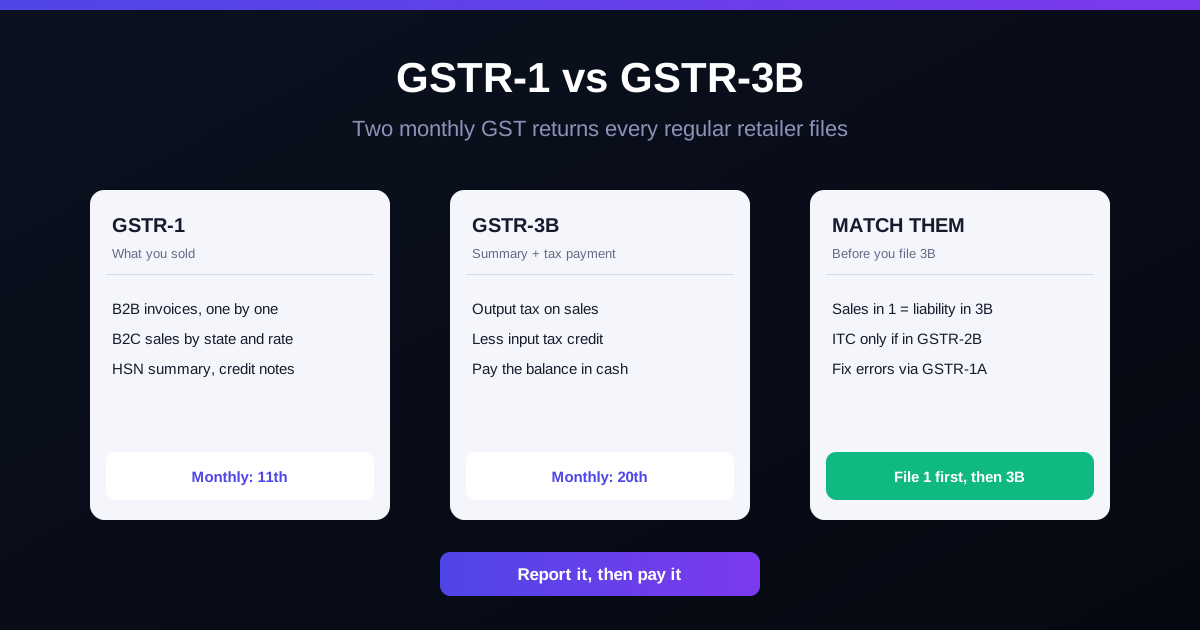
GSTR-1 lists what you sold: B2B invoices one by one, B2C sales as totals, credit notes and an HSN summary. GSTR-3B is a monthly summary where you declare the tax on those sales, subtract eligible input tax credit and pay the balance. File GSTR-1 first (11th), then GSTR-3B (20th), and make sure the sales in both agree. Small shops under ₹5 crore turnover can choose quarterly filing under QRMP.
GSTR-1 vs GSTR-3B at a glance
| GSTR-1 | GSTR-3B | |
|---|---|---|
| What it is | Statement of outward supplies (sales) | Summary return with tax payment |
| Detail level | Invoice-wise for B2B, totals for B2C | Totals only |
| Input tax credit | Not claimed here | Claimed here |
| Tax payment | No payment | Net GST paid in cash or from credit |
| Monthly due date | 11th of next month | 20th of next month |
| Under QRMP | 13th after the quarter (optional IFF for B2B invoices monthly) | 22nd or 24th after the quarter, by state |
| Why it matters to others | Feeds your B2B buyers' GSTR-2B, so they can claim credit | Settles your own tax liability |
What goes into GSTR-1
- B2B invoices: every sale to a GST-registered buyer, with their GSTIN, invoice number, value and tax. See GST invoice format.
- B2C sales: walk-in sales totalled by place of supply and tax rate. Large inter-state B2C invoices above the current limit are listed individually. See intra-state vs inter-state GST.
- Credit and debit notes for returns and price changes. See credit notes in GST.
- HSN summary of goods sold, with the digits required for your turnover. See finding HSN codes.
- Document summary: invoice number ranges issued and cancelled.
What goes into GSTR-3B
- Output tax: total taxable sales and GST on them, now auto-filled from your GSTR-1.
- Input tax credit: GST paid on purchases, claimable only when it appears in your auto-generated GSTR-2B, meaning your supplier has reported it.
- Net payment: output tax minus eligible credit, paid from your electronic cash ledger, plus any interest or late fee.
A worked example: a hardware store in Coimbatore
A Coimbatore hardware store, a regular GST dealer filing monthly, has these figures for a month. All items are at 18% and all sales are within Tamil Nadu:
| Item | Amount |
|---|---|
| Taxable sales (B2C ₹2,50,000 + B2B ₹1,50,000) | ₹4,00,000 |
| Output GST at 18% (CGST 9% + SGST 9%) | ₹72,000 |
| Purchases shown in GSTR-2B | ₹3,00,000 |
| Input tax credit | ₹54,000 |
| Net GST to pay in GSTR-3B | ₹18,000 |
By the 11th, the store files GSTR-1: its B2B invoices one by one (₹1,50,000 taxable), its B2C sales as a single Tamil Nadu 18% line (₹2,50,000), and the HSN summary. By the 20th, it files GSTR-3B showing ₹72,000 output tax, ₹54,000 credit and pays ₹18,000. Because both returns show ₹4,00,000 of sales, there is nothing to explain. The store and figures are illustrative.
Common mistakes that trigger notices
- Sales in GSTR-1 higher than in GSTR-3B. The department compares the two and asks for the gap plus interest.
- Claiming credit not in GSTR-2B. If your supplier has not filed, the credit is not yet yours to claim. Keep supplier records up to date and follow up.
- B2B sale reported as B2C. Your buyer loses credit and will come back to you. Capture the buyer's GSTIN at billing.
- Wrong place of supply on inter-state sales, putting IGST where CGST and SGST belong, or the reverse.
- Returns not reflected in credit notes. See return and refund management.
- Filing late. Late fee is charged per day of delay, lower for nil returns and capped by turnover, and interest runs at 18% a year on tax paid late. A missed GSTR-3B also blocks the next GSTR-1.
Monthly or quarterly: the QRMP scheme
If your aggregate turnover is up to ₹5 crore, you can opt for QRMP: GSTR-1 and GSTR-3B are filed quarterly, but tax is still paid every month through PMT-06. B2B sellers can upload invoices monthly through the optional IFF so their buyers get credit on time. QRMP cuts filing work for small shops; the monthly payment still needs your numbers ready. The composition scheme is a different option with its own returns.
How RichPOS helps
- GST-ready sales and purchase reports by HSN/SAC, built from the bills you already make. See GST & reports.
- GST invoices at the counter with the customer's GSTIN, so B2B and B2C sales separate cleanly. See Billing & POS.
- Purchase entries on record to check your claimed credit against GSTR-2B. See Purchase & Suppliers.
- One-click export to Excel, CSV or PDF for your CA or the GST portal.
For a wider look at GST reports, see GST reporting for retailers. RichPOS costs ₹199/month (₹2,000/year) with a 30-day free trial. See pricing.
Frequently asked questions
- What is the difference between GSTR-1 and GSTR-3B?
- GSTR-1 is a statement of your outward supplies: invoice-wise details of B2B sales, B2C sales summarised by state and rate, credit and debit notes, and an HSN summary. GSTR-3B is a summary return where you declare total output tax, claim input tax credit and pay the net GST. GSTR-1 reports; GSTR-3B pays.
- What are the due dates for GSTR-1 and GSTR-3B?
- For monthly filers, GSTR-1 is due on the 11th and GSTR-3B on the 20th of the following month. Under the QRMP scheme, GSTR-1 is due on the 13th after the quarter and GSTR-3B on the 22nd or 24th depending on your state, with monthly tax paid through PMT-06 by the 25th. Dates can be extended, so check the GST portal.
- Do I need to file GSTR-1 if I only sell to walk-in customers?
- Yes. A regular GST-registered shop files GSTR-1 even if every sale is B2C. Walk-in sales are reported as totals by place of supply and tax rate rather than invoice-wise, and the HSN summary is still required. If you had no sales at all, you file a nil return.
- What happens if GSTR-1 and GSTR-3B do not match?
- Sales in GSTR-1 higher than the tax paid in GSTR-3B can bring a notice asking you to pay the difference with interest or explain it. The portal now auto-fills GSTR-3B liability from GSTR-1, so correct errors in GSTR-1A or later amendments rather than changing figures only in GSTR-3B.
- Do composition dealers file GSTR-1 and GSTR-3B?
- No. Composition dealers pay tax quarterly through CMP-08 and file the annual GSTR-4 instead. They do not file GSTR-1 or GSTR-3B and cannot claim input tax credit.
Bottom line: GSTR-1 reports your sales, GSTR-3B pays the tax on them, and the two must agree. File GSTR-1 first, claim only credit that shows in GSTR-2B, and fix mistakes at the source. Want GST reports straight from your billing? Call +91 90333 31255 for a demo, or start the 30-day free trial from the pricing page.
This is general guidance, not tax advice. Due dates, late fees, thresholds and portal rules change often; confirm with your CA and the GST portal before filing.