Every GST tax invoice needs a serial number, and the rules are stricter than many shop owners expect. A repeated number, a 17-character code or a skipped bill can all raise questions in a GST notice or audit. This guide explains the invoice number rules in India, with examples you can copy.
Quick answer
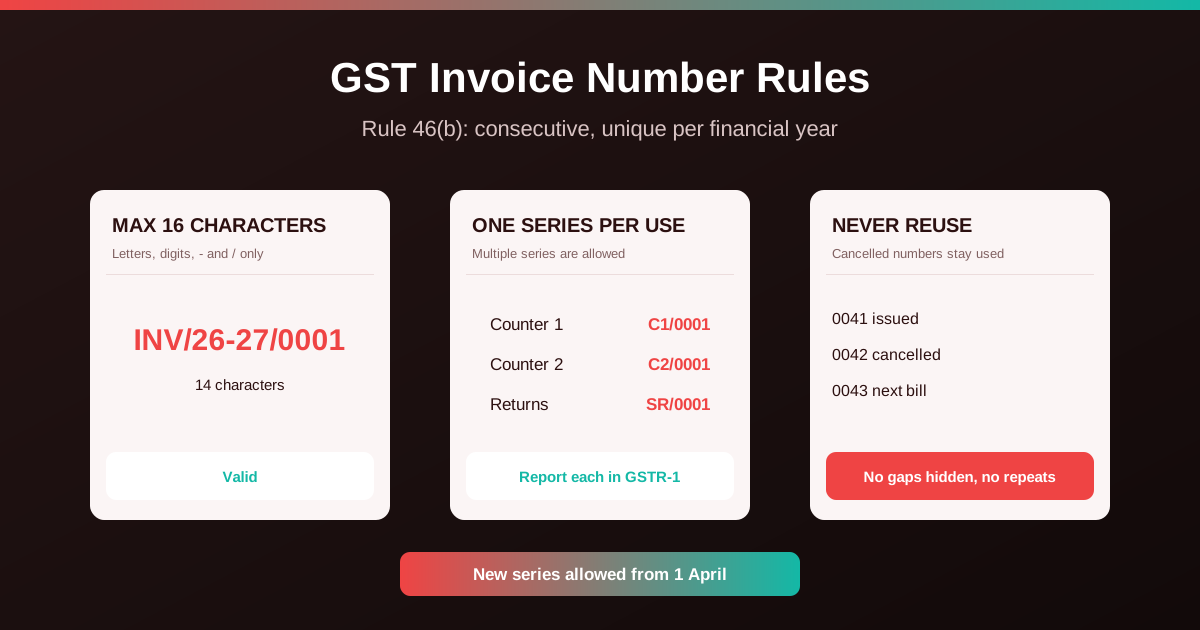
A GST invoice number must be consecutive, no longer than 16 characters, use only letters, digits, hyphen (-) and slash (/), and be unique for the financial year. You may run more than one series and start fresh each 1 April. Never reuse the number of a cancelled bill, and report your series in Table 13 of GSTR-1.
The rule: Rule 46(b) of the CGST Rules
Rule 46 lists what a tax invoice must contain. Clause (b) covers the number:
- Consecutive: numbers run in order, with no repeats.
- Up to 16 characters: including every letter, digit and symbol.
- Allowed characters: letters A to Z, digits 0 to 9, hyphen (-) and slash (/).
- One or more series: separate series are allowed.
- Unique for a financial year: the same number cannot appear twice between 1 April and 31 March.
For the other fields an invoice needs, see the GST invoice format guide.
Valid and invalid examples
| Invoice number | Length | Valid? | Why |
|---|---|---|---|
| INV/26-27/0001 | 14 | Yes | Prefix, year and serial within 16 characters |
| JPR-B2/26-27/0457 | 17 | No | One character over the limit |
| INV#2026_0001 | 13 | No | # and _ are not allowed |
| C2/26-27/00089 | 14 | Yes | Separate series for counter 2 |
| 0001 | 4 | Risky | Allowed, but repeats every year and hard to trace |
A good pattern is type / year / serial, for example SL/26-27/0001 for sales and SR/26-27/0001 for returns. It stays short and makes each bill easy to find.
Multiple series: when to use them
- Per counter or cashier: two counters billing at once can each run their own series without clashing.
- Per document: sales invoices, credit notes and bills of supply are usually kept in separate series.
- Per branch: a branch in another state has its own GSTIN and must have its own series. Branches under one GSTIN can share or split; splitting is easier to audit.
Starting a new series on 1 April
Because numbers only need to be unique within a financial year, you can restart at 0001 each April. Put the year in the prefix, such as 26-27, so a bill from April 2026 never looks like one from April 2027. Change the prefix before the first bill of the new year, not halfway through April.
Cancelled bills and gaps
If a bill is cancelled, its number is used up. Do not delete it or give the same number to the next customer. Keep the cancelled bill in your records, issue the next bill with the next number and report the count of cancelled documents in GSTR-1. If goods come back after a valid sale, issue a credit note rather than cancelling the invoice. For corrections after issue, see how to cancel or amend a GST invoice.
Reporting in GSTR-1, Table 13
Table 13 of GSTR-1, documents issued, asks for each series you used in the period: the first and last serial number, the total issued and the number cancelled. If your series has gaps or repeats, these numbers will not add up. See GSTR-1 vs GSTR-3B for what each return covers.
Common mistakes
- Writing bill numbers by hand and skipping or repeating one on a busy day.
- Two billing PCs using the same series and creating duplicate numbers.
- Long branch codes that push the number past 16 characters.
- Reusing a cancelled number for the next bill.
- Forgetting to change the year in the prefix in April.
How RichPOS helps
- Automatic numbering per store. Each store has its own prefix for sales, sales returns and quotations, and RichPOS adds the next serial on every bill, so cashiers never type a number. You can edit the prefix, for example at the start of a new financial year.
- Clean billing and returns. Thermal or A4 bills, and sales returns that correct stock and ledger. See Billing & POS.
- Branches and audit trail. Multiple stores from one login, with an activity log of who did what. See Multi-store and Users & roles.
- Reports for your CA. Sales reports by HSN/SAC, exportable to Excel, CSV or PDF. See GST & reports.
RichPOS costs ₹199/month (₹2,000/year) with a 30-day free trial. See pricing.
Frequently asked questions
- What is the rule for GST invoice numbers?
- Rule 46(b) of the CGST Rules says a tax invoice must carry a consecutive serial number of up to 16 characters, in one or more series, using letters, numbers, hyphen (-) or slash (/), and unique for the financial year.
- Can I restart invoice numbers every financial year?
- Yes. The number only has to be unique within a financial year, so most shops start a new series on 1 April, for example INV/26-27/0001. Add the year to the prefix so numbers from different years never look the same.
- Can a shop use more than one invoice series?
- Yes. You can run separate series for each counter, branch or document type, such as sales, returns and quotations. Each series must still be consecutive and every series you used is listed in Table 13 of GSTR-1.
- What happens to the number of a cancelled invoice?
- It stays used. Do not give it to another bill. Mark the invoice as cancelled in your records and report the cancelled count in Table 13 (documents issued) of GSTR-1.
- Does each branch need its own series?
- A branch in another state has its own GSTIN, so it needs its own series. Branches under the same GSTIN can share one series or use separate series per branch; separate series are easier to track and avoid duplicate numbers when billing at the same time.
Bottom line: Keep invoice numbers consecutive, under 16 characters, unique for the year and never reused. Use a clear prefix per document type, counter or branch, and change the year on 1 April. For a demo of RichPOS, call +91 90333 31255 or start the 30-day free trial from the pricing page.
This guide is general information based on the CGST Rules as of October 2026, not tax advice. Businesses covered by e-invoicing have further IRP checks; confirm your set-up with a qualified CA.