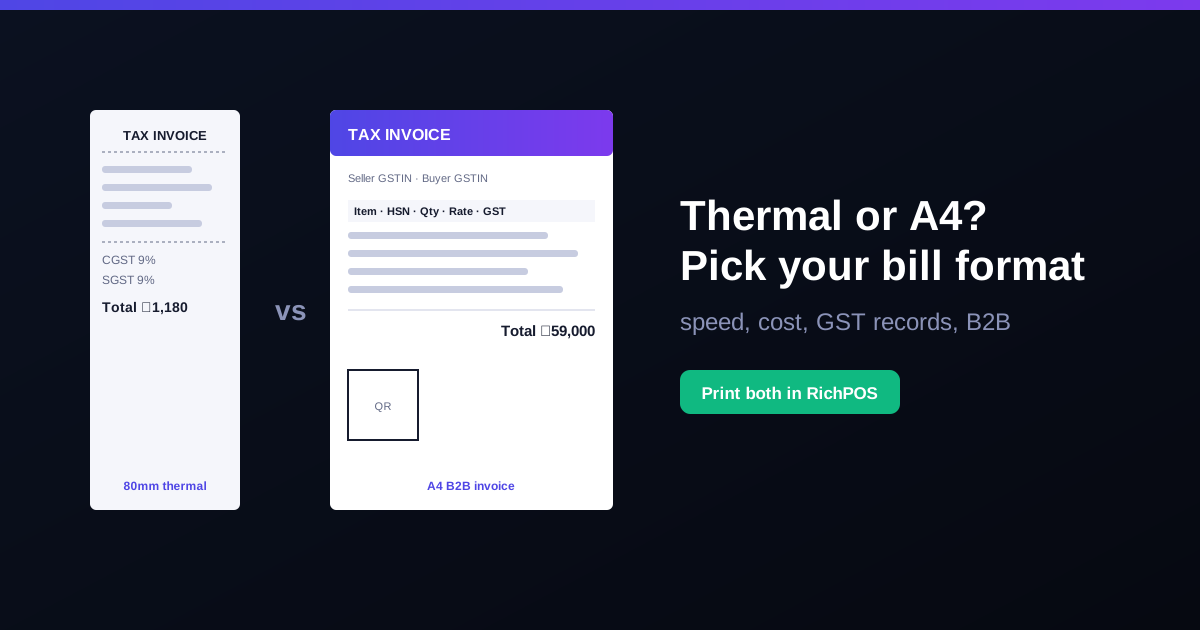
Every Indian shop that bills customers faces the same practical question sooner or later: print a small thermal receipt at the counter, or a full A4 invoice? The answer affects checkout speed, running cost, how your GST records hold up, and whether your business customers accept the bill. This guide compares the two formats and shows when to use each.
Quick answer
Use a thermal printer for fast B2C counter sales and an A4 invoice for B2B sales, credit customers and anything that needs a formal, long-lasting document. Many shops use both: thermal for walk-in customers, A4 when a registered business asks for a proper tax invoice with its GSTIN.
Thermal vs A4 at a glance
| Factor | Thermal (58mm / 80mm) | A4 (laser / inkjet) |
|---|---|---|
| Speed at counter | Very fast, prints in a second or two | Slower, more handling |
| Consumables | Thermal paper roll only, no ink or toner | Paper plus ink or toner |
| Space needed | Fits on a small counter | Needs desk space |
| Durability | Fades with heat, light and time | Lasts for years |
| Detail per line | Limited width; long item names wrap | Room for full item names, HSN, tax split, terms |
| Best for | Kirana, pharmacy, mobile accessories, restaurants, high-footfall B2C | Wholesale, distributors, B2B, electronics with warranty, credit sales |
When a thermal printer makes sense
If most of your sales are small, quick B2C bills (a grocery store in Pune, a mobile accessories shop in Surat, a medical store in Lucknow), a thermal printer keeps the queue moving. There is no ink to run out, the paper roll takes seconds to change, and the printer fits beside the barcode scanner.
Pick the width carefully. A 58mm (2-inch) roll works for very short bills. An 80mm (3-inch) roll fits more characters per line, so item names, HSN codes and the CGST/SGST split print without awkward wrapping. For a GST-registered shop, 80mm is usually the safer choice.
When you need an A4 invoice
- B2B sales: a registered buyer needs your invoice to claim input tax credit, and most businesses expect a clear A4 document with both GSTINs.
- High-value items: electronics, appliances and mobiles often carry warranty claims months later. A faded thermal slip is a poor warranty document.
- Credit and wholesale: payment terms, due dates and bank details fit comfortably on A4.
- E-invoicing: businesses above the e-invoicing turnover threshold must generate an IRN and QR code for B2B invoices, which prints naturally on A4.
The GST record-keeping catch
A thermal receipt is a valid tax invoice as long as it contains the mandatory fields; see our GST invoice format guide for the full list. The problem is durability. Under the CGST Act, accounts and records must be kept for 72 months from the due date of the annual return for that year. Thermal paper can fade well before that. The fix is not to keep paper at all: keep every invoice digitally in your billing software, where it can be reprinted on A4 or shared again whenever a customer or your CA needs it.
A practical setup for most shops
- Thermal 80mm printer at the billing counter for everyday B2C sales.
- An A4 printer (even a basic office one) for B2B, credit and high-value bills.
- Digital copies of every invoice in your software, plus the option to send bills on WhatsApp or email instead of printing at all.
How RichPOS handles invoice printing
In RichPOS every bill can be printed on a thermal or A4 printer, or sent by email and WhatsApp, from the same sale. Cash, card, UPI and split payments are recorded on the invoice, and quotations convert into invoices in one click. Because every invoice is stored in the system, you can reprint or resend it any time. See Billing & POS and SMS, email & WhatsApp for details.
Frequently asked questions
- Is a thermal printer receipt a valid GST invoice?
- Yes, if it carries every mandatory field of a tax invoice: your GSTIN, invoice number and date, HSN/SAC, taxable value, GST rate and amount, and total. The paper size does not matter; the contents do.
- Should I choose a 58mm or 80mm thermal printer?
- 58mm (2-inch) suits short bills at small counters such as kirana or tea stalls. 80mm (3-inch) fits more characters per line, so item names, HSN codes and the CGST/SGST split print clearly. Most retail shops with GST billing prefer 80mm.
- Do thermal receipts fade?
- Yes. Thermal paper darkens with heat and fades with light, heat and time. Since GST records must be kept for 72 months from the due date of the annual return, keep the digital invoice in your billing software rather than relying on the paper copy.
- Can RichPOS print both thermal and A4 invoices?
- Yes. RichPOS prints every bill on a thermal or A4 printer, and can also send it by email or WhatsApp, so you can use a thermal receipt at the counter and an A4 invoice for business customers.
Bottom line: thermal for speed at the counter, A4 for business customers and long-life documents, and digital copies for GST compliance. RichPOS supports all three from ₹199/month, with a 30-day free trial. See pricing or call +91 90333 31255.
GST rules summarised for general guidance as of 2026; confirm your specific case with your chartered accountant.