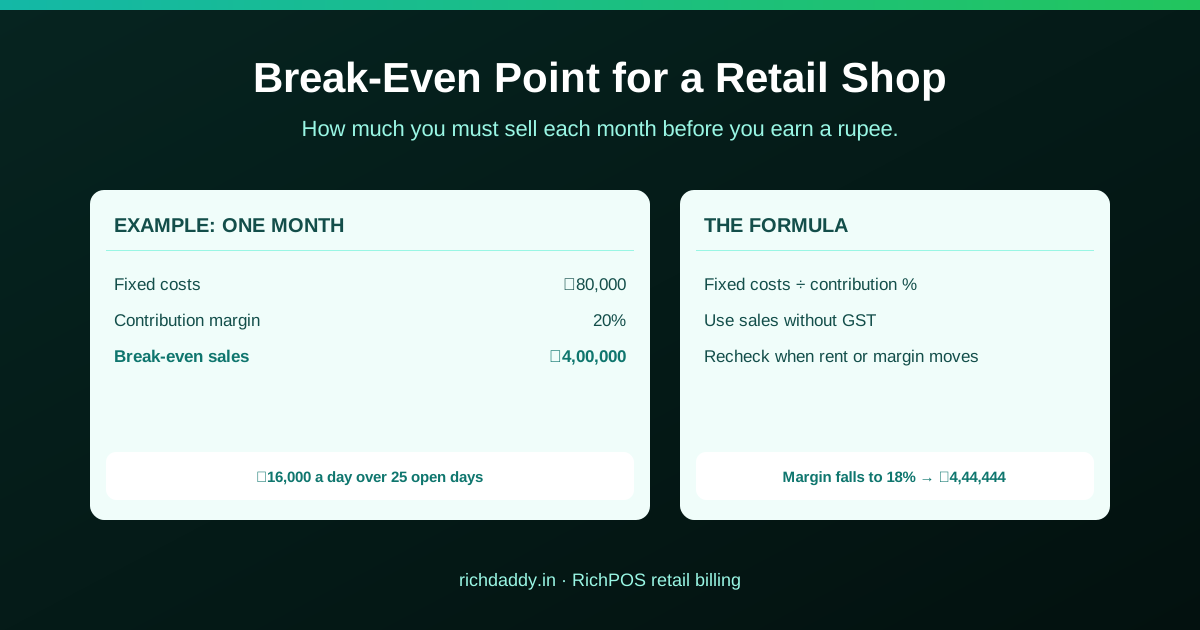
Short answer: Break-even sales = monthly fixed costs ÷ contribution margin %. If your shop pays ₹80,000 a month for rent, salaries, electricity and other fixed costs, and keeps ₹20 from every ₹100 of sales after the cost of goods and other sale-linked costs, you must sell ₹4,00,000 a month (without GST) before you make any profit. Over 25 open days, that is ₹16,000 a day.
This guide is for kirana, general, pharmacy, garment, footwear, mobile, hardware and other retail shops in India, whether you are planning a new shop or checking an existing one.
Step 1: List your fixed costs
Fixed costs stay roughly the same every month whether you sell a lot or a little.
| Fixed cost (monthly) | Amount |
|---|---|
| Shop rent | ₹40,000 |
| Salaries for 2 staff | ₹30,000 |
| Electricity | ₹6,000 |
| Internet, phone, software and other running costs | ₹4,000 |
| Total fixed costs | ₹80,000 |
Also add loan interest, a fair salary for yourself, and the cost of your shop fit-out spread over its life. A ₹6,00,000 fit-out expected to last 5 years works out to ₹10,000 a month. Our guide on tracking shop expenses helps you find the real figures.
Step 2: Find your contribution margin
Contribution margin is what is left from each ₹100 of sales after costs that rise and fall with sales.
| Per ₹100 of sales (without GST) | Amount |
|---|---|
| Sales | ₹100 |
| Less: purchase cost of goods sold | ₹78 |
| Gross margin | ₹22 |
| Less: carry bags, packing and delivery | ₹2 |
| Contribution margin | ₹20 (20%) |
Use your real average margin across all items, not the margin on your best item. If you are unsure of the difference between markup and margin, read markup vs margin first. Mixing them up is the most common reason break-even figures come out wrong.
Step 3: Work out break-even
| Measure | Working | Result |
|---|---|---|
| Break-even sales per month | ₹80,000 ÷ 20% | ₹4,00,000 |
| Break-even sales per day (25 open days) | ₹4,00,000 ÷ 25 | ₹16,000 |
| Sales for ₹50,000 profit a month | (₹80,000 + ₹50,000) ÷ 20% | ₹6,50,000 |
| Daily target for that profit | ₹6,50,000 ÷ 25 | ₹26,000 |
A daily figure is easier to act on. If you check today's sales at closing and they are below ₹16,000, you know that day did not pay its share of the month's costs.
Margin of safety
If the shop actually sells ₹5,00,000 a month:
- Margin of safety = ₹5,00,000 − ₹4,00,000 = ₹1,00,000, which is 20% of sales.
- Profit = ₹5,00,000 × 20% − ₹80,000 = ₹20,000.
A 20% margin of safety means sales can drop by a fifth, for example in a slow month after a festival, before the shop starts losing money. Your profit and loss report shows whether the real numbers match.
What moves your break-even point
| Change | New break-even sales | Effect |
|---|---|---|
| Margin falls from 20% to 18% (more discounts) | ₹80,000 ÷ 18% = ₹4,44,444 | +₹44,444 a month |
| Rent rises by ₹10,000 | ₹90,000 ÷ 20% = ₹4,50,000 | +₹50,000 a month |
| Margin improves to 22% | ₹80,000 ÷ 22% = ₹3,63,636 | −₹36,364 a month |
Small changes in margin move break-even a lot. Before running a big festival sale, check how much extra you need to sell to make up for the lower margin.
The GST side
Do every calculation on sales without GST. The GST you charge on a bill is collected for the government and paid out in your return, so it is not margin. Purchase cost should also be without the GST you claim back as input tax credit. If you are under the composition scheme, you cannot charge GST to customers and you pay tax on turnover from your own pocket, so treat that tax as a cost that reduces your contribution margin.
How to lower your break-even point
- Improve the mix: give more shelf space to items with better margins.
- Buy better: compare supplier rates and schemes on your highest-value items.
- Control discounts: set limits on what each cashier can give.
- Cut stock that does not move: money tied up in slow items still costs rent and interest. Track your inventory turnover.
- Review fixed costs once a year: rent, staff hours and power use are where the big savings usually sit.
Common mistakes
- Using sales including GST, which makes break-even look easier to reach than it is.
- Using markup instead of margin in the formula.
- Leaving out the owner's own salary.
- Working it out once when the shop opens and never again.
Frequently asked questions
- What is the break-even point of a shop?
- It is the level of sales at which your shop makes neither a profit nor a loss. The margin you earn on sales exactly pays for fixed costs such as rent, salaries and electricity. Every rupee of margin above that point is profit.
- How do I calculate break-even sales for my shop?
- Break-even sales = monthly fixed costs ÷ contribution margin %. Contribution margin is what is left from each ₹100 of sales after the cost of the goods and other costs that rise with sales, such as packing and delivery. With ₹80,000 of fixed costs and a 20% contribution margin, break-even sales are ₹4,00,000 a month.
- Should I include GST in sales when calculating break-even?
- No. Use sales without GST. The GST you collect from customers belongs to the government, so it is not part of your margin. Work out margins on taxable value. A composition dealer cannot collect tax from customers, so the tax paid on turnover is a cost and should reduce the contribution margin.
- Is my own salary a fixed cost?
- It should be. Put a fair monthly figure for your own time in fixed costs. Otherwise the shop can look like it breaks even while you are working for nothing.
- What is margin of safety?
- Margin of safety is how far your actual sales are above break-even sales. If you sell ₹5,00,000 a month and break-even is ₹4,00,000, the margin of safety is ₹1,00,000, or 20% of sales. Sales can fall by that much before the shop starts losing money.
- How often should I recalculate break-even?
- Recalculate whenever a fixed cost changes, such as a rent increase or a new staff member, and whenever your average margin changes, for example after a supplier price rise or a heavy discount season. A quick check every quarter is a good habit.
Bottom line: Break-even sales = fixed costs ÷ contribution margin %, worked out on sales without GST. Turn it into a daily target, check it at closing, and redo the sum whenever rent, salaries or margins change. RichPOS shows daily sales, item-wise margins and expenses in one place, so you can see each day whether the shop has covered its costs. Planning a new shop? Read how to start a grocery store, call +91 90333 31255, or start the 30-day free trial from the pricing page.