Ask ten shopkeepers what their margin is and many will say "25%", meaning they add 25% to the cost. That is a markup, not a margin, and the difference quietly eats profit on every bill. This guide explains both, shows how to convert one into the other, and how to price items so you actually earn the margin you planned, with GST and MRP in the picture.
Quick answer
Markup = profit ÷ cost. Margin = profit ÷ selling price. The same rupee profit is always a smaller percentage as margin than as markup. To earn a target margin, price at cost ÷ (1 − margin), not cost × (1 + margin). Work on prices before GST if you claim input tax credit, and never price packaged goods above MRP.
The two formulas
| Formula | Item bought at ₹100, sold at ₹125 | |
|---|---|---|
| Gross profit | Selling price − cost | ₹25 |
| Markup | Profit ÷ cost × 100 | 25% |
| Margin | Profit ÷ selling price × 100 | 20% |
Markup is handy at the purchase counter because you know the cost. Margin is what your profit and loss report shows, because gross profit there is measured against sales. Mixing the two is where the gap starts.
Markup to margin conversion table
| Markup on cost | Margin on selling price |
|---|---|
| 10% | 9.1% |
| 20% | 16.7% |
| 25% | 20% |
| 33.3% | 25% |
| 50% | 33.3% |
| 66.7% | 40% |
| 100% | 50% |
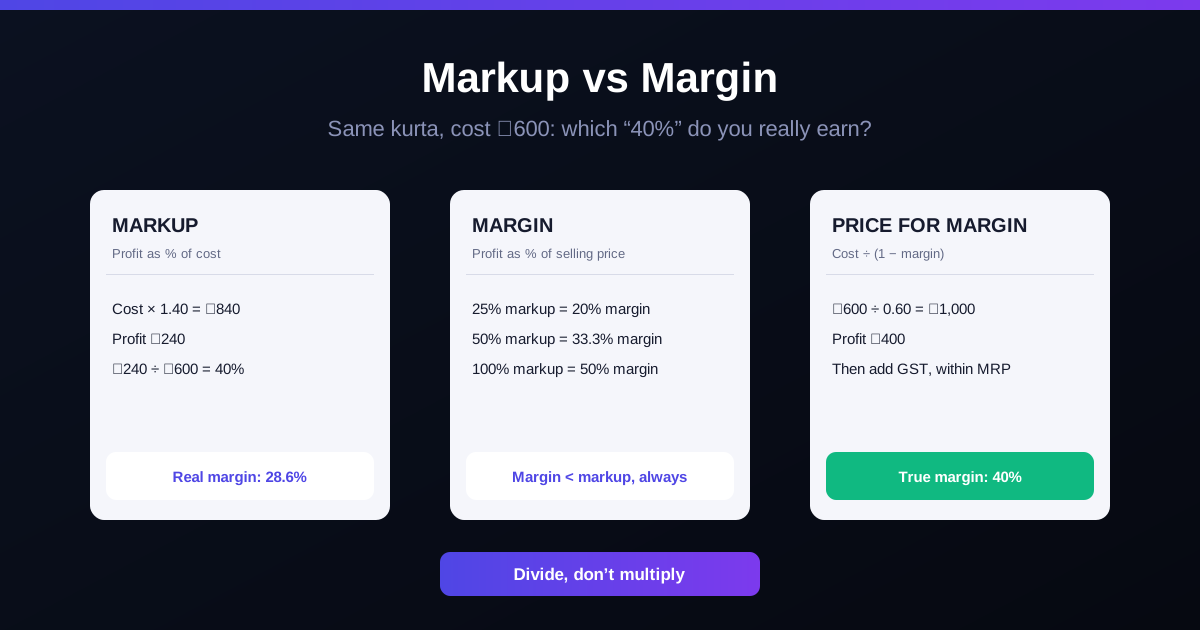
Margin = markup ÷ (1 + markup). Markup = margin ÷ (1 − margin). Note that margin can never reach 100%, while markup can go as high as you like.
How to price for a target margin
- Take the landed cost: purchase rate plus freight and loading, less any scheme or discount from the supplier. Use the rate before GST if you claim input tax credit.
- Decide the margin you need to cover rent, salaries, electricity and profit.
- Selling price before GST = cost ÷ (1 − margin).
- Add GST at the rate for that item's HSN code. See finding the HSN code.
- For packaged goods, check the result is not above MRP. If it is, you cannot charge it; renegotiate the purchase rate instead.
A worked example: a garment shop in Jaipur
A Jaipur garment shop buys kurtas at ₹600 each before GST and wants a 40% margin. The owner has always added 40% to cost:
| Cost × 1.40 (markup) | Cost ÷ 0.60 (margin) | |
|---|---|---|
| Selling price before GST | ₹840 | ₹1,000 |
| Gross profit per kurta | ₹240 | ₹400 |
| Actual margin | 28.6% | 40% |
| Profit on 200 kurtas | ₹48,000 | ₹80,000 |
The "40%" rule left ₹32,000 on the table over 200 pieces. GST is then added on the selling price at the rate that applies to that kurta; check GST on clothes for current slabs. The shop, city and figures are illustrative.
Where GST fits
- Regular GST dealer: GST paid on purchases comes back as input tax credit, and GST collected on sales goes to the government. Neither is your income or cost, so calculate markup and margin on amounts before GST.
- Composition dealer: you cannot claim input tax credit, so include the GST paid on purchases in your cost. See the composition scheme.
- Working back from an inclusive price: to find the pre-GST amount inside an MRP or counter price, use the reverse GST formula.
What discounts do to your margin
A discount comes straight out of profit, not out of cost. On an item sold at ₹100 with a 25% margin (₹25 profit), a 10% discount leaves ₹15 profit. To earn the same ₹25 in total you must sell 25 ÷ 15 ≈ 1.67 times as many units, about 67% more. Run that sum before a festival sale, and prefer discounts on slow items over bestsellers.
Common mistakes to avoid
- Calling markup "margin". Agree one word in the shop, and write both numbers on your price list if needed.
- Using the invoice rate, not landed cost. Freight, loading and breakage are part of cost.
- Counting GST as income. It inflates both sales and margin on paper.
- One margin for everything. Fast movers can take a thin margin; slow, fragile or seasonal items need more. See reducing dead stock.
- Never checking the result. Compare planned margin with the gross margin in your P&L every month.
How RichPOS helps
- Purchase cost on record: purchase orders and receiving keep supplier rates in the system, and purchase returns correct stock. See Purchase & Suppliers.
- Profit & loss and stock valuation reports from live sales and purchase data, so you can compare real margin with the plan. See GST & reports.
- GST reports by HSN/SAC, so tax stays separate from income.
- Hide profit from counter staff: per-module permissions let a cashier bill without seeing profit reports. See Users & Roles.
- Export to Excel, CSV or PDF for your CA.
RichPOS costs ₹199/month (₹2,000/year) with a 30-day free trial. See pricing.
Frequently asked questions
- What is the difference between markup and margin?
- Markup is profit as a percentage of cost. Margin is profit as a percentage of the selling price. An item bought for ₹100 and sold for ₹125 has a 25% markup but only a 20% margin, because the same ₹25 profit is divided by a bigger number.
- How do I convert markup to margin?
- Margin = markup ÷ (1 + markup). A 25% markup is 0.25 ÷ 1.25 = 20% margin. To go the other way, markup = margin ÷ (1 − margin), so a 25% margin needs a 33.33% markup.
- How do I set a selling price for a target margin?
- Divide the cost by (1 − target margin). For a 30% margin on an item that costs ₹700, the price is 700 ÷ 0.70 = ₹1,000 before GST. Adding 30% to cost (₹910) would give only about 23% margin.
- Should GST be included when calculating margin?
- For a regular GST-registered shop that claims input tax credit, work out cost and selling price before GST, then add GST on the selling price. GST collected from customers is not your income. A composition dealer cannot claim input tax credit, so the GST paid on purchases is part of their cost.
- Can I sell above MRP if my margin is too low?
- No. For packaged goods, MRP is the maximum price including all taxes, and selling above it is not allowed under the Legal Metrology rules. If the MRP does not leave you enough margin, the fix is on the buying side: a better purchase rate, scheme or supplier.
Bottom line: markup is on cost, margin is on price, and the gap between them is real money. Price at cost ÷ (1 − margin), keep GST out of the sum if you claim credit, stay within MRP, and check the result in your P&L. Want live profit reports from your own billing? Call +91 90333 31255 for a demo, or start the 30-day free trial from the pricing page.
This is general guidance, not tax or legal advice. GST rates, input tax credit rules and MRP rules can change; confirm with your CA for your products.