Closing stock is the single biggest number most shop owners guess at year-end. It decides your gross profit, your income tax and the stock figure your bank sees. Value it too high and you pay tax on profit you never made; too low and your books understate the business. This guide explains how closing stock is valued in India, with worked ₹ examples.
Quick answer
Value closing stock at the lower of cost and net realisable value (NRV). Work out cost using FIFO or weighted average, include purchase price and freight inward but not GST you can claim as input tax credit, and never use LIFO. Write slow, damaged or near-expiry stock down to what it will actually sell for.
Why closing stock decides your profit
Gross profit is sales minus cost of goods sold, and cost of goods sold is opening stock plus purchases minus closing stock. Every rupee added to closing stock adds a rupee to profit.
| Line | Correct value | Stock overvalued by ₹50,000 |
|---|---|---|
| Sales | ₹10,00,000 | ₹10,00,000 |
| Opening stock | ₹2,00,000 | ₹2,00,000 |
| Purchases | ₹8,00,000 | ₹8,00,000 |
| Closing stock | ₹2,50,000 | ₹3,00,000 |
| Cost of goods sold | ₹7,50,000 | ₹7,00,000 |
| Gross profit | ₹2,50,000 | ₹3,00,000 |
The extra ₹50,000 of profit exists only on paper, but it is taxed. It also becomes next year's opening stock, so the error carries forward. For reading the full statement, see the profit and loss report guide.
The rule: lower of cost and NRV
Accounting Standard 2 (AS 2), Valuation of Inventories, issued by ICAI, says stock is valued at the lower of cost and net realisable value. Indian accountants apply it to traders, retailers and manufacturers alike.
What goes into cost
- Include: purchase price, freight and cartage inward, loading and unloading, and taxes you cannot recover.
- Deduct: trade discounts and rebates received from the supplier.
- Exclude: GST you can claim as input tax credit, selling and delivery costs, general shop rent and salaries, and abnormal wastage.
If you are under the composition scheme, you cannot claim input tax credit, so the GST you pay on purchases becomes part of cost.
FIFO vs weighted average: worked example
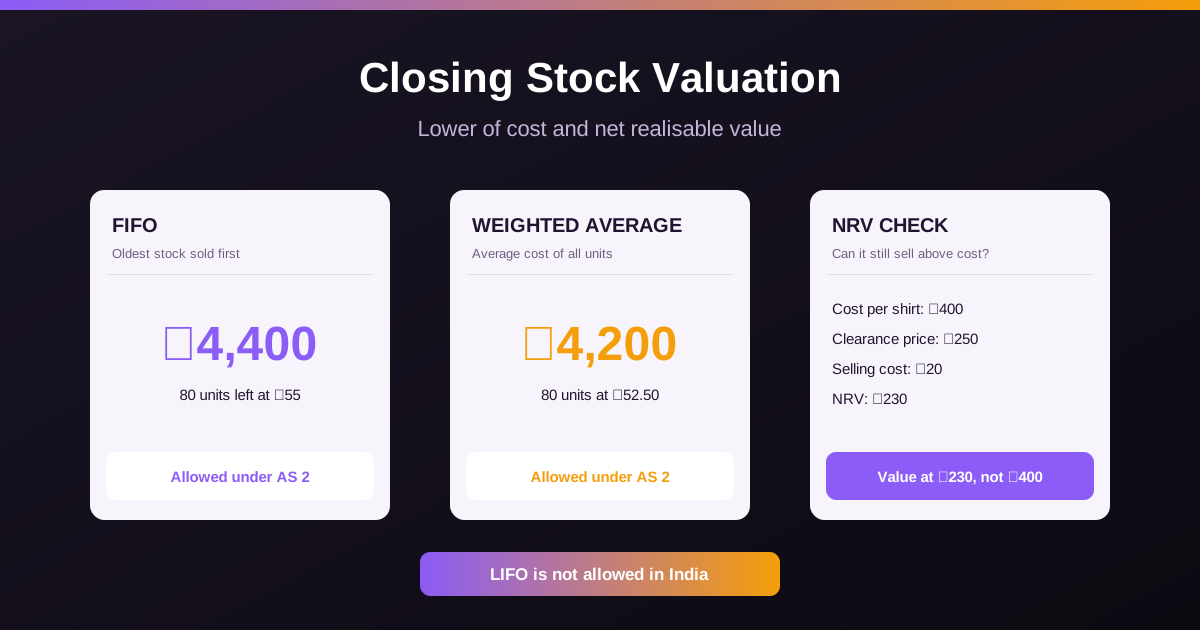
AS 2 allows two cost formulas for interchangeable items: first-in, first-out (FIFO) and weighted average. Last-in, first-out (LIFO) is not allowed. Items that are not interchangeable, such as a specific piece of jewellery or a serial-numbered phone, use specific identification of their actual cost.
A kirana store in Lucknow buys 100 packs of an item at ₹50 in April and 100 more at ₹55 in June. It sells 120 packs by 31 March, leaving 80.
| Method | How 80 packs are valued | Closing stock | Cost of goods sold |
|---|---|---|---|
| FIFO | Oldest packs sold first, so the 80 left are from the ₹55 lot | ₹4,400 | ₹6,100 |
| Weighted average | (₹5,000 + ₹5,500) ÷ 200 = ₹52.50 per pack | ₹4,200 | ₹6,300 |
When purchase prices are rising, FIFO gives a higher closing stock and higher profit; weighted average smooths out price swings. Both are acceptable. What matters is using the same method every year. A change is allowed only if it gives a more appropriate presentation, and its effect must be disclosed.
Large stores with thousands of fast-moving items with similar margins may use the retail method, which works back from selling price by deducting the gross margin. Discuss it with your CA before using it.
Writing stock down to NRV
Net realisable value is the expected selling price in the normal course of business minus the costs still needed to sell. When NRV is below cost, value the stock at NRV and take the loss this year, not when the stock finally sells.
A garment shop in Jaipur has 30 shirts from last season that cost ₹400 each. They will now sell only at ₹250 in a clearance sale, with about ₹20 per shirt in selling costs.
| Line | Amount |
|---|---|
| Cost: 30 × ₹400 | ₹12,000 |
| NRV: 30 × (₹250 − ₹20) | ₹6,900 |
| Write-down this year | ₹5,100 |
Typical candidates are damaged goods, items close to expiry, out-of-fashion garments and old phone models. The figures above are illustrative. To stop this stock building up, see how to reduce dead stock.
Closing stock and GST
- Valuation is not a GST event. Writing stock down to NRV changes your books, not your GST return.
- Destroyed or written-off stock is different. Under Section 17(5)(h) of the CGST Act, input tax credit is blocked on goods lost, stolen, destroyed or written off. If you claimed credit on such goods, it has to be reversed. Check with your CA where a write-down ends and a write-off begins.
- Cancelling GST registration. If you cancel registration, you must pay an amount equal to the input tax credit on stock held on that date, reported in GSTR-10.
Year-end checklist
- Count physical stock on 31 March and fix differences; see how to do a stock audit.
- Apply your usual cost formula (FIFO or weighted average) to every item.
- List damaged, near-expiry and slow-moving items and value them at NRV where it is lower than cost.
- Exclude claimable GST from cost; add non-claimable GST.
- Use the same figure in your accounts, your income tax return and any stock statement to your bank.
How RichPOS helps
- Stock valuation report from live data. Along with profit and loss, GST by HSN/SAC and expense reports, exportable to Excel, CSV or PDF for your CA. See GST & reports.
- Accurate stock counts. Barcode-based stock, low-stock alerts and an adjustment log that records the reason and user for every change. See Inventory & barcode.
RichPOS costs ₹199/month (₹2,000/year) with a 30-day free trial. See pricing.
Frequently asked questions
- How is closing stock valued in India?
- At the lower of cost and net realisable value, item by item or for groups of similar items. This is the rule in Accounting Standard 2 (AS 2), Valuation of Inventories, issued by ICAI. Cost is worked out using FIFO or weighted average, or specific identification for items that are not interchangeable.
- Is LIFO allowed for stock valuation in India?
- No. AS 2 does not permit the last-in, first-out (LIFO) formula. Indian shops normally use first-in, first-out (FIFO) or weighted average cost.
- What is net realisable value?
- Net realisable value (NRV) is the price you expect to sell the item for in the normal course of business, minus the costs still needed to complete and sell it. If NRV falls below cost, for example for damaged, near-expiry or out-of-fashion stock, the stock is valued at NRV.
- Should GST be included in the cost of closing stock?
- For your books, GST that you can claim as input tax credit is not part of cost, because it is recoverable. GST you cannot claim, such as under the composition scheme or on blocked credits, is added to cost. For income tax, Section 145A and ICDS II also apply to many businesses, so align the method with your CA.
- Can I change my stock valuation method every year?
- No. Use the same cost formula consistently from year to year. A change is allowed only if it gives a more appropriate presentation, and its effect has to be disclosed in the accounts.
Bottom line: Value closing stock at the lower of cost and NRV, use FIFO or weighted average consistently, keep claimable GST out of cost, and write down stock that will not sell at cost. A correct closing stock means you pay tax only on profit you actually made. For a demo of RichPOS, call +91 90333 31255 or start the 30-day free trial from the pricing page.
This guide is general information based on ICAI AS 2 and the CGST Act as of October 2026, not tax or accounting advice. Confirm your valuation method with a qualified CA.