Every Indian shop gives discounts: festival offers, round-off for a regular customer, a volume rebate from a distributor. What owners often get wrong is the GST. Some pay GST on the full price when the law lets them pay on the discounted price; others cut GST on a discount that the law does not recognise. This guide explains which discounts reduce GST, how to show them on the invoice, and when you need a credit note.
Quick answer
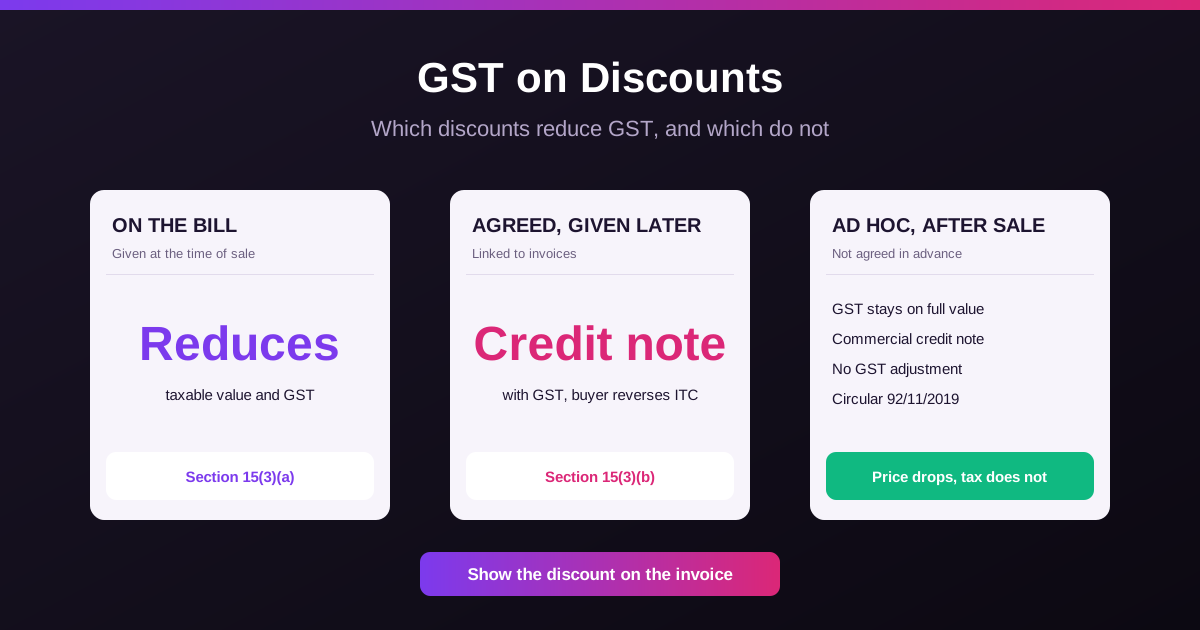
A discount shown on the invoice at the time of sale reduces the taxable value, so GST is charged on the discounted price. A discount given after the sale reduces GST only if it was agreed before or at the time of sale, is linked to specific invoices, is passed through a Section 34 credit note and the buyer reverses the matching input tax credit. An ad hoc discount decided later does not reduce GST at all.
Three kinds of discount, three GST treatments
| Discount | Example | Effect on GST |
|---|---|---|
| On the bill, at the time of sale | 10% festival offer printed on the invoice | Reduces taxable value. GST on the discounted price. |
| After the sale, agreed in advance | 2% year-end rebate in a distributor agreement | Reduces taxable value through a credit note with GST. The buyer reverses input tax credit. |
| After the sale, not agreed in advance | Extra 5% given to clear a slow-moving lot | No change to GST. Use a commercial credit note without GST. |
Source: Section 15(3) of the CGST Act and CBIC Circular 92/11/2019-GST. Finance Act 2025 tightened the wording of Section 15(3)(b) to tie the reduction to a Section 34 credit note and the buyer's input tax credit reversal; confirm the current wording with your CA.
1. Discount on the bill: GST on the reduced price
If you give the discount before or at the time of sale and record it on the invoice, it is excluded from the taxable value. Show the list price, the discount and the net taxable value as separate columns or lines, then calculate GST on the net value. A plain tax invoice carries all of this; see the GST invoice format for retail shops.
GST is charged on the actual transaction price, not MRP. MRP is only the maximum you may charge, inclusive of tax. If an item sells below MRP, back-calculate the taxable value from the price the customer paid, using the reverse GST formula.
Worked example: a 10% festival offer
A footwear shop in Pune sells a pair of shoes with an MRP of ₹1,180, including 18% GST. During a Diwali sale it gives 10% off at the counter and prints the discount on the bill.
| Line | No discount | 10% off on the bill |
|---|---|---|
| Price paid by customer | ₹1,180 | ₹1,062 |
| Taxable value | ₹1,000 | ₹900 |
| CGST 9% | ₹90 | ₹81 |
| SGST 9% | ₹90 | ₹81 |
| Total GST | ₹180 | ₹162 |
If the same ₹118 were handed back later as cash, with the bill still showing ₹1,180 and no credit note, the shop would still owe ₹180 of GST. Putting the discount on the bill saves ₹18 of tax on every pair. The rates and figures are illustrative; use the rate that applies to your product. For planning offers, see festival sale promotions for retail shops.
2. Discount after the sale, agreed in advance: credit note with GST
Volume rebates, target incentives and year-end schemes from brands and distributors are usually settled after the sales. They reduce the taxable value only if:
- the discount was agreed before or at the time of the sale, for example in a written distributor agreement or scheme letter;
- it can be linked to the specific invoices it relates to;
- the supplier issues a GST credit note under Section 34; and
- the buyer reverses the input tax credit on the discount.
Example: a distributor in Ahmedabad agrees in April to give a kirana chain 2% back on all its purchases if they cross ₹50 lakh in the year. The chain buys ₹60 lakh of goods at 18%. In March the distributor issues a credit note of ₹1,20,000 plus ₹21,600 GST, listing the original invoices. The distributor reduces its output tax by ₹21,600, and the chain reverses ₹21,600 of input tax credit.
Declare the credit note in a return no later than 30 November following the end of the financial year of the original sale, or the date of filing the annual return, whichever is earlier. Miss the date and the GST reduction is lost.
3. Ad hoc discount after the sale: no GST reduction
If the discount was not known or agreed at the time of sale, such as an extra rebate to clear old stock or to settle a complaint, it cannot reduce the taxable value. CBIC Circular 92/11/2019-GST lets the supplier issue a commercial (financial) credit note for the amount, but without GST. The supplier keeps paying GST on the original invoice value, and the buyer keeps its full input tax credit.
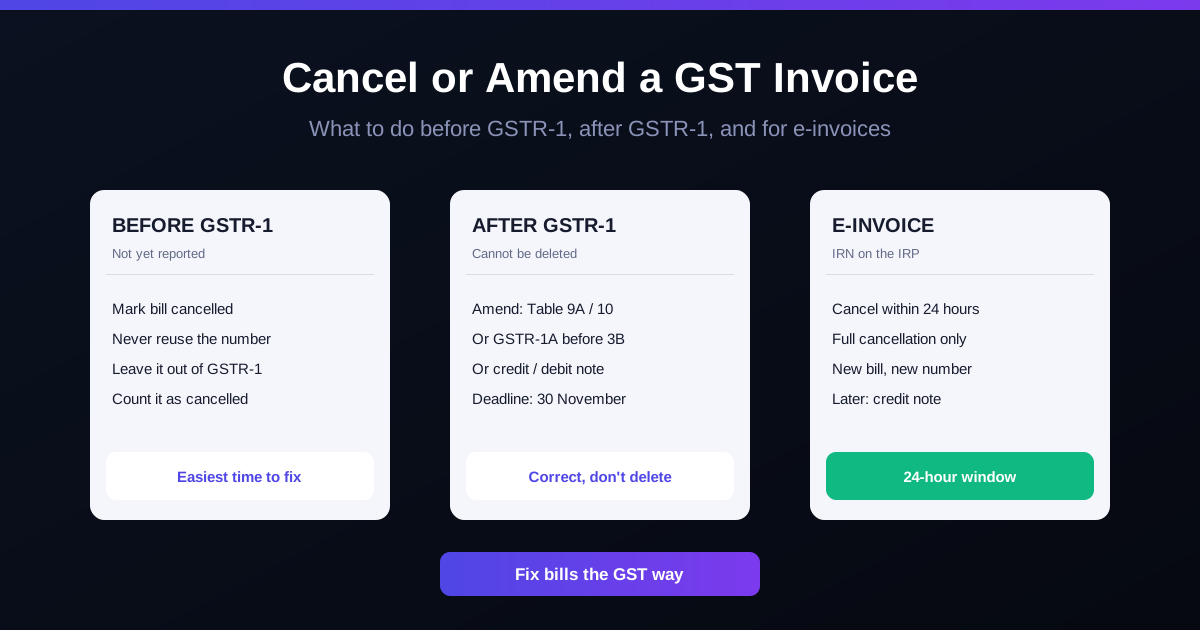
If the original invoice itself was wrong, the fix is different; see how to cancel or amend a GST invoice.
Offers that look like discounts
- Buy one get one free. Not a free supply. CBIC treats it as two items sold for one price, so GST is paid on the price charged and input tax credit is allowed on both items.
- Free gifts and samples. A genuine free item with no consideration is not a sale, but input tax credit on goods given away as gifts or free samples is blocked under Section 17(5)(h).
- Combo packs. A combo sold for one price may be a mixed supply taxed at the highest rate in the pack. Check the rate before printing the offer.
- Price-linked rates. Where the GST rate depends on the sale value per piece, as with some readymade garments, an on-bill discount can change the rate that applies. See GST on clothes and confirm borderline cases with your CA.
A discount also eats into profit faster than most owners expect. Before running an offer, check the numbers with markup vs margin.
How RichPOS helps
- Clean GST bills at the counter. Fast barcode billing on thermal or A4 with UPI, card and cash split payments, plus sales returns and quotations. See Billing & POS.
- Reports your CA can use. GST-ready sales and purchase reports by HSN/SAC, profit and loss, and export to Excel, CSV or PDF. See GST & reports.
RichPOS costs ₹199/month (₹2,000/year) with a 30-day free trial. See pricing.
Frequently asked questions
- Is GST charged before or after a discount?
- If the discount is given at the time of sale and shown on the invoice, GST is charged after the discount, on the reduced price. This is Section 15(3)(a) of the CGST Act. A discount given later reduces GST only if it was agreed before or at the time of sale, is linked to specific invoices and is passed through a credit note on which the buyer reverses input tax credit.
- Is GST charged on MRP or on the selling price?
- On the actual selling price, not on MRP. MRP is the maximum a shop may charge, inclusive of all taxes. If you sell below MRP and the discount is on the bill, work out the taxable value from the price the customer actually paid.
- Does a discount given after the sale reduce GST?
- Only when all the conditions of Section 15(3)(b) are met: the discount was agreed at or before the sale, it is linked to the original invoices, it is issued through a Section 34 credit note and the buyer reverses the matching input tax credit. An ad hoc discount decided later can be given through a commercial credit note, but GST stays on the original value (CBIC Circular 92/11/2019-GST).
- Is buy one get one free a free supply under GST?
- No. CBIC has clarified that a buy-one-get-one offer is one supply of two items for a single price, so GST is paid on the price charged and the shop can claim input tax credit on both items. Genuine free gifts and free samples are different: input tax credit on them is blocked under Section 17(5)(h).
- What is the deadline for a GST credit note for a discount?
- A Section 34 credit note must be declared in the return for a month no later than 30 November following the end of the financial year in which the original sale was made, or the date you file the annual return, whichever is earlier.
Bottom line: Put the discount on the bill whenever you can, because GST then applies only to the price the customer pays. Discounts settled later reduce GST only if they were agreed in advance, linked to invoices and passed through a Section 34 credit note in time. Ad hoc discounts given later never reduce GST. For a demo of RichPOS, call +91 90333 31255 or start the 30-day free trial from the pricing page.
This guide is general information based on the CGST Act and CBIC circulars as of October 2026, not tax advice. Rules change; confirm your position with a qualified CA.