Many small shops in India run for years without a GSTIN, and that is legal as long as sales stay under the limit. The problem is knowing the exact limit for your business and your state, and noticing the day you cross it. This guide explains the GST registration thresholds, what counts in turnover, when registration is compulsory at any turnover, and what to do once you cross the line.
Quick answer
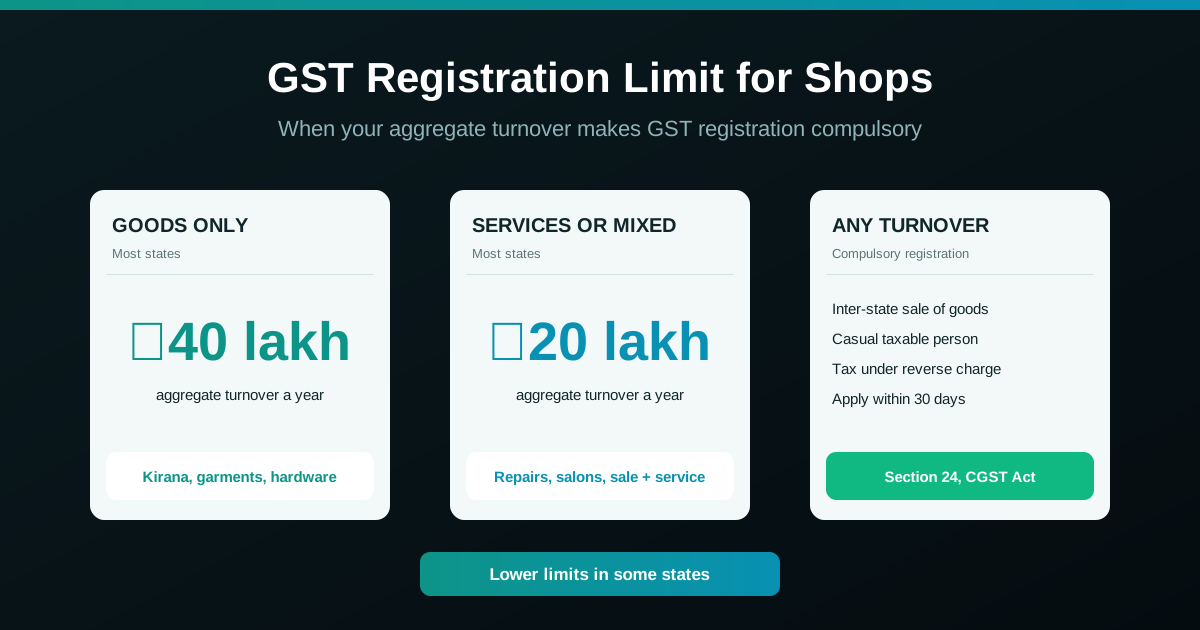
A shop selling only goods must register for GST once its aggregate turnover crosses ₹40 lakh in a financial year in most states, or ₹20 lakh if it also supplies services. Telangana and Puducherry keep ₹20 lakh for goods, and Manipur, Mizoram, Nagaland and Tripura use ₹10 lakh. Inter-state sellers of goods must register whatever their turnover. Apply within 30 days of becoming liable.
GST registration limits at a glance
| Business type | Most states | Telangana, Puducherry | Manipur, Mizoram, Nagaland, Tripura |
|---|---|---|---|
| Goods only | ₹40 lakh | ₹20 lakh | ₹10 lakh |
| Services only | ₹20 lakh | ₹20 lakh | ₹10 lakh |
| Goods and services together | ₹20 lakh | ₹20 lakh | ₹10 lakh |
Limits are per financial year, based on aggregate turnover. The ₹40 lakh goods limit comes from Notification 10/2019-Central Tax and applies only if you supply goods alone; ice cream, pan masala and tobacco sellers do not get it. State limits can change, so confirm yours with a CA.
What counts in aggregate turnover
The limit is checked against aggregate turnover, not only your taxable sales. It includes:
- Taxable sales of goods and services.
- Exempt sales, such as fresh fruit and vegetables or loose unbranded grains.
- Exports and inter-state sales.
- Sales from every branch and godown on the same PAN, across all states.
It excludes the GST amount itself and purchases on which you pay tax under reverse charge. The last point catches many owners: a grocery store with ₹28 lakh of packaged goods and ₹14 lakh of fresh vegetables has an aggregate turnover of ₹42 lakh, which is above the ₹40 lakh limit even though its taxable sales are lower. For more on which sales are taxable, see bill of supply vs tax invoice.
When registration is compulsory at any turnover
Section 24 of the CGST Act requires registration regardless of turnover in several cases. The ones that matter most to shops are:
- Inter-state taxable sale of goods. Selling and shipping goods to a customer in another state. See intra-state vs inter-state GST.
- Casual taxable person. Setting up a temporary stall at an exhibition or festival fair in a state where you have no fixed place of business.
- Tax payable under reverse charge. When the law makes you, the buyer, liable to pay the GST.
- Selling through e-commerce operators. There are relaxations for small sellers, with conditions. Check with your CA before listing on a marketplace.
The reverse also holds: a business supplying only wholly exempt goods or services does not need to register at all.
A worked example: two shops in Hyderabad and Indore
- A footwear shop in Indore, Madhya Pradesh sells only goods, so the ₹40 lakh limit applies. In the current financial year, its cumulative sales cross ₹40 lakh on 12 January. The owner must apply for registration within 30 days, by 11 February. If the application is made in time, registration takes effect from 12 January, the date the shop became liable.
- A mobile shop in Hyderabad, Telangana sells handsets and also does repairs. Because it supplies services as well as goods, and because Telangana kept ₹20 lakh for goods anyway, its limit is ₹20 lakh. With ₹16 lakh of phone sales and ₹5 lakh of repair income, its aggregate turnover of ₹21 lakh is already over the limit. See GST on mobile repair services.
The shops and figures are illustrative; your CA should confirm the date you became liable and the effective date of registration.
How to register once you cross the limit
- Keep PAN, Aadhaar, proof of business address (rent agreement or electricity bill), bank details and a photo ready.
- File form GST REG-01 on the GST portal and complete Aadhaar authentication. There is no government fee.
- Answer any query from the officer. Once approved, you get a GSTIN and a registration certificate (REG-06).
- Start issuing tax invoices with your GSTIN and file returns. Read GSTR-1 vs GSTR-3B for the monthly routine.
If turnover stays under ₹1.5 crore, you can consider the composition scheme instead of regular GST. For other licences a new shop needs, see retail shop licences and registrations.
Should you register voluntarily?
You can register before crossing the limit. It lets you claim input tax credit on purchases and sell to businesses that want GST invoices. The trade-off is monthly or quarterly returns and charging GST to walk-in customers. A shop selling mostly to consumers with thin input costs may prefer to wait; one supplying other businesses often registers early.
How RichPOS helps you track the limit
- Know your turnover any day. Sales reports read straight from your bills, and every report exports to Excel, CSV or PDF for your CA. See GST & reports.
- Count every branch together. Consolidated reports across stores and warehouses show the PAN-level total that the limit is checked against. See Multi-store & warehouse.
- Be ready on day one of registration. GST-ready sales and purchase reports by HSN/SAC and fast barcode billing on thermal or A4. See Billing & POS.
RichPOS costs ₹199/month (₹2,000/year) with a 30-day free trial. See pricing.
Frequently asked questions
- What is the GST registration limit for a shop in India?
- For a shop that sells only goods, registration becomes compulsory once aggregate turnover crosses ₹40 lakh in a financial year in most states. If the business also supplies services, the limit is ₹20 lakh. Some states have lower limits: ₹20 lakh for goods in Telangana and Puducherry, and ₹10 lakh in Manipur, Mizoram, Nagaland and Tripura. Confirm your state's limit with your CA.
- Do exempt sales count towards the GST registration limit?
- Yes. Aggregate turnover includes taxable sales, exempt sales such as fresh vegetables or loose unbranded grains, exports and inter-state sales. It excludes the GST itself and purchases on which you pay tax under reverse charge. It is also calculated on your PAN across India, so all branches count together.
- Do I need GST registration if I sell only exempt goods?
- No. A person supplying only goods or services that are wholly exempt from GST is not required to register, even if turnover is above the limit. A shop selling both exempt and taxable items must count both towards the limit.
- How soon must I apply after crossing the limit?
- Apply within 30 days of the date you become liable to register, using form GST REG-01 on the GST portal. There is no government fee. Failing to register when liable can attract a penalty of ₹10,000 or the tax evaded, whichever is higher, besides the unpaid tax with interest.
- Is inter-state selling allowed without GST registration?
- A shop making inter-state taxable supplies of goods must register regardless of turnover. Service providers making inter-state supplies below the ₹20 lakh limit are exempt from this. Sales through e-commerce platforms have separate rules, so check with your CA before listing on a marketplace.
Bottom line: Most goods-only shops must register once aggregate turnover crosses ₹40 lakh, and service or mixed businesses at ₹20 lakh, with lower limits in some states. Count exempt sales and every branch, and apply within 30 days of crossing. For a demo of RichPOS, call +91 90333 31255 or start the 30-day free trial from the pricing page.
This guide is general information based on the CGST Act and notifications as of September 2026, not tax advice. Limits and rules change; confirm your position with a qualified CA.