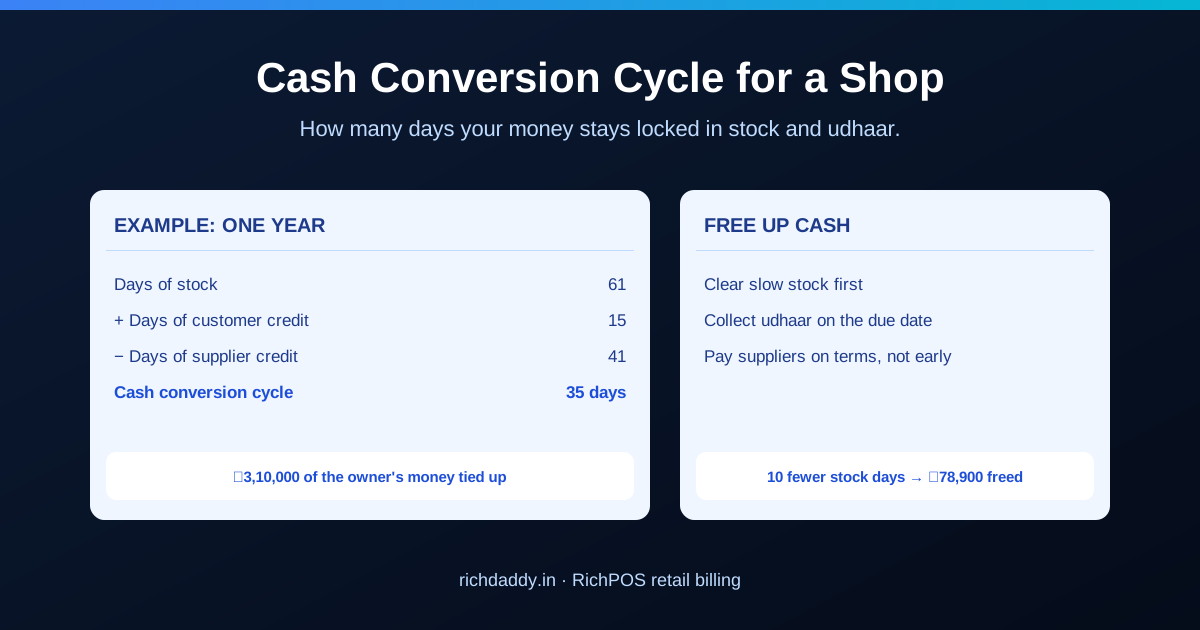
Short answer: Cash conversion cycle = days of stock + days of customer credit − days of supplier credit. If your stock sits for 61 days, customers on udhaar take 15 days to pay, and suppliers give you 41 days, your cycle is 35 days. That is how long each rupee spent on goods stays locked before it comes back as cash.
This guide is for kirana, general, pharmacy, garment, footwear, mobile, electronics, hardware and other retail shops in India that feel short of cash even when sales look good.
Why a profitable shop can still run short of cash
Profit shows up in your books when you make a sale. Cash shows up only when the customer pays, and you paid for that stock weeks earlier. A shop that keeps adding stock and giving more credit can show a profit every month and still struggle to pay rent and suppliers. The cash conversion cycle tells you how big that gap is in days, and the three parts tell you where to fix it.
The three parts and their formulas
| Part | Formula | What it shows |
|---|---|---|
| Days of stock | Average stock at cost ÷ yearly cost of goods sold × 365 | How long goods sit before they are sold |
| Days of customer credit | Average udhaar outstanding ÷ yearly sales × 365 | How long customers take to pay |
| Days of supplier credit | Average supplier dues ÷ yearly cost of goods sold × 365 | How long you take to pay suppliers |
Use figures without GST. Average stock can be the opening and closing stock added and halved, or better, the average of the 12 month-end figures. Days of stock is the same idea as inventory turnover, just expressed in days.
Worked example: a general store for one year
| Item (without GST) | Figure | Working | Days |
|---|---|---|---|
| Yearly sales | ₹36,00,000 | ||
| Yearly cost of goods sold | ₹28,80,000 | ||
| Average stock at cost | ₹4,80,000 | 4,80,000 ÷ 28,80,000 × 365 | 61 |
| Average udhaar outstanding | ₹1,50,000 | 1,50,000 ÷ 36,00,000 × 365 | 15 |
| Average supplier dues | ₹3,20,000 | 3,20,000 ÷ 28,80,000 × 365 | 41 |
| Cash conversion cycle | 61 + 15 − 41 | 35 |
In rupees, the owner's money tied up in trading is stock + udhaar − supplier dues = ₹4,80,000 + ₹1,50,000 − ₹3,20,000 = ₹3,10,000. That money is either the owner's capital or a bank limit that charges interest.
How much cash each improvement frees
| Change | Working | Cash freed |
|---|---|---|
| Stock sits 10 days less | ₹28,80,000 ÷ 365 × 10 | about ₹78,900 |
| Customers pay 5 days sooner | ₹36,00,000 ÷ 365 × 5 | about ₹49,300 |
| Both together | about ₹1,28,200 |
Cutting the cycle from 35 to 20 days frees over ₹1.2 lakh without selling a single extra item. If that money was coming from a cash credit limit at 11% interest, it also saves about ₹14,000 a year in interest.
Ways to shorten the cycle
Hold less stock for the same sales
- Clear slow items before buying more. Our guide to reducing dead stock shows how to find them.
- Reorder fast movers in smaller, more frequent lots using low-stock alerts instead of buying a month's stock at once.
- Raise purchase orders against what actually sold last month, not a guess.
Collect udhaar faster
- Set a credit limit and a due date for each regular customer.
- Send a reminder the day a payment is due, not when it is a month late. See how to recover udhaar.
- Make paying easy with a UPI QR on the counter and on the bill.
Use supplier credit well
- Pay on the due date, not early, unless the supplier gives a cash discount worth taking.
- Keep a running supplier ledger so you know exactly what falls due each week.
- Do not stretch past the agreed terms. It costs you goodwill and better rates.
The GST and tax side
Keep GST out of every figure. The GST you collect from customers is due when you file GSTR-3B, so treat it as money already spent, not working capital. On the purchase side, you can claim input tax credit only on invoices that appear in your GSTR-2B, so a supplier who files late also delays your credit. Read GSTR-2B reconciliation to catch this early.
For income tax, Section 43B(h) allows a payment to a registered micro or small enterprise supplier as an expense only if it is made within 45 days, or 15 days where there is no written agreement. Check which of your suppliers this applies to with your CA before planning longer credit.
If your shop draws on a bank cash credit limit, the bank sets that limit from your stock and debtors. A shorter cycle means you need less of it. See stock statement for a bank CC limit.
Common mistakes
- Valuing stock at MRP instead of cost, which makes days of stock look far higher than it is.
- Including GST in sales or purchases.
- Looking at the cycle once a year instead of every month.
- Chasing more sales on credit when the real problem is slow stock.
Frequently asked questions
- What is the cash conversion cycle of a shop?
- It is the number of days between paying your supplier for goods and getting the cash back from customers who buy them. Cash conversion cycle = days of stock + days of customer credit − days of supplier credit. The shorter it is, the less of your own money is locked up in the business.
- How do I calculate days of stock?
- Days of stock = average stock at cost ÷ yearly cost of goods sold × 365. With ₹4,80,000 of average stock and ₹28,80,000 of yearly cost of goods sold, days of stock = 61.
- Should I include GST in the calculation?
- No. Use sales, purchases and stock without GST. The GST you collect on bills is owed to the government in your next return, so it is not your working capital, even though it sits in your bank account for a few weeks.
- What is a good cash conversion cycle for a retail shop?
- There is no single figure. A kirana or pharmacy with fast-moving stock and short supplier credit may run at 10 to 30 days. A garment, footwear or hardware shop with slow seasonal stock often runs at 60 days or more. Compare your own figure month by month and work to bring it down.
- Can the cash conversion cycle be negative?
- Yes. If suppliers give you more days of credit than the days your stock sits plus the days customers take to pay, the cycle is negative. Supplier money then funds your stock. This is rare for small shops but common for fast-moving supermarkets.
- Is it safe to delay supplier payments to improve cash flow?
- Only within the agreed credit period. Paying late damages supplier trust and terms. Also, if a supplier is a registered micro or small enterprise, Section 43B(h) of the Income Tax Act allows the expense only when you pay within 45 days (15 days without a written agreement). Confirm with your CA.
Bottom line: Cash conversion cycle = days of stock + days of customer credit − days of supplier credit, all without GST. Work it out every month, then cut slow stock and late udhaar first. RichPOS keeps stock, customer credit and supplier ledgers in one place, so the three numbers are always ready. Also check your break-even point, call +91 90333 31255, or start the 30-day free trial from the pricing page.