A garment trader in Surat sends 400 metres of grey fabric to a dyeing unit down the road. A kirana owner in Jaipur shifts 30 cartons of oil from the godown to the shop. A jeweller in Thrissur sends a few pieces to a regular customer's home on approval. None of these is a sale, yet in every case goods are leaving your premises, and GST law expects a document to travel with them. That document is the delivery challan.
Quick answer
A delivery challan is used when goods move without being sold at that moment: job work, transfers between your own locations under the same GSTIN, goods on approval, and a few other cases under Rule 55 of the CGST Rules. It is made in three copies, carries a serial number, the consigner and consignee details, HSN, quantity and value, and needs no GST if the movement is not a supply. If the movement is a sale, you need a tax invoice instead.
Delivery challan vs tax invoice
| Point | Delivery challan | Tax invoice |
|---|---|---|
| Used for | Movement without a sale at that time | A sale (supply) of goods |
| Ownership | Usually stays with you | Passes to the buyer |
| GST charged | No, when the movement is not a supply | Yes |
| Buyer can claim input tax credit on it | No | Yes, if the buyer is registered |
| Copies | Three: consignee, transporter, you | Original and copies as per the invoice rules |
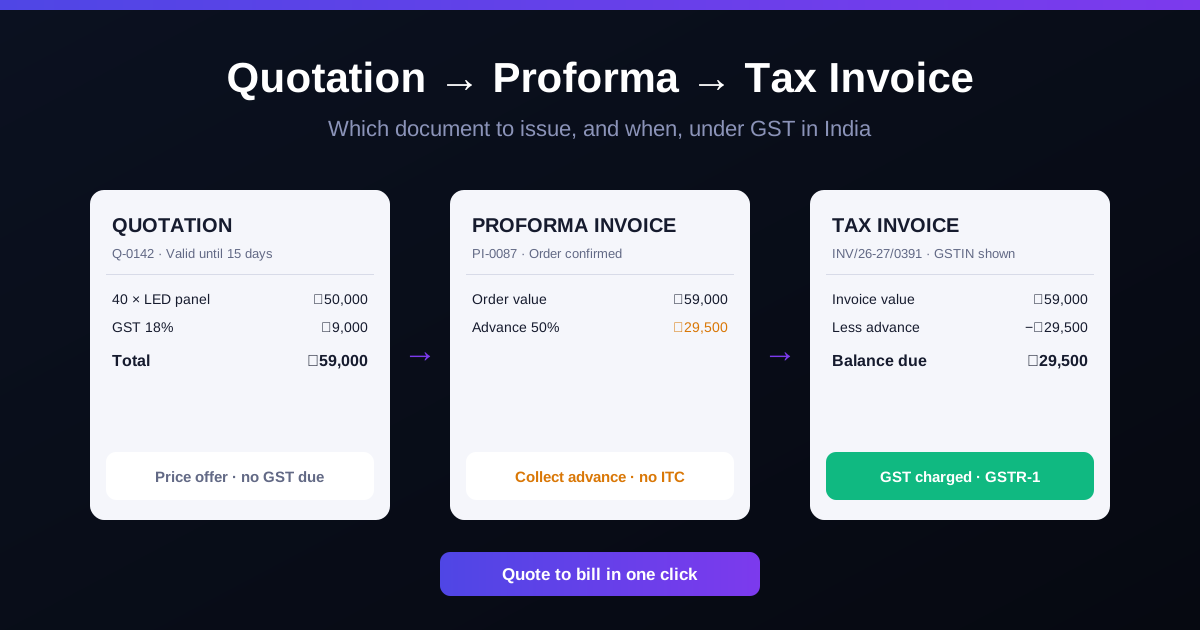
For more on invoice rules, see the GST invoice format for retail shops and quotation vs proforma invoice vs tax invoice.
When to issue a delivery challan
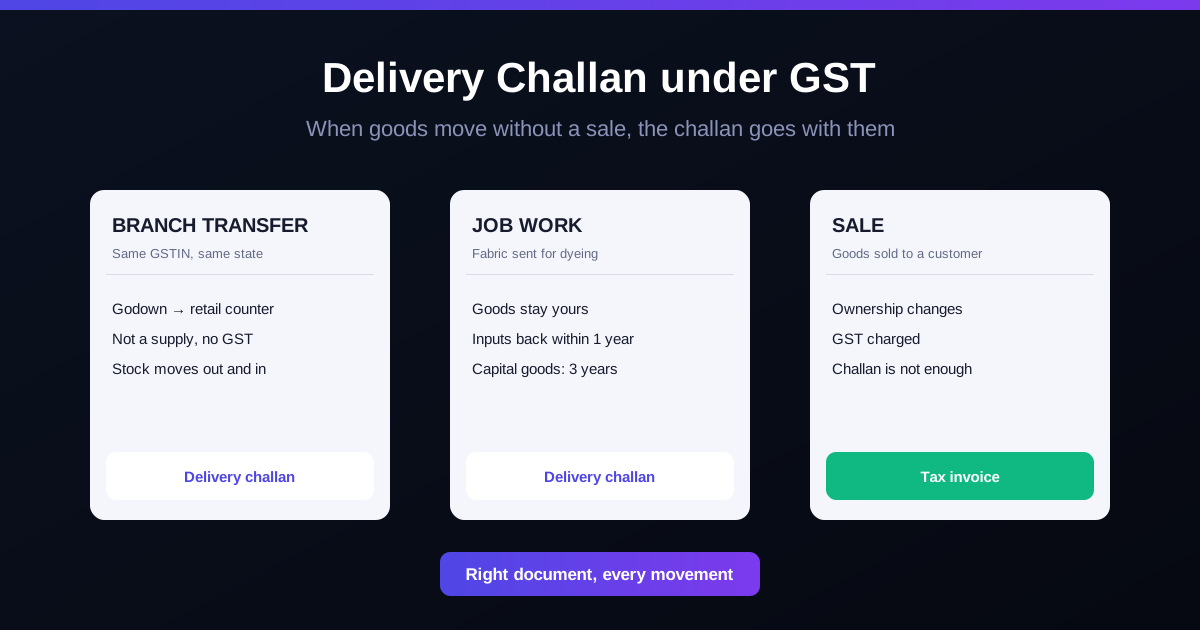
- Job work: fabric sent for dyeing, gold sent for polishing, parts sent for assembly. Inputs must come back within 1 year and capital goods within 3 years, or the movement is treated as a supply from the date it left.
- Transfer between your own locations under the same GSTIN: godown to shop, or one shop to another in the same state. This is not a supply, so no GST. See managing multiple retail stores.
- Goods sent on approval: the customer may keep or return them. The tax invoice is issued when the sale happens, or within six months of removal if nothing has come back by then.
- Goods moved in batches: a large item sent in parts (completely or semi knocked down). You issue the full invoice before the first batch and a challan with each batch.
- Liquid gas where the quantity is not known at dispatch, and other cases the government notifies.
Not a challan case: a transfer between branches in different states. Each state registration is a separate GSTIN, and GST treats them as distinct persons, so the transfer is a taxable supply that needs a tax invoice and IGST. See intra-state vs inter-state GST.
What a delivery challan must show
- Date and a serial number of up to 16 characters, unique for the financial year
- Name, address and GSTIN of the consigner (you)
- Name, address and GSTIN (if registered) of the consignee
- HSN code and description of the goods; see how to find HSN codes
- Quantity (provisional, where the exact quantity is not known)
- Taxable value
- Tax rate and tax amount, where the goods are being moved for supply to the consignee
- Place of supply, for inter-state movement
- Signature of the supplier or an authorised person
E-way bill with a delivery challan
An e-way bill follows the goods, not the sale. If the value of the goods on the challan is above the e-way bill limit, which is ₹50,000 in most cases, you generally need one even though no GST is charged, and the challan details go in the e-way bill. Inter-state movement to a job worker needs one whatever the value. Some states use a different limit for movement within the state. Details are in the e-way bill guide.
A worked example: a textile trader in Surat
A textile trader in Surat sends 400 metres of grey fabric, valued at ₹1,20,000, to a dyeing unit in the same city on 3 September.
| Step | What happens |
|---|---|
| Document | Delivery challan no. DC/26-27/0042 in three copies, showing HSN, 400 metres and ₹1,20,000 |
| GST | None; job work is not a sale |
| E-way bill | Generated, because the value is above ₹50,000; the trader checks Gujarat's current intra-state rule |
| Return | Dyed fabric comes back on 20 September with the job worker's own challan or invoice for the dyeing charges |
| Stock | 400 metres out on 3 September, 396 metres back on 20 September; the 4-metre process loss is recorded |
The fabric never stopped belonging to the trader, so no GST was due on the movement itself. The job worker charges GST on the dyeing service. The trader, figures and dates are illustrative.
Common mistakes to avoid
- Using a challan for a sale: if the goods are sold, a challan does not replace the tax invoice.
- Forgetting the return deadline: job work inputs not back within a year become a deemed supply, with GST and interest due.
- No stock entry for the movement: goods out on challan still belong to you. If your system shows them as sold or missing, your stock and stock audit will not match.
- Treating inter-state branches like one shop: a different GSTIN means a tax invoice, not a challan.
- Skipping the e-way bill: "it was not a sale" is not a defence if the goods are stopped in transit without one.
How RichPOS helps
- Warehouse-to-warehouse stock transfers: record stock leaving one location and arriving at another, so both locations stay accurate without a manual adjustment. See Purchases & Suppliers.
- Many stores and warehouses in one account: see stock per location and in total. See Multi-store & Warehouse.
- GST reports by HSN/SAC: when goods are actually sold, sales and purchase GST reports are organised by HSN/SAC for filing. See GST reports.
RichPOS costs ₹199/month with a 30-day free trial. See pricing.
Frequently asked questions
- What is a delivery challan in GST?
- A delivery challan is the document that goes with goods when they are moved for a reason other than a sale, or when the tax invoice cannot be issued at the time of removal. Examples are sending goods to a job worker, moving stock between your own godown and shop under the same GSTIN, and sending goods on approval. It is covered by Rule 55 of the CGST Rules.
- Is GST charged on a delivery challan?
- No GST is payable when the movement is not a supply, such as a transfer between two locations under the same GSTIN or goods sent for job work that come back within the time limit. The challan still shows the value of the goods. If the movement is actually a sale, you need a tax invoice and GST is charged on it.
- How many copies of a delivery challan are needed?
- Three. The original goes to the consignee, the duplicate goes to the transporter, and the triplicate stays with the consigner, that is, you.
- Is an e-way bill required with a delivery challan?
- Often, yes. An e-way bill is based on the movement of goods, not only on sales, so a challan movement above the value limit (₹50,000 in most cases) generally needs one, with the challan details entered in it. Inter-state movement of goods to a job worker needs an e-way bill whatever the value. Some states set a different limit for intra-state movement, so check the current rule for your state.
Bottom line: use a delivery challan when goods move without a sale, such as job work, same-GSTIN transfers and goods on approval, and a tax invoice when they are sold or go to a branch with a different GSTIN. Want your stock transfers between locations recorded in one place? Call +91 90333 31255 for a demo, or start the 30-day free trial from the pricing page.
This is general guidance on GST documentation, not legal or tax advice. Rules, limits and state thresholds change; confirm your case with your CA.