Chopda Pujan 2026: New Books at Diwali, Same GST Bill Series
Chopda Pujan is on 8 Nov 2026, Labh Pancham on 14 Nov. Start a new chopda, but keep GST invoice numbers running: Rule 46 needs them unique till 31 March.
Updated 26 October 2026 · By Ashok Sachdev · Sources: CGST Rule 46(b), sections 35 and 36 of the CGST Act, Drik Panchang for festival dates. Not tax advice; confirm with your CA.
Quick answer
Chopda Pujan 2026 falls on Sunday, 8 November 2026, the main day of Diwali, and Labh Pancham, when many Gujarati traders reopen with new books, is on Saturday, 14 November 2026. You can start a new chopda for the Vikram Samvat year, but your GST and income tax year still runs from 1 April to 31 March. Do not restart your GST invoice numbers at Diwali: Rule 46(b) needs a serial number that stays unique for the whole financial year.
Hinglish mein: Diwali pe naya chopda zaroor shuru karo, par GST ka saal April se March hi rehta hai. Bill number Diwali pe 1 se dobara mat shuru karo; purani series 31 March tak chalne do, aur udhaar, stock aur supplier ka hisaab Diwali se pehle milaa lo.
For generations, traders in Gujarat, Rajasthan, Maharashtra and many Marwari and Jain business families have closed the old year's books at Diwali and started a fresh chopda (bahi khata) with Lakshmi and Ganesh puja. The tradition is alive even in shops that now bill on a computer or phone. What has changed is the law around the books: GST and income tax follow the April to March financial year, and a few Diwali habits can clash with that. This guide covers the dates, what to settle before the puja, and what to leave alone.
Diwali 2026 dates for traders
Day
Date
What traders usually do
Diwali, Lakshmi Puja, Chopda Pujan, Sharda Puja
Sunday, 8 November 2026
Puja of the new account books in the evening muhurat
Gujarati New Year (Bestu Varas)
9 or 10 November 2026, depending on the calendar you follow
New Vikram Samvat year; greetings to customers and suppliers
Labh Pancham (Labh Panchami)
Saturday, 14 November 2026
Shops reopen; first entries in the new chopda
Muhurat times change from city to city. Check your local panchang or Drik Panchang's Chopda Puja page with your city selected before you fix the time.
Samvat year vs the financial year
The chopda follows the Vikram Samvat year, from Diwali to Diwali. The law does not. GST returns, the annual return and income tax all use the financial year from 1 April to 31 March; under the Income-tax Act, 2025 it is called the tax year. So a shop effectively runs two calendars:
Item
Follows Diwali (Samvat) year?
Follows April to March?
New chopda, puja, first entry
Yes, by tradition
No
GST invoice number series
No
Yes: unique for the financial year (Rule 46(b))
GSTR-1, GSTR-3B, annual return
No
Yes
Income tax return and closing stock for tax
No
Yes: stock as on 31 March
Customer and supplier balances
Carried forward into the new chopda
Carried forward on 1 April too
Keeping a Diwali-to-Diwali view for the family's own review is fine. Just make sure the figures your CA files come from the April to March books.
Do not reset your bill numbers at Diwali
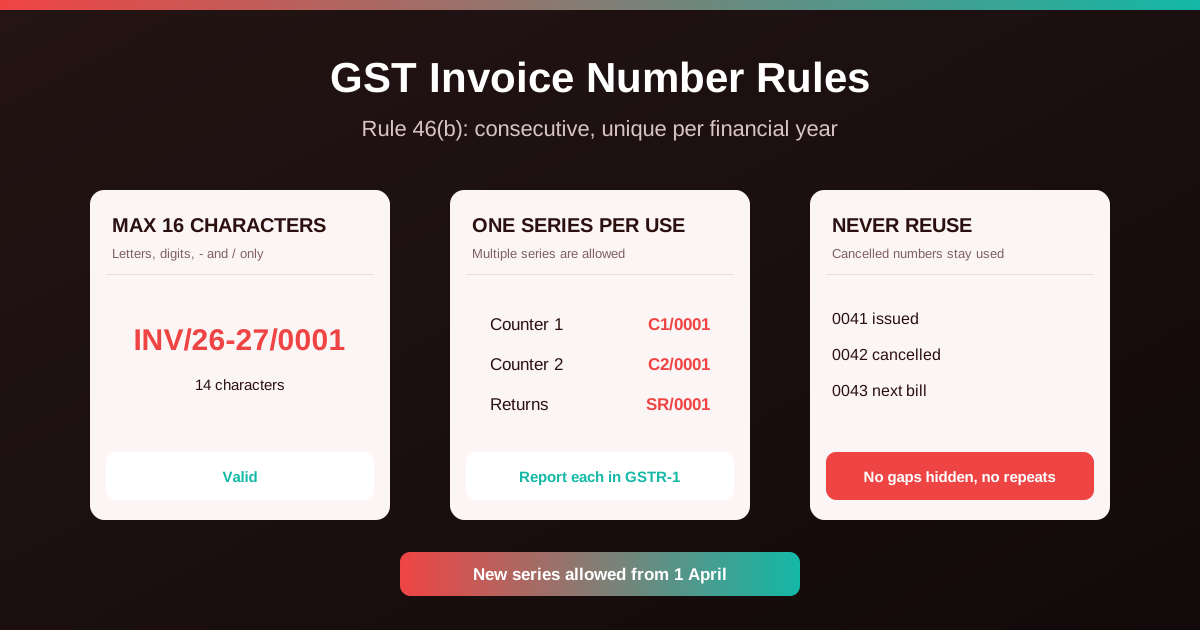
This is the most common mistake. Rule 46(b) of the CGST Rules says a tax invoice must carry a consecutive serial number, up to 16 characters, that is unique for a financial year. If you restart from 1 on Labh Pancham, you will issue a second invoice number 1, number 2 and so on in the same financial year, and those duplicates show up in your GSTR-1 and in your buyers' credit claims.
Simplest: keep the current series running until 31 March and start the new series on 1 April.
If you want a fresh series at Diwali: it must still be unique in the financial year, for example a new prefix like "SV83/" next to your old one. Report every series you used in the documents-issued table of GSTR-1. Ask your CA before switching.
Many families try to clear dues before Diwali. Send each credit customer their exact balance a week or two before the festival, collect what you can and carry the rest forward with the date of each old bill. Do not write a balance off just because the book is changing; if you decide not to collect, record it properly so the accounts match. See how to recover udhaar politely.
2. Supplier balances
Match your supplier ledger with each supplier's statement before Diwali. Differences are much easier to sort out now than at year-end. More: supplier payments ledger.
3. Stock count
Diwali is a good time for a mid-year physical count: the festival rush has emptied some shelves and you are about to restock for the wedding season. Count high-value items fully and fast movers by category. For tax, the closing stock that matters is still 31 March. See how to run a stock count and closing stock valuation.
4. Cash and bank
Close the cash drawer on the last working day before the puja, deposit surplus cash, and match the bank statement with your books. Festival weeks bring more UPI and card payments than usual, so match them by date.
Books to keep, old and new
Under section 35 of the CGST Act and Rule 56, a registered shop keeps accounts of sales, purchases, stock, input credit and tax paid at its place of business, either on paper or electronically. Section 36 says these records must be kept for 72 months from the due date of the annual return for that year. So the old chopda and the old software data both stay; a new book does not end the duty to keep the last one. Your billing records, purchase bills and stock register together are the books a GST officer or your CA will ask for. See GSTR-9 annual return for shops for what the year-end needs.
Chopda Pujan with digital billing
Plenty of shops keep the ritual and move the accounting to software. Families do it in different ways: a new red chopda with only the puja entries and the first sale of the year written by hand, the opening balances printed from the software and placed in the book, or the shop laptop or billing phone placed with the books for the puja. Do what your family tradition says. The point is that the real books stay complete and in one place.
In RichPOS, invoice numbers run automatically in one series (with a separate prefix for each store if you have more than one), so the numbering stays unique without anyone remembering the last number. You can pull sales and profit and loss reports for any date range, so a Diwali-to-Diwali view for the family and an April to March view for the CA come from the same data. Udhaar balances carry forward on each customer's ledger with WhatsApp reminders you send from their record, and a barcode stock audit shows short and excess stock at purchase value. RichPOS has a free 30-day trial, then ₹99/month for the first 3 months and ₹199/month after, or ₹2,000/year. See RichPOS GST billing software, stock audit and udhaar reminders on WhatsApp.
Fix the puja muhurat for your city from a panchang.
Send balance messages to every credit customer; record what is collected.
Match supplier ledgers with their statements.
Count stock, at least high-value items and fast movers.
Close cash, deposit surplus, match bank and UPI receipts.
Keep the GST invoice series running; decide with your CA before any new series.
Store the old chopda and export the year's reports; keep both for at least 72 months from the annual return due date.
FAQ
Frequently asked questions
When is Chopda Pujan in 2026?
Chopda Pujan is on Sunday, 8 November 2026, the main day of Diwali, together with Lakshmi Puja and Sharda Puja. Labh Pancham, when many traders reopen and make the first entries, is on Saturday, 14 November 2026. Check a local panchang for the muhurat in your city.
Should I start a new GST invoice series at Diwali?
You do not need to, and restarting from 1 is wrong. CGST Rule 46(b) needs invoice numbers that are unique for the financial year, which runs from April to March. Most shops keep the current series until 31 March. A new series with a different prefix is possible if every number stays unique in the year and all series are reported in GSTR-1.
Is the Diwali new year the financial year for GST?
No. GST returns, the GST annual return and income tax all follow the financial year from 1 April to 31 March. The Vikram Samvat year that starts at Diwali is a traditional business year only.
Can I do Chopda Pujan if I use billing software?
Yes. Many shops keep a new chopda for the puja and the first entry of the year while the full accounts stay in the software. Some families also place the shop's laptop or billing phone with the books during the puja.
How long must I keep old account books?
Under section 36 of the CGST Act, accounts and records must be kept for 72 months from the due date of the annual return for the year they relate to. Keep the old chopda, purchase bills and software data for at least that long.
Should I write off old udhaar at Diwali?
Only if you have really decided not to collect it, and then record the write-off properly so the accounts match. Otherwise carry the balance forward with the original bill dates and keep reminding the customer.
Founder, RichPOS Software, Ahmedabad. We build RichPOS for Indian shops and write these guides from what shop owners ask us every day. Facts on tax rates and prices are dated; confirm GST matters with your CA. Questions? WhatsApp us.
Make GST bills in seconds with RichPOS
Billing, stock, WhatsApp bills and GST reports in one app. Free 30-day trial with no card, then ₹99/month for 3 months and ₹199/month after.
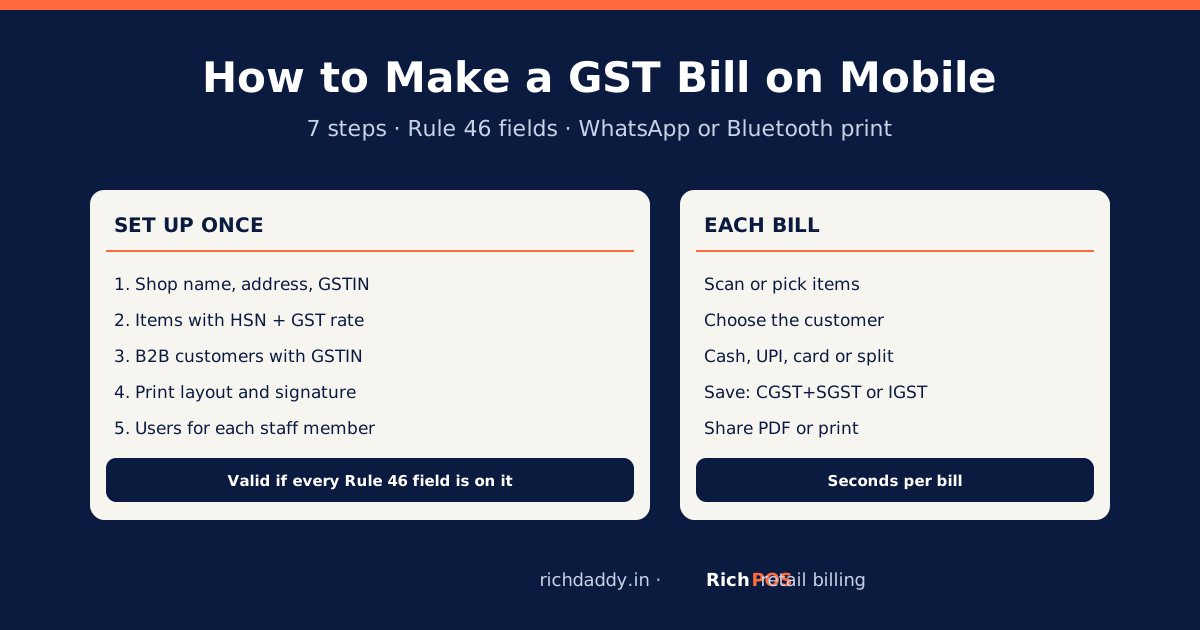
How to Make a GST Bill on Mobile: Step-by-StepMake a valid GST bill on your phone in 7 steps: shop GSTIN, items with HSN and rate, customer, payment, then WhatsApp or print. Rule 46 fields listed.