On this page · 8 sections
- Step 1: choose your focus and location
- Step 2: licences and registrations
- Step 3: GST on hardware items in 2026
- Step 4: suppliers, stock and the first purchase
- Step 5: contractor credit, quotations and big orders
- Step 6: billing that fits a hardware counter
- Opening checklist
- Frequently asked questions
Updated 26 October 2026 · By Ashok Sachdev · GST rates read from Notification No. 9/2025-Central Tax (Rate), in force from 22 September 2025; e-way bill limit from CGST Rule 138. Not legal or tax advice; confirm local licences and GST matters with your CA.
Quick answer
To start a hardware shop in India, pick a focus (general hardware, sanitary and plumbing, electrical, paint or building material), register under your state's Shops and Establishments Act, get a municipal trade licence, take GST registration (almost every hardware shop needs it because contractors and builders ask for GST bills), open 3 to 5 supplier accounts, and set up billing that keeps every finish and size apart and tracks contractor credit. Most hardware items carry 18% GST, including cement since 22 September 2025.
Hinglish mein: hardware dukaan kholni hai to pehle line chuno (sanitary, electrical, paint ya general), Shop Act aur trade licence lo, GST number lo kyunki contractor GST bill maangte hain, aur billing aisi rakho jisme har finish aur size alag dikhe aur contractor ka udhaar saaf rahe.
A hardware shop looks simple from the outside: shelves of taps, screws, pipes and paint. Inside, it is one of the hardest retail businesses to keep in order. One tap model comes in three finishes and two sizes, screws arrive by the box and leave ten at a time, and a large share of sales goes to plumbers and contractors who pay weeks later. This guide covers the steps in order, with the GST rules and the stock habits that decide whether the shop makes money.
Step 1: choose your focus and location
| Type of hardware shop | What sells | Watch out for |
|---|
| General hardware | Fasteners, locks, hinges, hand tools, adhesives | Thousands of small items; rate list discipline |
| Sanitary and plumbing | Taps, pipes, fittings, sanitaryware, tanks | Many finishes and sizes per model; breakage |
| Electrical | Wires, switches, MCBs, lights, fans | Brand price lists change often; ISI-marked goods only |
| Paint shop | Paint, putty, primer, brushes, tinting | Shade-wise stock; dealer schemes |
| Building material | Cement, steel, sand, aggregates, plywood | Heavy credit to builders; transport and e-way bills |
Most shops start with one focus and add a second line once they know their buyers. Location matters more than size: a shop near a growing residential area or a busy building-material market sees steady walk-ins from homeowners and daily visits from plumbers and electricians.
Step 2: licences and registrations
| Registration | Who needs it | Where |
|---|
| Shop and Establishment registration | Almost every shop with a physical address | State labour department portal |
| Trade licence | Almost always | Municipal corporation, municipality or panchayat |
| GST registration | Required above ₹40 lakh turnover for goods in most states (₹20 lakh or ₹10 lakh in some states), for any inter-state sale, and in practice for any shop selling to contractors | GST portal (no government fee) |
| Udyam (MSME) | Optional and free; helps with bank loans | Udyam portal |
| Fire NOC / storage permission | Only if you store paint thinners, solvents or other inflammable goods in bulk | Local fire department; ask your municipality |
Fees and forms differ by state and city. For the full list, see licences and registrations for a retail shop and the GST registration limit. Contractors and companies claim input tax credit on what they buy, so they prefer a shop that gives a proper tax invoice with their GSTIN. That is why many hardware shops register for GST from day one, even below the limit. If your buyers are mostly households, the composition scheme is an option, but a composition shop cannot charge GST or pass input credit to a contractor.
Step 3: GST on hardware items in 2026
| Item | HSN | GST |
|---|
| Cement (all types) | 2523 | 18% (was 28% before 22 Sep 2025) |
| Paint, enamel, distemper | 3208, 3209, 3210 | 18% |
| Plastic pipes and fittings; taps and valves | 3917; 8481 | 18% |
| Ceramic tiles and sanitaryware | 6907; 6910 | 18% |
| Screws, bolts, nails, locks | 7317, 7318, 8301 | 18% |
| Hand tools (pliers, spanners, hammers) | 8203 to 8205 | 18% |
| Manual farm tools (spade, hoe, sickle) | 8201 | Nil |
| Switches, MCBs, wires and cables | 8536; 8544 | 18% |
| Plywood | 4412 | 18% |
Source: CBIC GST rates, Notification 9/2025-Central Tax (Rate), Schedule II, and Notification 10/2025 for nil-rated items. Save the HSN code and rate on each item once, so the counter never guesses. More detail: GST on cement, hardware and building materials.
Step 4: suppliers, stock and the first purchase
- Suppliers: open accounts with 3 to 5 distributors or brand dealers. Agree credit days, rate-list updates and whether damaged or slow pieces can be returned, in writing.
- Quality marks: cement and many electrical goods fall under compulsory BIS certification. Buy ISI-marked stock from a GST-registered supplier and keep the invoice; it protects you if a product fails.
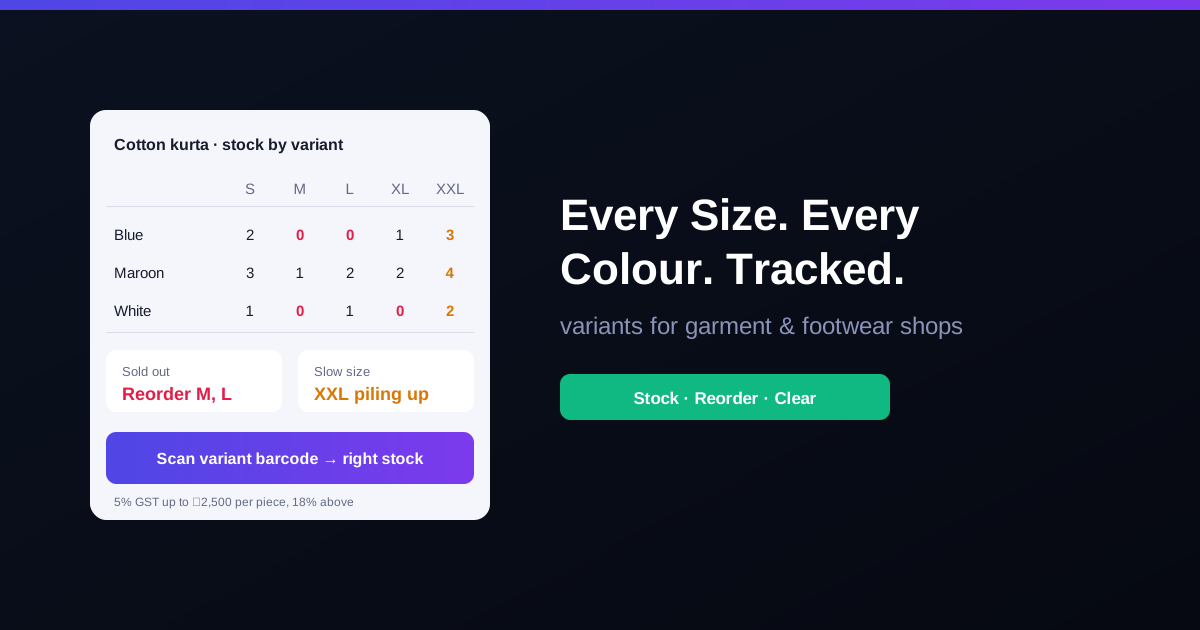
- Finish and size: treat every finish and size as its own stock line. "Pillar cock" is not one item; Chrome 15 mm and Matt Black 20 mm have different prices and run out at different times.
- Boxes and pieces: screws, wall plugs and fittings come in boxes of 50 or 100 and sell loose. Record both units, or stock is wrong the day the box is opened.
- Start narrow: buy the fast sizes of each model first, then add slow sizes once you see real demand. Slow stock locks up cash; see reducing dead stock.
Opening budget worksheet
The numbers below are an EXAMPLE format, not a quote. Fill in your own figures from your landlord and suppliers.
| Head | What to include | Your figure |
|---|
| Rent and deposit | Advance rent, security deposit, agreement cost | ₹ ____ |
| Racks and fit-out | Slotted racks, bins, counter, lighting, signboard | ₹ ____ |
| Opening stock | First purchase for your chosen focus | ₹ ____ |
| Counter setup | Computer or tablet, printer, barcode scanner, billing software | ₹ ____ |
| Working capital | Contractor credit you will carry, plus 2 to 3 months of expenses | ₹ ____ |
The last line is the one most new owners underestimate. If half your sales go to contractors on 30 to 60 days' credit, you need cash to buy the next stock before that money comes back.
Step 5: contractor credit, quotations and big orders
Plumbers, electricians and builders are the backbone of a hardware shop, and also its biggest risk. A few habits keep credit under control:
- Open a separate ledger for each contractor, and bill every pickup the same day, even when it is on credit.
- Set a credit limit per contractor and do not cross it without the owner's approval. See how to set a credit limit for customers.
- Give a written quotation for site orders and convert it to the bill when material is picked up, so the rates match what was promised.
- Put the contractor's GSTIN on the bill when he is registered, so his tax invoice is valid for input credit. See how to make a B2B GST invoice.
- For a consignment worth more than ₹50,000 moved by vehicle, an e-way bill is generally needed (some states set a higher limit for movement inside the state). See the e-way bill rules.
- Send a polite reminder before the due date, not months after it. Old dues are the hardest to collect.
Step 6: billing that fits a hardware counter
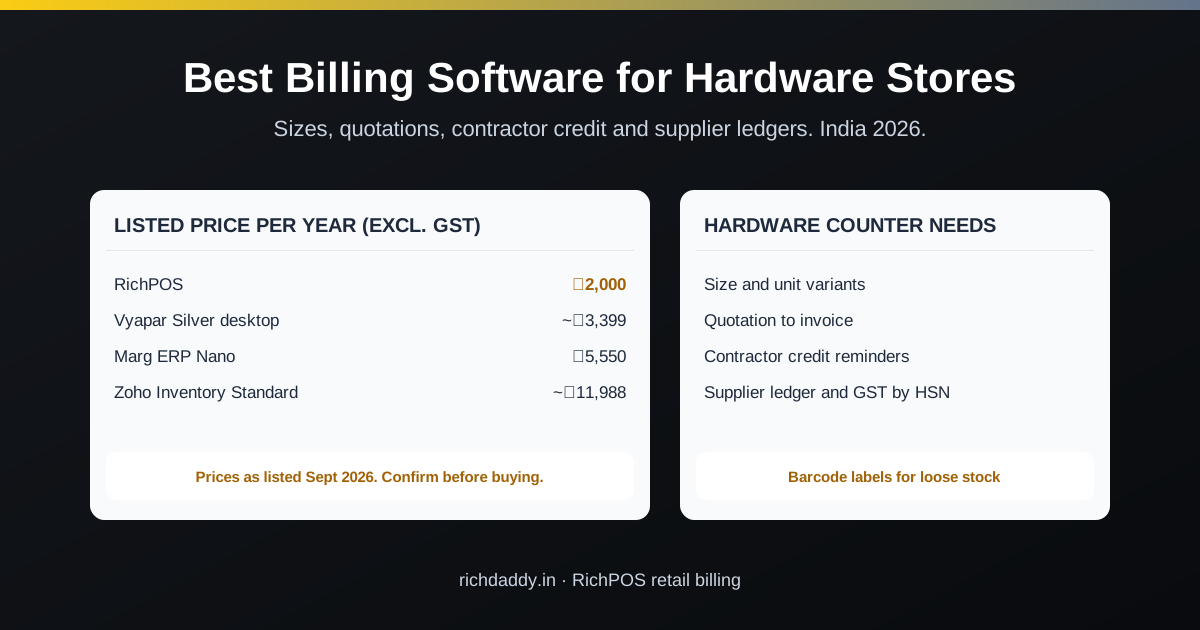
A hardware counter needs software that keeps each finish and size apart, sells loose from a box, prints HSN on GST bills and keeps contractor dues in one place. RichPOS does this: optional Finish and Size fields show on item search, the bill and barcode labels; labels can carry the item's photo so staff match the part in the bin; an item can have a box unit (for example 1 Box = 100 PCs) with its own price and barcode; and the unpaid part of a contractor's bill goes to his ledger with part payments, an optional credit limit and a WhatsApp reminder you send from his record. It runs in the browser, on Windows, Mac and Linux desktop apps and on Android, with a free 30-day trial, then ₹99/month for the first 3 months and ₹199/month after, or ₹2,000/year. It needs internet and does not make e-way bills, so plan those on the e-way bill portal. See RichPOS for hardware and sanitary shops, the free hardware shop bill format and how to choose hardware store billing software.
Opening checklist
- Shop and Establishment registration, trade licence, GST registration and a current account.
- Supplier accounts with written credit days and return terms.
- Item list in Excel: name, brand, finish, size, unit, HSN, GST rate, purchase price, MRP, sale price.
- Rack and bin labels with name, size and price; barcode labels on boxed items. A free barcode label generator works for a start.
- A contractor list with credit limits and phone numbers.
- Daily cash and UPI tally, a weekly reorder list and a monthly count of high-value items.
FAQ
Frequently asked questions
What licences are needed to open a hardware shop in India?
Usually a Shop and Establishment registration from the state labour department and a trade licence from the municipal body. GST registration is required above ₹40 lakh turnover for goods in most states and for any inter-state sale, and most hardware shops take it early because contractors ask for GST bills. Bulk storage of paint thinners or other inflammables may need a fire department permission.
What is the GST rate on hardware items?
Most hardware items are taxed at 18%: cement, paint, pipes, taps, tiles, sanitaryware, screws, locks, hand tools, switches and wires. Cement moved from 28% to 18% on 22 September 2025 (Notification 9/2025-Central Tax (Rate)). Manual farm tools such as spades and sickles are nil-rated.
Is a hardware shop a profitable business?
It can be, because hardware is a repeat need for homes, plumbers, electricians and builders. Profit depends on buying the right sizes, controlling contractor credit and avoiding dead stock in slow finishes. Track profit item-wise from the first month rather than judging by daily cash.
Do I need an e-way bill for hardware deliveries?
For goods worth more than ₹50,000 in one consignment moved by vehicle, an e-way bill is generally required under CGST Rule 138. Some states set a higher limit for movement within the state. Check your state's rule before large site deliveries.
How do I manage thousands of small hardware items?
Give each finish and size its own stock line, record box and piece units, label every bin, and use billing software with barcode or name search. Import the item list from Excel once instead of typing it at the counter.
Can I sell to contractors on credit?
Yes, most hardware shops do. Keep a ledger per contractor, bill every pickup the same day, set a credit limit and send reminders before the due date. Put the contractor's GSTIN on the bill when he is registered so he can claim input credit.
ASWritten by Ashok SachdevFounder, RichPOS Software, Ahmedabad. We build RichPOS for Indian shops and write these guides from what shop owners ask us every day. Facts on tax rates and prices are dated; confirm GST matters with your CA. Questions? WhatsApp us.
Make GST bills in seconds with RichPOS
Billing, stock, WhatsApp bills and GST reports in one app. Free 30-day trial with no card, then ₹99/month for 3 months and ₹199/month after.