GST on Advance Payment from Customers: Goods vs Services
Customer paid an advance? For goods, a regular GST shop pays GST only at the invoice (Notification 66/2017). For services, GST is due on receipt with a receipt voucher. Examples, refunds and composition shops.
If a customer pays you an advance for goods, such as a booking amount for furniture, a fridge or a wedding order of sarees, a regular GST-registered shop does not pay GST on that advance. GST is due when you issue the tax invoice (Notification 66/2017-Central Tax). If the advance is for a service, such as a repair, stitching, printing or installation, GST is due when you receive the advance: issue a receipt voucher and pay the tax in that month's GSTR-3B. Composition shops are not covered by the 2017 relief, so they should check with their CA.
Shops take advances all the time: a token for a bed that will be delivered next week, half the amount for a printing job, a deposit for a phone repair, a booking for a festival order. The money comes in before the bill, so the question is when GST is due. The answer depends on one thing: is the advance for goods or for a service?
Advance for goods: no GST until the invoice
Under Section 12 of the CGST Act, the time of supply for goods would normally be the earlier of the invoice date or the date you receive payment. Notification 66/2017-Central Tax, dated 15 November 2017, changed this for every registered person who has not opted for composition: for goods, GST is paid at the invoice stage (Section 12(2)(a)), and advances are not taxed on receipt.
In practice, for a regular shop selling goods:
Record the advance against the customer as a liability (money you owe in goods), not as a sale.
Give the customer a plain advance receipt with the amount, date and mode of payment. Do not show GST on it.
When you deliver, issue the full tax invoice for the whole value, charge GST on the full value, and adjust the advance against the bill.
Report the sale in GSTR-1 and GSTR-3B of the month of the invoice, as usual.
Example: a customer books a sofa for ₹40,000 (GST included at 18%) and pays ₹10,000 on 5 November. Delivery is on 2 December. No GST on the ₹10,000 in November. On 2 December you issue a tax invoice for ₹40,000 (taxable value ₹33,898, GST ₹6,102), adjust the ₹10,000 already received, and collect ₹30,000.
For services, Section 13 still makes the time of supply the earlier of the invoice date or the date of payment, and the 2017 notification does not apply. So if a customer pays in advance for a service, GST is due on that advance in the month you receive it.
Issue a receipt voucher (Section 31(3)(d), Rule 50) with your name, address and GSTIN, a serial number, the date, the customer's details, a description, the amount of the advance, the tax rate and the tax amount.
If the rate is not known yet, charge 18%. If you cannot tell whether the supply will be inter-state or intra-state, treat it as inter-state (IGST). Both are set out in Rule 50.
Pay the tax on the advance in that month's GSTR-3B and show it in GSTR-1 (the advances table, 11A).
When you issue the final invoice, charge GST on the full value and adjust the tax already paid on the advance (the adjustment table, 11B, in GSTR-1). Your CA will usually handle the tables; you just need to give them the list of advances.
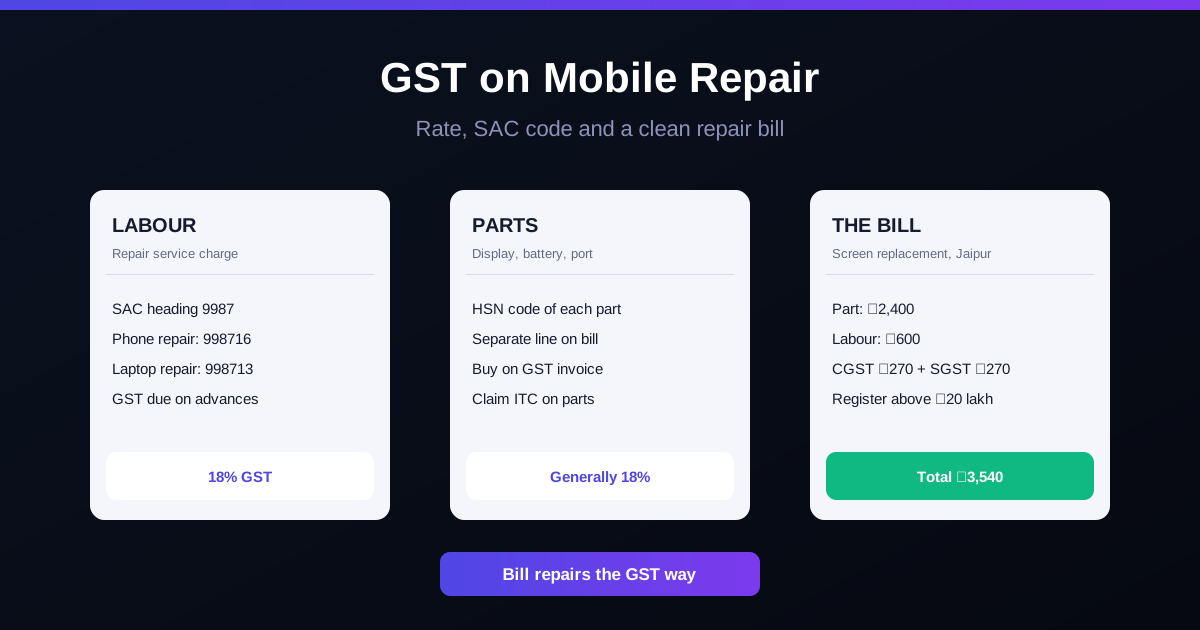
Example: a mobile repair shop takes ₹1,180 in advance for a screen replacement on 28 November and hands the phone back on 3 December. The receipt voucher shows ₹1,000 plus ₹180 GST at 18%. The ₹180 goes into November's GSTR-3B. The December tax invoice adjusts it.
Goods or service? Common shop cases
Advance for
Usually
GST on the advance?
Booking furniture, appliances, a phone or a bike accessory to be delivered later
Goods
No, GST at invoice (regular shop)
Wedding order of sarees, jewellery or sweets
Goods
No, GST at invoice (regular shop)
Mobile, laptop or appliance repair
Service (spares are usually part of the repair)
Yes, at receipt
Stitching, fall-pico or alteration on the customer's cloth
Service
Yes, at receipt
Printing on the customer's design (visiting cards, flex)
Often treated as a service; depends on the job
Check with your CA
Installation or AMC
Service
Yes, at receipt
Mixed jobs, where you supply goods and a service together (a cupboard with fitting, a CCTV kit with installation), are taxed according to the main supply. If you are unsure, ask your CA once and then follow the same treatment every time.
What if the order is cancelled?
Goods advance returned: no GST was paid on it, so simply refund it and record the refund against the customer.
Service advance returned: issue a refund voucher (Section 31(3)(e), Rule 51) against the receipt voucher. It lets you adjust the GST you paid on the advance in your returns.
Advance kept as cancellation charge: the amount you keep is generally treated as consideration for a service (tolerating the cancellation), so GST may apply to it. Ask your CA about the rate.
Composition shops
Notification 66/2017 covers only registered persons who have not opted for composition. A composition shop pays tax at a flat rate on turnover, and on a strict reading its advances for goods are part of the turnover of the quarter in which they are received. The amounts are small, but treat them consistently and confirm the approach with your CA. See the composition scheme for small retailers.
Advance, proforma invoice or receipt voucher?
A proforma invoice is a quote that often asks for an advance; it is not a tax document. A receipt voucher is the GST document for an advance on a service. An advance receipt for goods is a simple acknowledgement. The final tax invoice comes when you supply. The differences are explained in quotation vs proforma invoice vs tax invoice, and you can make a quote with the free proforma invoice format.
Where billing software helps
In RichBills (formerly RichPOS) you can record an advance against a customer under Customers (Add Advance), see all advances in the Advance List, and tick "adjust advance payment" on the final bill so the advance is set off and only the balance is collected. The customer's account shows what was paid and what is still due. This keeps booking advances from getting lost in the cash book. See billing software for furniture shops, for boutiques and accounts and cash. RichBills does not file GSTR-1 or GSTR-3B, and the GST treatment of a service advance is something to confirm with your CA.
Pricing: 30 din free, phir ₹99/month pehle 3 mahine, phir ₹199/month ya ₹1,999/saal.
Bottom line: for goods, a regular GST shop pays no GST on a customer's advance; it charges GST on the full value when it issues the tax invoice and adjusts the advance. For services, GST is due when the advance arrives, with a receipt voucher, and is adjusted on the final invoice. Composition shops and mixed jobs need a word with the CA.
General information based on the CGST Act, Rules and Notification 66/2017-Central Tax as of November 2026, not tax advice. Check your case with a CA.
FAQ
Frequently asked questions
Is GST applicable on advance payment for goods?
Not for a regular GST-registered shop. Since Notification 66/2017-Central Tax (15 November 2017), GST on goods is paid when the tax invoice is issued, not when the advance is received.
Is GST applicable on advance received for services?
Yes. For services, GST is due on the earlier of the invoice date or the payment date, so an advance is taxed in the month it is received. Issue a receipt voucher and pay the tax in that month's GSTR-3B.
What is a receipt voucher in GST?
The document a supplier issues on receiving an advance for a service (Section 31(3)(d) and Rule 50). It shows the advance, the tax rate and the tax amount. If the rate is unknown, 18% is used.
What if the customer cancels after paying an advance?
For goods, refund the advance; no GST was paid on it. For services, issue a refund voucher (Rule 51) against the receipt voucher so the tax paid on the advance can be adjusted.
Do composition dealers pay GST on advances?
The 2017 relief does not cover composition taxpayers, so on a strict reading their advances are part of the quarter's turnover. Confirm the treatment with your CA.
How do I show an advance on the final bill?
Issue the tax invoice for the full value with full GST, then show the advance already received as a deduction from the amount payable. The tax is never charged on the balance only.
Where are advances reported in GSTR-1?
Advances for services on which tax was paid go in Table 11A, and their adjustment against invoices in Table 11B. Advances for goods by a regular shop are not reported because no tax is due on them.
Founder, RichBills Software, Ahmedabad. We build RichBills for Indian shops and write these guides from what shop owners ask us every day. Facts on tax rates and prices are dated; confirm GST matters with your CA. Questions? WhatsApp us.
Make GST bills in seconds with RichBills
Billing, stock, WhatsApp bills and GST reports in one app. Free 30-day trial with no card, then ₹99/month for 3 months and ₹199/month after.
GST Notice on UPI Payments: What Shopkeepers Should KnowNo GST on UPI payments; once MDR starts, GST is only on the bank's fee. Why UPI data led to GST notices, why your UPI total is not your turnover, and how to reply to a notice.
GST Composition Scheme 2026 for Small RetailersGST composition scheme 2026 for retailers: turnover limit, the flat 1% tax, who qualifies, and what you give up. Plus how to bill with a bill of supply.
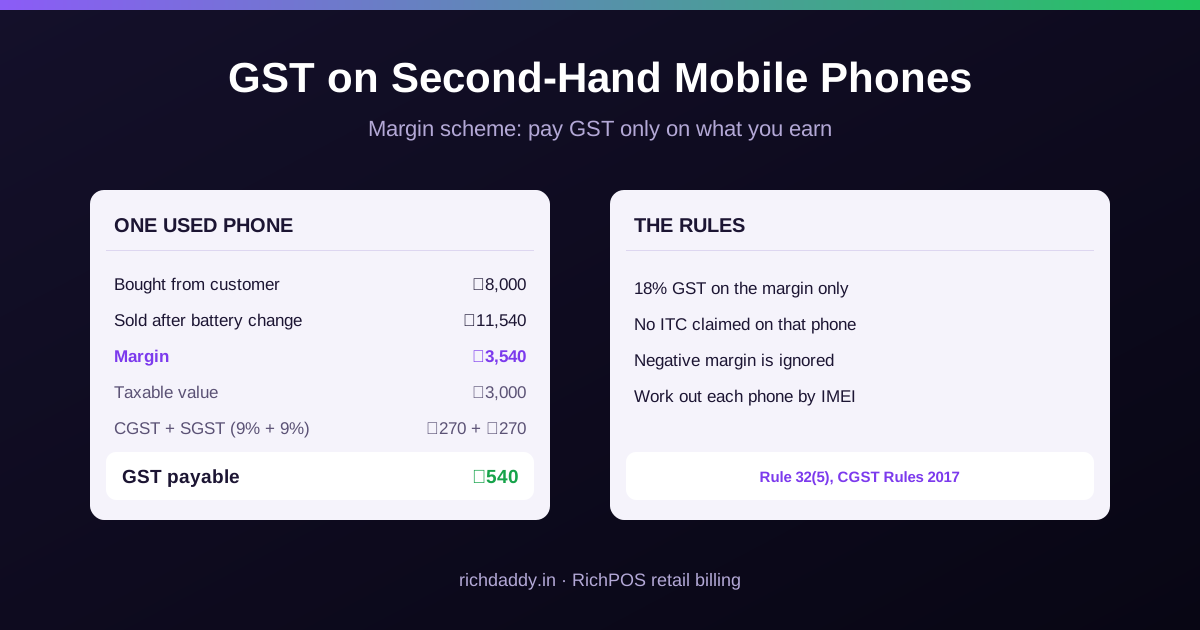
GST on Second-Hand Mobile Phones: Margin Scheme GuideHow GST works when your shop buys and resells used mobile phones in India: the margin scheme under Rule 32(5), a worked example, ITC rules and records to keep.