Updated 12 November 2026 · By Ashok Sachdev · Source: Section 15(3) and Section 34 of the CGST Act, CBIC Circular 92/11/2019-GST and Circular 212/6/2024-GST
Quick answer
There is no HSN or SAC code for discount received. A discount from your supplier is a cut in the price of the goods you bought, not something you supply, so you do not charge GST on it. What changes is your input tax credit: if the supplier gives the discount through a GST credit note, you reverse the matching ITC; if it comes as a financial (commercial) credit note without GST, your ITC stays as it is. The one exception is a "discount" paid to you for doing promotion for the brand: that is a service, and you charge GST on it.
Most GST articles look at discounts from the seller's side: how to show 10% off on the bill. This guide is for the other side of the counter: the kirana, medical, mobile or hardware shop that receives discounts, rebates and schemes from distributors and brands. If you have ever opened your GSTR-2B and wondered why a credit note reduced your ITC, or asked your accountant which HSN to put against "discount received", this is for you. For discounts you give to your own customers, read GST on discount: HSN code and how to show it on a bill.
Is GST applicable on discount received?
No, not in the normal case. GST is charged on a supply. When a distributor gives you 2% off, you have not supplied anything to the distributor; you have simply paid less for what you bought. So:
You do not raise an invoice for the discount.
You do not show it in your GSTR-1 as an outward supply.
There is no HSN or SAC code to look up, because there is no supply.
The discount still matters for GST, but on the input side. It can reduce the input tax credit you are allowed to keep, depending on how the supplier passes it to you.
Bill shows ₹10,000 less 3% = ₹9,700, GST on ₹9,700
ITC only on the GST actually charged
Nothing to do
Later, through a GST credit note (Section 34)
Quarterly target scheme agreed in the scheme letter, credit note with GST
Reverse ITC equal to the GST in the credit note
No output GST
Later, through a financial credit note (no GST)
Extra rebate to clear a slow lot, decided after the sale
Keep full ITC
No output GST
Paid for promotion work you do
Brand pays you to put up displays or run a sales drive
Not a discount at all
You charge GST on it as a service
Source: Section 15(3) of the CGST Act, Section 34 and CBIC Circular 92/11/2019-GST (paragraph 3 on secondary discounts). Finance Act 2025 reworded Section 15(3)(b); confirm the current text with your CA.
1. Discount on the purchase bill: the simplest case
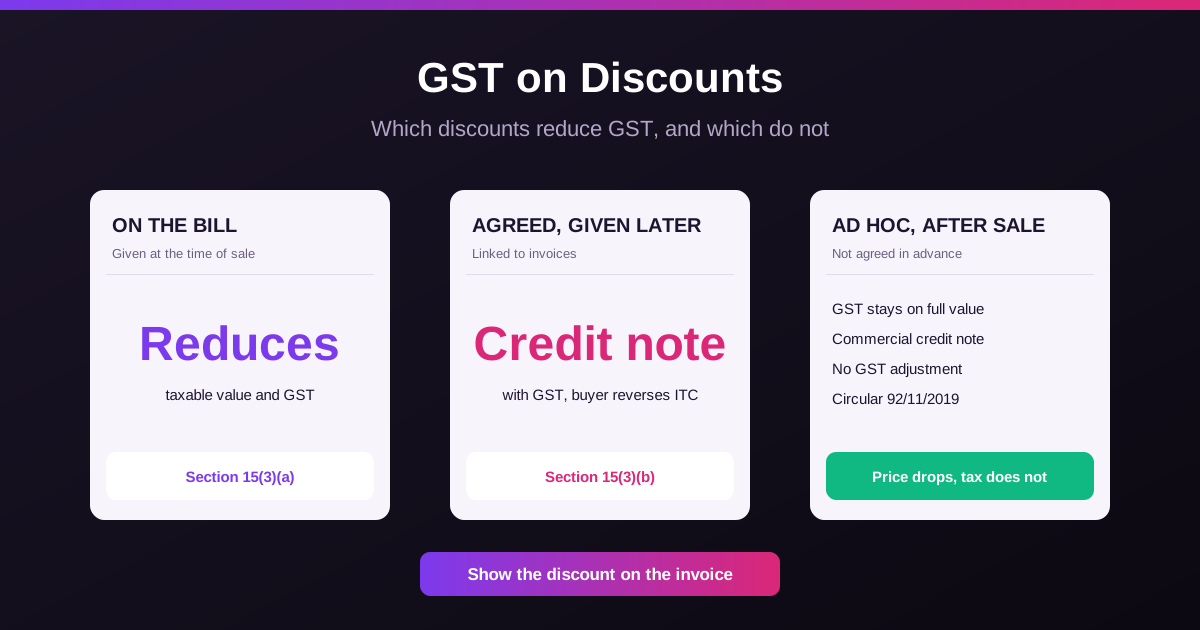
When the discount is printed on the supplier's invoice, GST is charged on the price after the discount (Section 15(3)(a)). Your ITC is simply the GST shown on the bill. Nothing is reversed later, and there is no separate entry for "discount received", because the purchase is already booked at the lower price.
This is also the cleanest option for you. If your distributor offers a scheme, ask whether it can be given on the bill rather than later. Less paperwork, nothing to chase in GSTR-2B, and your stock is valued at what you really paid.
2. Discount later through a GST credit note: reverse the ITC
Target schemes, quarterly volume rebates and turnover discounts from FMCG and mobile distributors usually come after the sales, as a credit note. A post-sale discount reduces the supplier's taxable value only when it was agreed at or before the time of supply, is linked to the relevant invoices, and you reverse the ITC that relates to it. The supplier then issues a credit note with GST under Section 34 and reports it in GSTR-1.
On your side, the credit note shows up in GSTR-2B as a credit note against the supplier's GSTIN, and it reduces the input tax credit available to you. You have effectively paid less GST on those purchases, so you claim less.
Worked example: a 2% quarterly scheme
A kirana shop in Indore buys ₹2,00,000 of packed food from a distributor in a quarter, at 5% GST, so it has paid ₹10,000 of GST and claimed that as ITC. The scheme letter, signed before the quarter started, promises 2% back if purchases cross ₹1,50,000.
Line
Amount
Purchases in the quarter (taxable value)
₹2,00,000
GST paid and claimed as ITC (5%)
₹10,000
Scheme discount, 2% of ₹2,00,000
₹4,000
GST in the credit note (5% of ₹4,000)
₹200
ITC the shop reverses
₹200
Net cash benefit to the shop
₹4,200 off the supplier's dues, less ₹200 of ITC = ₹4,000
The figures are illustrative; use your own rates. The point: the GST part of the credit note is not extra income. It cancels out against the ITC you give up, and your real gain is the ₹4,000 discount.
Your supplier may ask you to confirm that you reversed the ITC. CBIC Circular 212/6/2024-GST lets the supplier rely on an undertaking from you, or on a CA or cost accountant's certificate for larger amounts. Expect this request on big scheme credit notes, and keep a copy of what you sign.
3. Financial credit note without GST: keep your ITC
If the discount was not agreed at the time of sale, for example a one-off extra rebate to clear old stock or to settle a complaint about late delivery, it cannot reduce the supplier's taxable value. Circular 92/11/2019-GST says the supplier may still issue a financial or commercial credit note for the amount, but without GST. The supplier keeps paying GST on the full invoice value, and you, the buyer, do not reverse any ITC.
In your books it is plain income: debit the supplier, credit "Discount received". It does not appear anywhere in your GST returns. Do not put GST on it yourself, and do not reverse ITC "to be safe": you would lose credit the law allows you to keep.
4. When a "discount" is really a payment for your service
Some brands give dealers an additional amount for doing something specific: a special sales drive, a window display, putting up their hoarding, an in-store promotion or a co-branded advertisement. Circular 92/11/2019-GST treats this differently. Because you did an activity for the brand, the amount is payment for a service you supplied. You raise a tax invoice for it, usually at 18%, and the brand takes ITC on your invoice.
This is where the confusion about "discount received HSN code" often comes from. The invoice you raise carries a SAC code for the service you did (advertising or sales promotion, depending on the activity), not an HSN code for goods. Ask your CA to pick the right SAC, and keep the brand's scheme letter that describes the activity. If you are below the GST registration limit and unregistered, talk to your CA before accepting such schemes, since a service income can count towards your turnover.
Free quantity schemes: "10 + 1 free"
Distributors often give extra pieces instead of money off: buy 10 cartons, get 1 free. CBIC treats offers like this as a single supply at the price charged, not a free gift. The supplier pays GST on the invoice value, and you can claim ITC on that invoice. Record all 11 cartons in stock at the total price you paid, so your cost per carton drops. If the free pieces arrive on a separate "free" invoice with zero value, keep it with the main bill so your stock and the supplier's records match.
Supplier Dr; Discount received Cr (indirect income)
Cash discount for early payment, not on the bill
Supplier Dr; Bank Cr; Discount received Cr
Payment for promotion work
Your own tax invoice: Brand Dr; Promotion income Cr; Output GST Cr
Your accountant may use slightly different ledger names, which is fine. What matters for GST is the right column: whether input GST goes down (case 2), stays (case 3) or output GST goes up (case 4).
Monthly checklist for shops that get schemes
Keep the scheme letter. It proves the discount was agreed in advance, which decides whether a GST credit note is valid.
Match credit notes in GSTR-2B. Every GST credit note from a supplier should match one you received on paper or WhatsApp. If one is missing, ask the supplier; if one appears that you did not expect, ask before accepting it. See GSTR-2B reconciliation for a retail shop.
Reverse ITC once, not twice. Credit notes in GSTR-2B already reduce the auto-filled ITC in GSTR-3B. Check with your CA that the same credit note is not also reversed by hand.
Book financial credit notes as income. No GST, no ITC change.
Invoice promotion payments. If the brand paid you for an activity, raise your tax invoice in the same month.
Reduce the supplier's balance. Whatever the GST type, the credit note reduces what you owe. Update the supplier ledger so you do not overpay.
Discount mistakes on the buying side usually come from scattered paperwork: the scheme letter is in one WhatsApp chat, the credit note in another, and the supplier balance in a notebook. In RichBills you enter purchase bills at the price you actually paid, send goods back through purchase returns (stock is corrected automatically) and keep a running ledger for every supplier, so a credit note reduces the balance you owe in one place. See purchase and supplier management and supplier payments ledger. RichBills does not file GST returns; your CA still checks GSTR-2B and makes the ITC reversal.
Pricing: 30 din free, phir ₹99/month pehle 3 mahine, phir ₹199/month ya ₹1,999/saal.
FAQ
Frequently asked questions
What is the HSN code for discount received?
There is none. A discount received from a supplier reduces the price of the goods you bought; it is not a supply by you, so it has no HSN or SAC code. Only if a brand pays you for doing promotion work do you raise an invoice, and that invoice carries a SAC code for the service.
Is GST payable on discount received from a supplier?
No. You do not charge GST on a discount you receive. If the supplier issues a GST credit note, you reverse the input tax credit equal to the GST in that credit note. If it is a financial credit note without GST, you keep your ITC.
Do I have to reverse ITC on a financial credit note?
No. CBIC Circular 92/11/2019-GST says the recipient does not reverse ITC for a financial or commercial credit note issued without GST, because the supplier has not reduced the tax it paid.
Is "discount received" income for a shop?
Yes, in your accounts. A financial credit note or an early-payment discount is booked as indirect income (or as a reduction in purchase cost). It is income for income tax, but it is not an outward supply under GST.
Does a cash discount for early payment reduce GST?
Only if it meets the Section 15(3)(b) conditions: agreed at or before the sale, linked to the invoices, passed through a GST credit note and matched by your ITC reversal. Most early-payment discounts given at settlement are simply booked as discount received, with no GST change on either side.
How do I check credit notes from my suppliers?
They appear in your GSTR-2B under the supplier's GSTIN as credit notes. Match each one with the paper or PDF credit note and the scheme letter before your CA files GSTR-3B.
A brand paid me for a display. Is that a discount?
No. Under Circular 92/11/2019-GST an amount paid for an activity you carry out, such as a display, sales drive or advertisement, is payment for a service. You raise a tax invoice, usually with 18% GST, and the brand can claim ITC on it.
Bottom line: discount received never has an HSN code and never carries output GST, unless it is really a payment for your promotion work. Your only GST job is on the input side: reverse ITC for GST credit notes, keep it for financial ones, and keep the scheme letter that shows which is which.
Founder, RichBills Software, Ahmedabad. We build RichBills for Indian shops and write these guides from what shop owners ask us every day. Facts on tax rates and prices are dated; confirm GST matters with your CA. Questions? WhatsApp us.
Make GST bills in seconds with RichBills
Billing, stock, WhatsApp bills and GST reports in one app. Free 30-day trial with no card, then ₹99/month for 3 months and ₹199/month after.
HSN Code in India: How to Find the Right OneYour HSN code depends on turnover: 4 digits up to ₹5 crore, 6 digits above. Wrong digits make an invoice defective. Here's how to find yours.
GST क्या है? पूरा नाम, किस पर लगता है, दरें और फ़ायदेGST का पूरा नाम Goods and Services Tax (वस्तु एवं सेवा कर)। 1 जुलाई 2017 से लागू, किस पर लगता है, 22 सितंबर 2025 की नई दरें, रजिस्ट्रेशन सीमा और दुकानदार के फ़ायदे।