GST on Warranty Replacement: Circular 195 for Shops (2026)
Free warranty replacement of a phone, appliance or part carries no further GST under CBIC Circular 195/07/2023, extended to whole goods by Circular 216/10/2024. What a dealer bills in each case, extended warranty rules, and a worked mixer-grinder example.
No GST is charged when a manufacturer replaces a part, or the whole product, free under warranty. CBIC Circular No. 195/07/2023-GST says the original sale price already includes the likely cost of warranty replacement and repair, so no further GST is payable and the manufacturer does not reverse input tax credit (ITC). Circular No. 216/10/2024-GST extends this to replacement of the goods as such, not only parts. GST does apply to anything extra the customer pays, and to any invoice a dealer raises on the manufacturer for the replacement.
A customer walks in with a phone that will not charge, or a mixer-grinder whose motor burnt out in the fourth month. What do you bill, to whom, and does GST come in at all?
The answer depends on who gives the replacement, where the unit comes from, and who pays.
Seedhi baat: warranty mein free replacement par customer se GST nahi lagta. Customer se kuch extra paisa liya to us extra par GST lagega. Aur agar aapne company ko replacement ka bill banaya, to us bill par GST lagega.
What Circular 195 and Circular 216 say
Circular 195 (17 July 2023) was issued because field offices were reading free warranty replacements differently. Its core reasoning is one line: "The value of original supply of goods (provided along with warranty) by the manufacturer to the customer includes the likely cost of replacement of parts and / or repair services to be incurred during the warranty period, on which tax would have already been paid at the time of original supply of goods."
Circular 195 only spoke of "parts". On 26 June 2024, Circular 216 clarified that the same treatment applies "in case where the goods as such are replaced under warranty", and that every mention of "any part", "parts" and "part(s)" in Circular 195 "may be read as 'goods or its parts, as the case may be'". So a full handset or a full mixer-grinder replaced under warranty is covered, not just a battery or a jar.
Scenario (as in the circulars)
GST position
ITC position
Manufacturer replaces goods or parts, or repairs, under warranty with no charge to the customer
No further GST on the replacement or repair
Manufacturer need not reverse ITC; the circular says these are not exempt supplies
Manufacturer charges the customer something extra for a part or a service
GST payable on that additional consideration
Normal rules
Distributor replaces or repairs for the customer on behalf of the manufacturer, charges the customer nothing
No GST payable by the distributor on that activity
See the four sub-cases below
Distributor charges the customer something extra
GST payable by the distributor on that additional consideration
The four distributor cases (S. No. 4 of the circular)
This is where most shops sit. If you are the brand's dealer or distributor and you hand over the replacement on the brand's behalf, Circular 195 (S. No. 4) and Circular 216 (which added point (d)) describe four ways the stock and money can move:
Case
How the replacement happens
What the circular says
4(a)
You replace from your own stock (or buy from a third party) and charge the manufacturer by a tax invoice
GST is payable by you on that supply to the manufacturer. The manufacturer can take ITC on it, subject to other conditions. You need not reverse ITC.
4(b)
You raise a requisition, the manufacturer sends the part or goods to you, you hand it to the customer
No GST payable by the manufacturer on that replacement. No ITC reversal by the manufacturer.
4(c)
You replace out of stock already received from the manufacturer, and the manufacturer issues you a credit note for it under section 34(2)
The manufacturer may adjust its tax liability, on condition that you have reversed the ITC you took on the items replaced.
4(d)
You replace from your own stock, then the manufacturer replenishes you through a delivery challan with no charge
No GST payable on the replenishment. No ITC reversal by the manufacturer.
Case 4(d), added by Circular 216, fits shops that give a new unit on the spot and get the brand's stock back later. Delivery challan basics are in delivery challan format and rules.
When the dealer charges the manufacturer for repair work
S. No. 5 of Circular 195 covers a distributor who repairs the product for the customer free, on the manufacturer's behalf, and then bills the manufacturer for the repair by a tax invoice or debit note. The circular says this is a supply of service by the distributor, and the manufacturer is the recipient under section 2(93)(a) of the CGST Act. GST is payable by the distributor, and the manufacturer can take ITC on it, subject to other conditions.
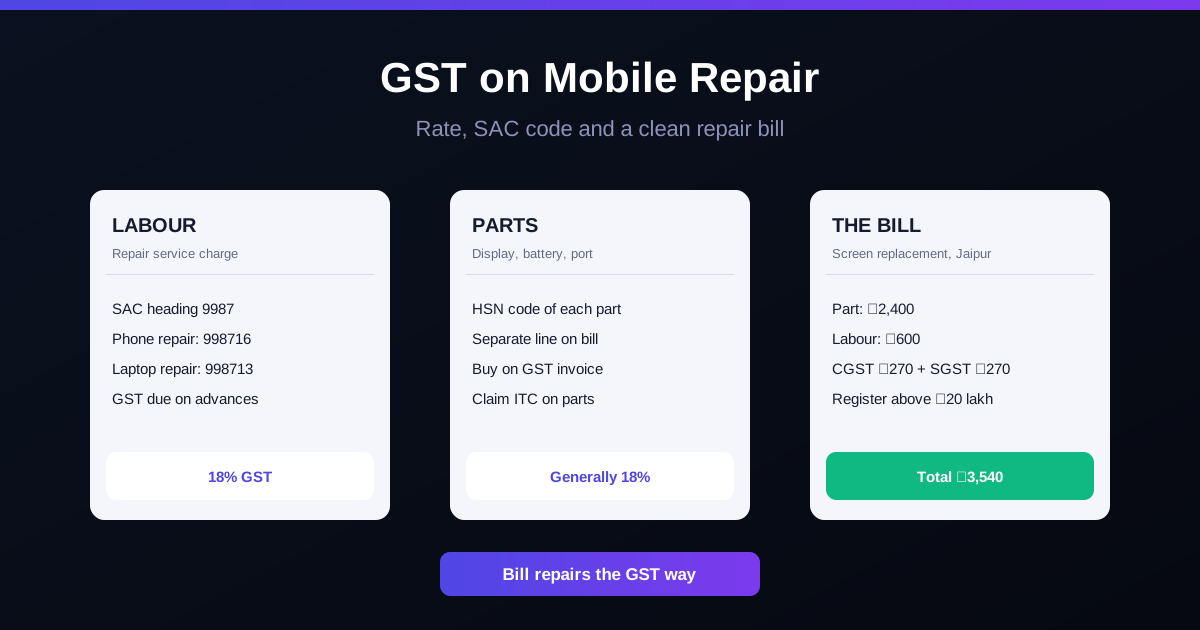
If the customer pays you for a repair outside warranty, that is an ordinary repair sale; see GST on mobile repair services.
Extended warranty: three cases
Circular 216 replaced the extended warranty answer in Circular 195 (S. No. 6). The current text reads:
When and from whom the extended warranty is bought
GST treatment per Circular 216
At the time of sale, from the same supplier who sells the goods
Part of the value of a composite supply; principal supply is the goods, and GST is payable accordingly
At the time of sale, but from a different person (for example the shop sells the goods and the OEM or a third party gives the extended warranty)
Separate supply from the goods, taxable as a supply of services
Any time after the original sale
Supply of services distinct from the goods; the extended warranty supplier pays GST on it
The circular calls an extended warranty an "assurance", not an actual replacement or repair. If your shop sells its own extended warranty plan along with a phone or appliance, it rides with the goods on the same bill. If you only sell a brand or third-party plan, ask your CA how your role (seller, agent or commission earner) should be billed; the circulars do not cover that.
Worked example: a mixer-grinder under warranty (illustrative)
A shop sells a mixer-grinder in April for ₹5,000 plus GST at 18% (₹900), total ₹5,900. The 18% rate is only for illustration; use the rate for your item. In August, within the brand's one-year warranty, the motor fails. Here is how the paperwork looks in each case.
Case
What the shop does
Customer pays
GST effect on the shop
Brand service centre replaces the unit
Shop only directs the customer; no bill
₹0
None
4(d): shop gives a new unit from shelf, brand replenishes by delivery challan free
Records the exchange and the stock received back
₹0
No GST on the swap or on the replenishment
4(a): shop gives a new unit from shelf and invoices the brand at its cost of ₹4,200
Tax invoice to the brand: ₹4,200 + ₹756 GST = ₹4,956
₹0
₹756 output GST; the brand can take it as ITC. No ITC reversal by the shop.
4(c): shop gives a unit already bought from the brand, brand issues a credit note for it
Reverses the ITC on that unit (₹756 on a ₹4,200 cost)
₹0
₹756 ITC reversed; brand adjusts its tax
Warranty covers motor only; customer also wants a new jar for ₹500
Bill for the jar: ₹500 + ₹90 GST = ₹590
₹590
₹90 GST on the additional consideration
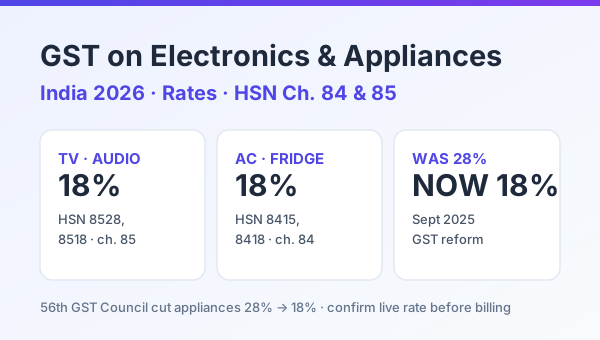
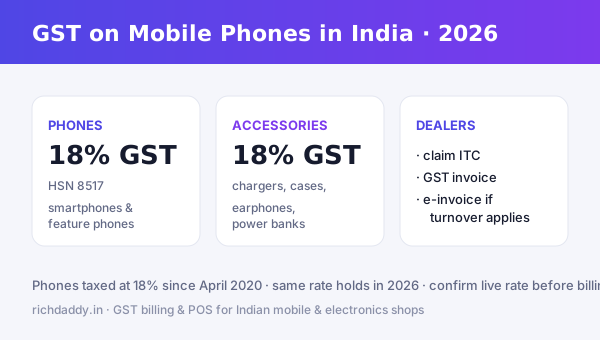
The same logic works for a phone: a free handset swap carries no GST, while a ₹1,200 screen guard and case bought at the same visit is a normal GST sale. Phone GST rates are in GST on mobile phones, and appliance rates in GST on electronics and appliances.
Counter situations the circulars do not cover
Both circulars speak of manufacturers and of distributors acting on the manufacturer's behalf. Some shop cases fall outside that:
You swap a faulty item yourself, with no brand claim. For example, a customer returns a phone charger that failed in the first week and you give a new one from your shelf as goodwill. The circulars do not speak to this. Section 34(1) of the CGST Act allows a credit note where "the goods supplied are returned by the recipient" or "found to be deficient". Many shops record this as a sales return plus a fresh bill. Ask your CA which suits you. See return and refund management.
You only collect the item and send it to the service centre. If you charge the customer nothing, the circulars give no reason to bill GST. If you charge a pick-up or handling fee, that is an additional charge and should be billed.
Warranty has expired. Any paid repair or replacement is a normal sale of goods or services with GST.
Common mistakes
Making a GST bill to the customer for a free warranty swap. The customer paid nothing, and no further GST is chargeable.
Reversing ITC where the circular says no reversal is needed: by the manufacturer on free warranty replacements, and by the distributor in case 4(a).
Invoicing the brand for a replacement (case 4(a)) without charging GST on that invoice.
Accepting the brand's credit note (case 4(c)) and not reversing your ITC on the replaced items. The brand's adjustment is conditional on it.
Not writing the IMEI or serial number of the old and new unit anywhere, then having no record when the brand queries the claim.
How RichBills (formerly RichPOS) helps
RichBills makes GST bills with HSN codes and the CGST/SGST/IGST split, so the extra-charge cases (a paid jar, a handling fee, an invoice to the brand) go out as normal tax invoices. Sales returns and exchanges correct stock and the customer ledger, and credit notes appear in the GSTR-1-ready report. Purchase entry, purchase returns and the supplier ledger keep your account with the brand or distributor clear, and reports export to Excel, CSV or PDF for your CA. You can add your warranty terms to the invoice footer from store settings. See sales return and exchange, billing for mobile shops and billing for home appliance shops.
What RichBills does not do: it has no IMEI or serial-number tracking. You can type an IMEI only as a free-text note on a bill line or on a repair job card. It does not track or file manufacturer warranty claims, does not decide which circular case applies to you, does not generate e-invoices or e-way bills, and does not file your GST returns.
Pricing: 30 din free, phir ₹99/month pehle 3 mahine, phir ₹199/month ya ₹1,999/saal.
Bottom line: A free warranty replacement or repair, of a part or the whole product, carries no further GST and needs no ITC reversal by the manufacturer. Extra charges to the customer are taxable. As a dealer: invoice the brand and you charge GST; free replenishment by delivery challan, no GST; brand credit note, you reverse ITC.
General information based on CBIC Circular No. 195/07/2023-GST, Circular No. 216/10/2024-GST and the CGST Act as published, as of November 2026. Not tax or legal advice; confirm your case with your CA.
FAQ
Frequently asked questions
Is GST applicable on warranty replacement?
Not when the replacement is free. Circular No. 195/07/2023-GST says the original sale value already includes the likely cost of warranty replacement and repair, so no further GST is chargeable. GST applies only to any additional amount charged to the customer.
Which GST circular covers warranty replacement?
CBIC Circular No. 195/07/2023-GST dated 17 July 2023, read with Circular No. 216/10/2024-GST dated 26 June 2024. Circular 216 extends it to replacement of whole goods, adds the delivery challan replenishment case, and rewrites the extended warranty answer.
Does the manufacturer have to reverse ITC on free warranty replacement?
No. The circular says these replacements cannot be treated as exempt supplies, so the manufacturer need not reverse ITC on the replaced goods, parts or repair services.
Does a dealer pay GST when the brand replenishes a replaced unit?
If the brand sends the replacement stock through a delivery challan without charging for it, no GST is payable on that replenishment (point (d), added by Circular 216). If you instead invoice the brand for the unit you gave, GST is payable on your invoice.
What if the brand gives a credit note for the replaced unit?
Under point (c), the manufacturer can adjust its tax on a credit note under section 34(2), but only if you, the distributor, have reversed the ITC you took on the items replaced.
Is GST payable on extended warranty?
Yes. Bought with the goods from the same seller, it is part of a composite supply with the goods. Bought from a different person, or after the sale, it is a separate supply of services and the extended warranty supplier pays GST.
Can RichBills track IMEI numbers or warranty claims?
No. RichBills has no IMEI or serial-number tracking; you can only note an IMEI as free text on a bill line or a repair job card. It does not track manufacturer warranty claims.
Founder, RichBills Software, Ahmedabad. We build RichBills for Indian shops and write these guides from what shop owners ask us every day. Facts on tax rates and prices are dated; confirm GST matters with your CA. Questions? WhatsApp us.
Make GST bills in seconds with RichBills
Billing, stock, WhatsApp bills and GST reports in one app. Free 30-day trial with no card, then ₹99/month for 3 months and ₹199/month after.
GST on Second-Hand Mobile Phones: Margin Scheme GuideHow GST works when your shop buys and resells used mobile phones in India: the margin scheme under Rule 32(5), a worked example, ITC rules and records to keep.
Buying from Unregistered or Composition Dealer: RCM, ITC, GSTR-3BBuying from a supplier without GSTIN or from a composition dealer? Ordinary stock attracts no RCM and gives no ITC; the ₹5,000/day limit is gone. RCM applies to metal scrap and, from 1 Nov 2026, plastic, tyre, e-waste and used cooking oil. Self-invoice rules, GSTR-3B rows and a ₹ example.