Sale on Approval Basis in GST: Time Limit, Challan, E-way Bill
Sending sarees, lehengas, jewellery or furniture to a customer's home to choose from? Under section 31(7) of the CGST Act you invoice only what is kept, at approval or within six months of removal. How the rule 55 delivery challan, e-way bill, inter-state IGST and returns work, with a worked example.
Maal approval par bhej rahe ho? RichBills mein delivery challan banao, phir 'Convert to invoice' se sirf rakhe hue maal ka bill kaato.30 din free try karo →
"Sale on approval basis" means you send goods to a customer who decides later whether to buy them. Under GST, section 31(7) of the CGST Act says the invoice must be issued before or at the time of supply (when the customer approves) or six months from the date of removal, whichever is earlier. Until then, the goods move on a delivery challan (rule 55), with an e-way bill where rule 138 requires one. You invoice only the pieces the customer keeps.
Wedding season (roughly November to February) is when this happens most: six sarees go to the bride's home, three lehenga sets go for trial, a sofa sits in the family's drawing room for a weekend. Some pieces come back. When do you bill, and on what paper do the goods travel until then?
Seedhi baat: maal approval par bhejo to bill mat kaato, delivery challan banao. Customer jo rakhe sirf uska bill kaato, aur 6 mahine ke andar kaato, chahe customer ne jawab diya ho ya nahi.
What "sale on approval basis" means
In a sale on approval (or "sale or return"), the customer has the goods but the sale happens only when they say yes, or keep the goods beyond the agreed time. Until then the goods are still your stock, at someone else's place.
This is different from:
A sale with home delivery: already bought; bill at removal under section 31(1).
A sale with a return option: bill now; on return, issue a credit note.
Sale on approval basis under GST: section 31(7) and the 6-month limit
Section 31(7) of the CGST Act reads: "Notwithstanding anything contained in sub-section (1), where the goods being sent or taken on approval for sale or return are removed before the supply takes place, the invoice shall be issued before or at the time of supply or six months from the date of removal, whichever is earlier."
So the ordinary "invoice at removal" rule does not apply:
Event
What you do
Customer approves (says yes, pays, or keeps the item as agreed)
Issue the tax invoice at or before that point, for the items kept
Six months pass from the date the goods left your shop, with no return
Issue the tax invoice by the end of six months from removal
Customer returns everything before either of the above
No invoice; close the challan
Section 12(2) makes the time of supply of goods the earlier of the invoice date (or the last date section 31 allows for it) and the date you receive payment. In plain terms: once six months from removal pass, GST on goods still with the customer is due whether or not you issued the bill. If the family pays an advance first, see the advance payment post above.
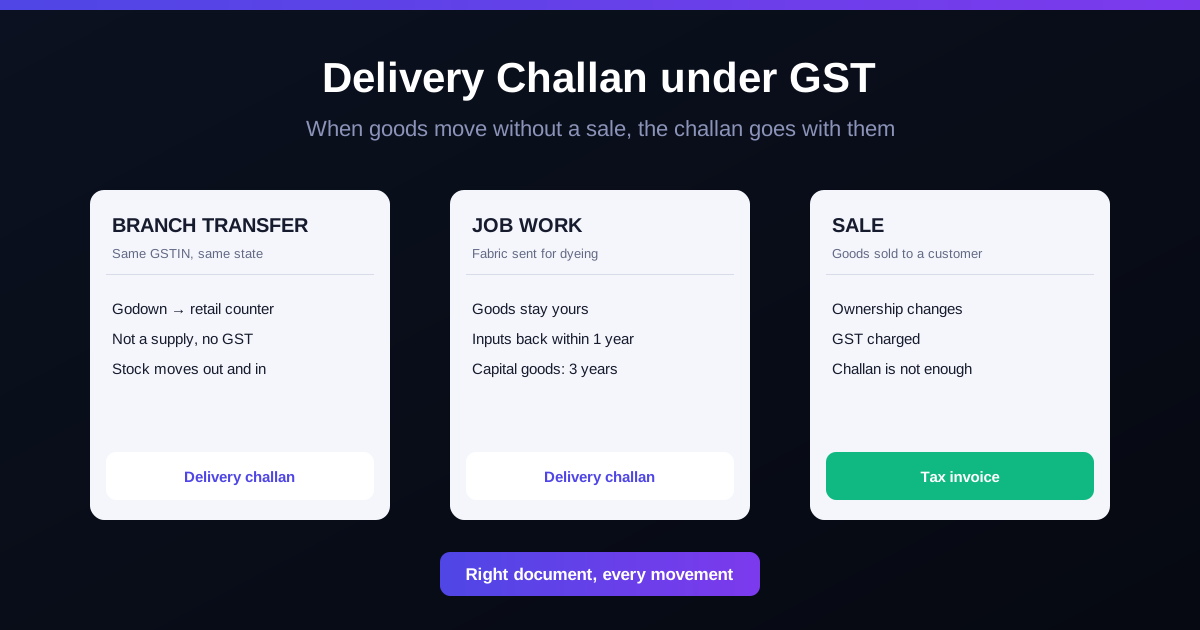
The delivery challan under rule 55
Rule 55(1) does not have a separate clause titled "approval". CBIC's Circular No. 10/10/2017-GST explains which clauses apply: it points to rule 55(1)(c) (a delivery challan for "transportation of goods for reasons other than by way of supply"), rule 55(3) (the challan is declared as specified in rule 138, the e-way bill rule) and rule 55(4) (where the tax invoice could not be issued at removal, "the supplier shall issue a tax invoice after delivery of goods").
Rule 55(1) lists what the delivery challan must contain. It must be serially numbered, not exceeding sixteen characters, in one or more series:
Date and number of the delivery challan
Name, address and GSTIN of the consigner (you), if registered
Name, address and GSTIN or UIN of the consignee, if registered
HSN code and description of goods
Quantity (provisional, where the exact quantity being supplied is not known)
Taxable value
Tax rate and tax amount (central, State, integrated, UT tax or cess), "where the transportation is for supply to the consignee"
Place of supply, in case of inter-State movement
Signature
Rule 55(2) says the challan "shall be prepared in triplicate, in case of supply of goods": ORIGINAL FOR CONSIGNEE, DUPLICATE FOR TRANSPORTER and TRIPLICATE FOR CONSIGNER. Three copies is a safe habit for approval goods too. A ready layout is on our delivery challan format page, and the full rule is covered in delivery challan GST format and rules.
E-way bill and inter-state approval goods
Rule 138(1) says every registered person who causes movement of goods of consignment value exceeding fifty thousand rupees, "in relation to a supply; or for reasons other than supply", must furnish Part A of FORM GST EWB-01 before movement. The circular confirms approval goods move "on a delivery challan along with the e-way bill wherever applicable".
Value: under Explanation 2 to rule 138, consignment value is the section 15 value declared in the invoice, bill of supply or delivery challan, including any tax charged in that document. For approval goods, that is the challan value.
Below ₹50,000: rule 138 makes the e-way bill optional ("may, at his option"). Some states have notified different limits for movement within the state. Check your own state's current rule.
Jewellery: the Annexure to rule 138(14) lists "Jewellery, goldsmiths' and silversmiths' wares and other articles (Chapter 71)", except imitation jewellery (7117), as goods for which no e-way bill is required under the CGST Rules. The portal also has an intra-state "Gold e-Way Bill" option for HSN 71 goods, used where a state requires it. Ask your CA.
Which sub-type to choose on the portal: the e-Way Bill System user manual (version 1.7, June 2025) lists outward sub-types such as Supply, Job Work, Recipient Not Known, For Own Use, Exhibition or Fairs, Line Sales and Others. There is no sub-type named "approval". Delivery Challan is the document type for Recipient Not Known, Line Sales and Others ("Others" needs a description). Choose with your CA. More on limits, validity and generation is in e-way bill rules, limits and how to generate.
Approval goods sent to another state
Circular 10/10/2017-GST answered jewellery suppliers who carry goods to other states for approval and cannot register as casual taxable persons. It clarifies that:
Goods for supply on approval can move from your place of business to another place in the same state or outside it on a delivery challan, with the e-way bill wherever applicable.
The invoice may be issued at the time of delivery of goods. The person carrying the goods can carry the invoice book and issue the invoice "once the supply is fructified".
Where the supplier carries goods from one state and supplies them in another, these are inter-state supplies and attract integrated tax (IGST) under section 5 of the IGST Act.
The clarification applies "to all goods supplied under similar situations", not only jewellery.
Partly kept, damaged, six months out, and your books
Customer keeps some, returns the rest
Raise one tax invoice for the kept items only, quoting the challan number. Do not bill everything and then issue credit notes; the returned goods were never sold. A return after invoicing is a normal sales return with a credit note (see return and refund management).
Goods come back damaged
The GST text we read does not cover this directly. If the customer agrees to buy the damaged piece, invoice it at the agreed price. If they pay a damage charge instead, ask your CA how to bill it. Agree it in writing, and do not put the piece back into saleable stock.
Six months pass with no answer
If the goods are still with the customer six months from removal, issue the invoice for them by then. Follow up well before.
How to record it in the books
A common, simple approach (confirm entries with your CA):
At dispatch: no sale entry. Record the goods in an approval register: challan number, date, customer, items, value, date due back.
At approval: normal sale entry for kept items only: debit customer (invoice total); credit sales (taxable value) and output CGST/SGST or IGST.
On return: no entry. Mark the items received in the register.
At year end: goods still out on approval are part of your closing stock. Count them from the register.
Worked example: a saree shop, 6 sarees sent, 4 kept (illustrative)
On 3 December, a Jaipur saree shop sends six sarees to a bride's family across town on delivery challan DC0042 (three copies).
Saree
Value on challan
Outcome
1. Cotton silk
₹4,500
Returned
2. Kota doria
₹6,000
Kept
3. Leheriya georgette
₹7,500
Kept
4. Chiffon with zari border
₹8,000
Returned
5. Banarasi silk
₹9,500
Kept
6. Bridal Banarasi
₹12,000
Kept
Total
₹47,500
Kept ₹35,000, returned ₹12,500
E-way bill: ₹47,500 is below the ₹50,000 in rule 138(1) and the move is within the state, so it is optional under the CGST rule (the shop still checks Rajasthan's rule).
On 9 December the family keeps four. The shop issues a tax invoice for ₹35,000 taxable value plus GST at the rate for each saree's HSN (check current rates in the GST rates for wedding season items list), quoting DC0042.
The two returned sarees (₹12,500) go back into stock; DC0042 is closed.
If the family had gone silent, the invoice for whatever they still held would be due by 3 June, six months from removal.
Step list and common mistakes
Steps for approval sales
Make a delivery challan with all rule 55 details, in three copies.
Check the e-way bill need: value above ₹50,000, your state's limit, inter-state movement, any goods-specific rule.
Enter the challan in your approval register with a "due back" date well inside six months.
When the customer decides, invoice only what they keep, quoting the challan number. IGST if supplied in another state.
Review open challans weekly; bill anything still out before six months.
Common mistakes
Billing everything at dispatch, then issuing credit notes for returns.
Sending goods on a plain slip without HSN, value and serial number.
Forgetting the six-month limit. Tax becomes due even if you never raised the bill.
Skipping the e-way bill because "it is not a sale". Rule 138 covers movement "for reasons other than supply" too.
Charging CGST and SGST when the goods were supplied in another state. The circular says IGST.
How RichBills (formerly RichPOS) helps
RichBills has a Delivery Challan on all plans (Sales > Delivery Challan). Each challan gets its own number (DC0001, DC0002 and so on), carries no tax, and can be printed. When the family decides, "Convert to invoice" opens a bill with the challan lines and links the bill to the challan. The bill is a normal editable POS bill, so remove the returned lines before saving and you bill only what was kept. If that bill is deleted, the challan reopens. There is also an optional "Stock out on challan" setting (off by default): turn it on and the goods leave stock with the challan number, and that is reversed when the challan is billed or the bill is deleted. See billing software for saree shops, for boutiques and for furniture shops.
RichBills does not generate e-way bills; you make those on the e-way bill portal. It does not track the six-month deadline or remind you about open challans, so check them yourself weekly. It has no IMEI or serial-number tracking for individual pieces.
Pricing: 30 din free, phir ₹99/month pehle 3 mahine, phir ₹199/month ya ₹1,999/saal.
Bottom line: Send approval goods on a rule 55 delivery challan, with an e-way bill where rule 138 or your state requires it. Under section 31(7), invoice only what the customer keeps, when they approve and never later than six months from removal. Goods supplied in another state attract IGST.
General information based on the CGST Act, the CGST Rules and CBIC Circular No. 10/10/2017-GST as published by CBIC and the GST Council, and the NIC e-Way Bill System user manual, as of November 2026. Not tax/legal advice; confirm with your CA.
FAQ
Frequently asked questions
What is sale on approval basis?
It is when a seller sends goods to a customer who decides later whether to buy. The sale happens only when the customer approves, or keeps the goods past the agreed time. Until then the goods remain the seller's stock, held at the customer's place.
Which section of GST covers sale on approval basis?
Section 31(7) of the CGST Act. It says the invoice for goods sent on approval for sale or return must be issued before or at the time of supply, or six months from the date of removal, whichever is earlier. Section 12(2) ties the time of supply to this deadline.
What is the time limit for goods sent on approval under GST?
Six months from the date the goods were removed from your premises. If the customer has not approved or returned them by then, you must issue the invoice by that date for whatever they still hold.
Is an e-way bill needed for goods sent on approval?
Rule 138 requires an e-way bill when consignment value exceeds ₹50,000, including movement for reasons other than supply. Below that it is optional under the CGST rule, but some states set their own intra-state limits. Jewellery (Chapter 71, except imitation jewellery) is exempt under the CGST Rules annexure.
Which document is used to send goods on approval?
A delivery challan under rule 55 of the CGST Rules, as Circular 10/10/2017-GST clarifies. It needs serial number, date, your and the consignee's details, HSN, quantity, taxable value, place of supply for inter-state movement, and a signature.
If the customer keeps only some goods, how do I bill?
Issue one tax invoice for the items kept, quoting the challan number. The returned items were never sold, so no credit note is needed for them. Put them back into stock and close the challan.
What is the journal entry for sale on approval basis?
Usually no entry at dispatch; keep an approval register. When the customer approves, debit the customer and credit sales and output GST for the kept items only. Returns need no entry. Unsold goods with customers count in closing stock. Confirm entries with your CA.
Founder, RichBills Software, Ahmedabad. We build RichBills for Indian shops and write these guides from what shop owners ask us every day. Facts on tax rates and prices are dated; confirm GST matters with your CA. Questions? WhatsApp us.
Make GST bills in seconds with RichBills
Maal approval par bhej rahe ho? RichBills mein delivery challan banao, phir 'Convert to invoice' se sirf rakhe hue maal ka bill kaato.
Billing, stock, WhatsApp bills and GST reports in one app. Free 30-day trial with no card, then ₹99/month for 3 months and ₹199/month after.
GST Challan PMT-06: How to Create, Pay and Fix MistakesHow to pay GST with a PMT-06 challan: create it on the portal, CPIN valid 15 days, payment modes incl. UPI and card where live, ₹10,000 OTC limit, CIN, wrong head fix with PMT-09 and missing payment with PMT-07.
GST on Sale of Old Furniture, Computer or AC by a Shop: ITC RuleSelling old shop furniture, a billing computer or an AC? A registered shop charges GST. If ITC was taken, pay the higher of ITC minus 5 points per quarter or GST on the sale price (Section 18(6)). Worked example and billing steps.
How to Make a GST Bill on Mobile: Step-by-StepMake a valid GST bill on your phone in 7 steps: shop GSTIN, items with HSN and rate, customer, payment, then WhatsApp or print. Rule 46 fields listed.