Bill to Ship to in GST: Invoice, IGST and E-way Bill Rules
Billed to one party, goods delivered to another? Place of supply is the bill-to party's state (IGST Act s.10(1)(b)), the invoice shows the delivery address (Rule 46), and only one e-way bill is needed. Worked example: Ahmedabad, Mumbai, Pune.
In a "bill to ship to" sale, you bill one party (A) but send the goods straight to another party (C) on A's instruction. Under section 10(1)(b) of the IGST Act, the place of supply on your invoice is A's principal place of business, not the delivery address. So you charge CGST + SGST if A is in your state and IGST if A is in another state, wherever the goods actually go. Your invoice carries A's name, address and GSTIN, the place of supply with the state name, and C's address as the address of delivery (Rule 46). Two invoices are involved (you to A, and A to C), but only one e-way bill is needed for the single movement, and either you or A can generate it.
This is common in wholesale: a Mumbai dealer buys from an Ahmedabad wholesaler and asks him to deliver straight to the dealer's customer in Pune, saving freight and a reloading. The bill and the truck go to different places, and that is where shops get the tax type and the e-way bill wrong.
Seedhi baat: GST bill jisko bana rahe ho uske state se tay hota hai, maal kahan ja raha hai usse nahi. Bill par delivery address alag likho. E-way bill ek hi banega, do nahi.
Section 10(1)(b) of the IGST Act says that where goods are delivered by the supplier to a recipient or any other person on the direction of a third person, before or during movement, that third person is deemed to have received the goods, and the place of supply is the principal place of business of that person. For B's invoice, A is that third person. So B looks at A's state, not C's.
The e-way bill FAQ agrees: tax is entered as per the bill-to party's state, "irrespective of movement of goods". The general rule for same-state and other-state sales is in intra-state vs inter-state GST; bill to ship to is the main exception shop owners meet.
Seller B in
Bill to A in
Ship to C in
Tax on B's invoice
Gujarat
Maharashtra
Maharashtra
IGST
Gujarat
Maharashtra
Gujarat
IGST, even though the goods never leave Gujarat
Gujarat
Gujarat
Maharashtra
CGST + SGST, even though the goods cross into Maharashtra
For A's own invoice to C, the goods move and the movement ends at C's address. Section 10(1)(a) makes the place of supply the location where the movement terminates for delivery to the recipient, so A compares C's delivery state with his own state.
Worked example: Ahmedabad, Mumbai, Pune
Shah Traders, a wholesaler in Ahmedabad (GSTIN starting 24, Gujarat), gets an order from Mehta Distributors in Mumbai (GSTIN starting 27, Maharashtra) for 100 cartons. Mehta has already sold them to Patil Hardware in Pune (GSTIN starting 27) and asks Shah to deliver directly to Pune. GST at 18% is used only for illustration; use your item's actual rate.
Line
Invoice-1: Shah (Ahmedabad) to Mehta (Mumbai)
Invoice-2: Mehta (Mumbai) to Patil (Pune)
Buyer GSTIN on invoice
Mehta's, 27...
Patil's, 27...
Place of supply
27-Maharashtra (Mehta's principal place of business)
27-Maharashtra (Pune, where the goods are delivered)
Address of delivery
Patil Hardware, Pune
Patil Hardware, Pune
Taxable value
₹2,00,000
₹2,30,000
Tax
IGST 18%: ₹36,000
CGST 9%: ₹20,700 + SGST 9%: ₹20,700
Invoice total
₹2,36,000
₹2,71,400
Shah charges IGST because Gujarat and Maharashtra differ. Mehta charges CGST + SGST because he and the Pune delivery point are both in Maharashtra. Mehta can claim the ₹36,000 IGST as input tax credit, subject to the normal conditions, as on any purchase.
Now change one fact: Mehta's customer is in Surat, Gujarat. Shah's invoice still shows IGST with place of supply 27-Maharashtra, because the bill is to Mehta. Mehta's invoice to the Surat shop is then an inter-state sale for him (Maharashtra to Gujarat), so he charges IGST.
What to show on a bill to ship to invoice
Rule 46 of the CGST Rules lists the contents of a tax invoice. The fields that matter most here:
Your name, address and GSTIN (clause a), invoice number and date (clauses b, c).
Recipient's name, address and GSTIN if registered (clause d). This is the bill-to party, A.
Place of supply with the name of the state, for an inter-state supply (clause n). Writing the state code too, like "27-Maharashtra", avoids confusion.
Address of delivery, where it is different from the place of supply (clause o). This is the ship-to party, C.
HSN, description, quantity, taxable value, rate and tax amounts (clauses g to m), reverse charge yes or no (clause p) and signature (clause q).
For an unregistered recipient, Rule 46(e) asks for name, address and address of delivery with the state name and code when the value is ₹50,000 or more. All fields: GST invoice format guide; steps for registered buyers: how to make a B2B GST invoice. Verify A's GSTIN with the GSTIN checker before billing: the GSTIN is what decides the tax type.
How the e-way bill is filled
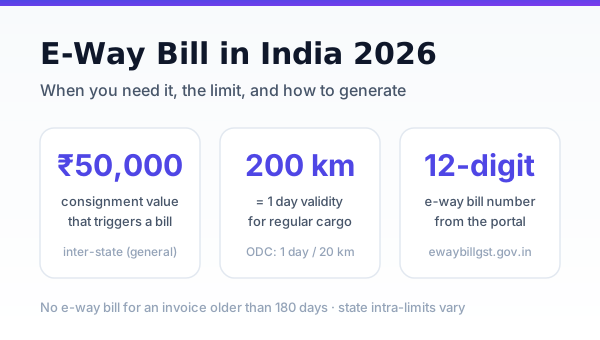
Under Rule 138(1), a registered person who causes movement of goods of consignment value above ₹50,000 must furnish Part A of FORM GST EWB-01 before the movement starts; a transporter can do it on his authorisation. Limits, validity and how to generate are covered in our e-way bill guide.
For bill to ship to, the 2018 press release says either A or B can generate the e-way bill, but only one e-way bill is required. The portal's user manual adds that it blocks a second e-way bill by the consignor on the same invoice number and alerts others who try.
Part A field
Case 1: B (Shah) generates
Case 2: A (Mehta) generates
Bill From
B's details
A's details
Dispatch From
B's place of business where goods are dispatched
B's place of business where goods are dispatched
Bill To
A's details
C's details
Ship To
C's address
C's address
Invoice details
Invoice-1 (B to A)
Invoice-2 (A to C)
In our example, if Shah generates it, Bill To is Mehta's Mumbai GSTIN, Ship To is Patil's Pune address, and the tax entered is IGST from Invoice-1. If Mehta generates it, Bill From is Mehta, Dispatch From is Shah's Ahmedabad godown, Bill To and Ship To are Patil, and the tax is CGST + SGST from Invoice-2. Agree on the order who will make it.
The four transaction types on the portal
The e-way bill form asks for a transaction type. The user manual defines four:
Type
Parties
Meaning
1. Regular
2
Billing and movement both directly from consignor to consignee
2. Bill To - Ship To
3
Billed to the consignee, goods sent to a third party at the consignee's request
3. Bill From - Dispatch From
3
Billed by the consignor, goods moved from a third party's premises to the consignee
4. Combination of 2 and 3
4
Goods moved from a third party to a fourth party at the consignee's request
In Case 1, Shah bills Mehta and ships to Patil from his own godown: that is type 2. In Case 2, Mehta bills Patil while the goods leave Shah's premises: that fits the manual's description of type 3.
Is the ship-to party's GSTIN mandatory?
Rule 46 asks for the recipient's GSTIN (the bill-to party) and the address of delivery. It does not list the ship-to party's GSTIN as a field on your invoice. On the e-way bill, the FAQ describes the "Ship To" side as the address of the destination, while the "Bill To" side takes the GSTIN and trade name. If the bill-to party is unregistered, the FAQ says to enter "URP" (unregistered person) in the GSTIN column.
Common mistakes
Charging tax by the delivery state. B's invoice follows A's state. A wrong tax type has to be corrected later in the invoice and the return, with your CA's help.
Leaving out the delivery address. Rule 46(o) asks for it, and without it the invoice going to Pune shows only a Mumbai buyer.
Two e-way bills for one truck. Only one is needed. Decide who makes it.
Using a delivery challan instead of the invoice. A challan is for movements that are not sales, such as job work; see delivery challan rules.
How RichBills (formerly RichPOS) helps
RichBills makes the GST tax invoice for your side of the deal. Save the buyer (A) with their GSTIN on the customer record and it prints on the bill, with HSN and the CGST/SGST or IGST split, on A4 or thermal printers. In the GSTR-1 report the bill shows under B2B with that GSTIN; see billing and GST reports, and check the tax split with the GST calculator.
RichBills does not generate e-way bills or e-invoices (IRN). Generate the e-way bill on the e-way bill portal or through your CA or transporter, using the invoice number from RichBills.
Pricing: 30 din free, phir ₹99/month pehle 3 mahine, phir ₹199/month ya ₹1,999/saal.
Bottom line: bill the party who ordered, charge tax by that party's state, show the ship-to address as the address of delivery, and make only one e-way bill, by either the seller or the buyer.
General information based on the IGST Act, CGST Rules 46 and 138 as published by CBIC, the Ministry of Finance press release of 23 April 2018 and the e-way bill portal FAQ and user manual, as of November 2026. Not tax advice; confirm your case with your CA.
FAQ
Frequently asked questions
What is bill to ship to in GST?
A sale billed to one party with the goods delivered to another on that buyer's instruction: two invoices, one movement of goods.
Is IGST or CGST + SGST charged in bill to ship to?
On the seller's invoice, it depends on the bill-to party's state. Section 10(1)(b) of the IGST Act makes the buyer's principal place of business the place of supply. Same state as the seller: CGST + SGST. Different state: IGST.
Who generates the e-way bill in bill to ship to?
Either the seller or the buyer who ordered the delivery, as the Ministry of Finance clarified on 23 April 2018. Only one e-way bill is required for the movement.
How do I fill an e-way bill when the ship to state is different?
Bill-to party's GSTIN in Bill To, delivery address in Ship To. Tax follows the bill-to state, whatever the route of the goods.
Is the GST number of the ship to party mandatory on the invoice?
Rule 46 requires the GSTIN of the recipient (bill-to party, if registered) and the address of delivery. It does not list the ship-to party's GSTIN as a required field.
Which transaction type do I choose on the e-way bill portal?
If you bill the buyer and ship from your own premises to his customer, choose Bill To - Ship To. The other types are Regular, Bill From - Dispatch From and Combination of 2 and 3.
Can my billing software generate the e-way bill?
RichBills does not; it makes the GST invoice and GSTR-1 data. Generate the e-way bill on the portal using the invoice details.
Founder, RichBills Software, Ahmedabad. We build RichBills for Indian shops and write these guides from what shop owners ask us every day. Facts on tax rates and prices are dated; confirm GST matters with your CA. Questions? WhatsApp us.
Make GST bills in seconds with RichBills
Billing, stock, WhatsApp bills and GST reports in one app. Free 30-day trial with no card, then ₹99/month for 3 months and ₹199/month after.
Branch Transfer under GST: Within State, Interstate, E-Way BillBranch transfer under GST: same-GSTIN shop or godown moves go on a delivery challan with no GST; transfers to another state's branch (or a second GSTIN) are taxable supplies on a tax invoice, valued under Rule 28. E-way bill above ₹50,000. Worked Ahmedabad to Mumbai example.
Composition to Regular Scheme GST (and Back): Forms, DatesHow a shop moves from GST composition to the regular scheme (CMP-04, ITC-01 within 30 days) or from regular to composition (CMP-02 before 1 April, ITC-03 within 60 days), with ₹ stock examples, bill and return changes, and the ₹1.5 crore limit.