Updated 17 November 2026 · By Ashok Sachdev · Sources: CGST Act section 25, section 7, Schedule I and section 16; CGST Rules 28, 55 and 138 (CBIC); e-way bill FAQ
Quick answer
GST on a branch transfer depends on whether the two places share one GSTIN. Moving stock between your own shop and shop, or shop and godown, under the same GSTIN in the same state is not a supply: send it on a delivery challan under Rule 55, with no GST. Sending stock to a branch in another state is a supply even without payment, because each GST registration is a "distinct person" (section 25(4)) and Schedule I para 2 taxes supplies between distinct persons made in the course of business. That needs a tax invoice with IGST, valued under Rule 28, and the receiving branch claims the IGST as credit. A second GSTIN in the same state works the same way, with CGST and SGST. An e-way bill is needed for inter-state movement above ₹50,000 consignment value, even when no GST is charged, and the e-way bill rules also cover challan movements within a state, where each state sets its own limit.
A hardware dealer moving stock to his godown across town and a clothing wholesaler sending kurtas from Surat to a Mumbai branch both call it a "stock transfer". GST treats them very differently. The test is not whether money changes hands but whether the receiving place is on your GSTIN.
Seedhi baat: ek hi GSTIN ke andar maal bhejo to challan banao, GST nahi. Doosre GSTIN par bhejo (doosra state ya doosra registration) to tax invoice banao aur GST lagao, chahe paisa na aaye. Doosre state mein ₹50,000 se upar ho to e-way bill lagega; state ke andar apne state ki limit check karo, challan wale maal par bhi lagta hai.
Branch transfer under GST: three cases
| Transfer | Is it a supply? | Document | GST |
|---|
| Shop to shop or shop to godown, same state, same GSTIN | No | Delivery challan (Rule 55) | None |
| Branch in another state (its own GSTIN) | Yes, between distinct persons (s.25(4), Schedule I para 2) | Tax invoice | IGST |
| Second GSTIN in the same state (separate registration under s.25(2)) | Yes, each registration is a distinct person (s.25(4)) | Tax invoice | CGST + SGST |
In all three, the e-way bill rules apply on top. Whether you need a second GSTIN in the same state at all is covered in two shops, one GST number.
Rule 55(1)(c) lets you issue a delivery challan instead of an invoice for "transportation of goods for reasons other than by way of supply". It shows HSN, quantity and value, and a tax line only where goods move for supply, so a same-GSTIN transfer carries no tax. The full field list and a sample layout are in our delivery challan guide, and you can make one with the free delivery challan format tool.
Rule 55(3) adds that goods moving on a challan must be declared under Rule 138, the e-way bill rule.
Branch transfer under GST e-way bill rules
Rule 138(1) requires a registered person who causes movement of goods of consignment value over ₹50,000 to furnish e-way bill details before movement starts, whether the movement is "in relation to a supply" or "for reasons other than supply". The official e-way bill FAQ says the same in plain words: e-way bills are required even where goods are moved for reasons other than supply, and the delivery challan is the basis for generating one.
- Consignment value is the value declared in the invoice, bill of supply or delivery challan, including any CGST, SGST, IGST and cess shown (Rule 138, Explanation 2).
- Inter-state transfer: generate the e-way bill from the tax invoice. Over ₹50,000 including IGST, it is needed.
- Same-state transfer: generate it from the challan. States can notify their own rules for movement within the state, so check your state's current limit; see the e-way bill guide.
Branch transfer under GST outside the state
GST registration is state-wise. Section 25(4) says a person with more than one registration, "whether in one State or Union territory or more than one State", is treated as a distinct person for each registration. Section 25(5) says the same for establishments in different states.
Section 7(1)(c) brings the activities in Schedule I within "supply" even when made without consideration. Paragraph 2 of Schedule I covers supply of goods or services "between distinct persons as specified in section 25, when made in the course or furtherance of business". So it does not matter that your Mumbai branch pays nothing.
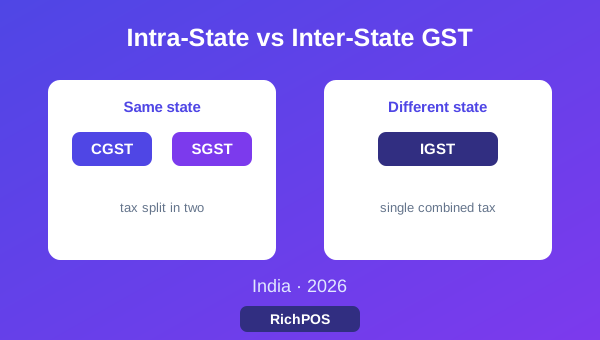
Because the supplier and the place of supply are in two different states, it is an inter-state supply and IGST applies. The difference is explained in intra-state vs inter-state GST. The sender issues a normal tax invoice to the branch's GSTIN, as to any registered buyer (see how to make a B2B GST invoice), and reports it in GSTR-1 and GSTR-3B.
What value to put on the invoice: Rule 28
There is no sale price, so Rule 28(1) of the CGST Rules sets the value for supplies between distinct persons:
- Open market value of the supply.
- If that is not available, the value of goods of like kind and quality.
- If neither works, the value under Rule 30 or Rule 31, in that order.
Two provisos matter most to shops:
- Goods meant for resale as they are: at the supplier's option, the value can be 90% of the price the receiving branch charges its own unrelated customers for goods of like kind and quality.
- Receiving branch eligible for full ITC: "the value declared in the invoice shall be deemed to be the open market value". For a branch that resells taxable goods, this usually applies, so your invoice value stands.
Whether your branch is eligible for full credit is a question for your CA.
The receiving branch claims ITC
Under section 16 the receiving branch can take credit of the IGST, subject to the usual conditions: it holds the invoice, has received the goods, the sender has reported the invoice in its outward statement and the tax has been paid. The general rules are in input tax credit for retail shops.
Worked example: Ahmedabad shop to Mumbai branch
An electronics retailer has a shop in Ahmedabad (Gujarat GSTIN) and a branch in Mumbai (Maharashtra GSTIN). On 17 November 2026 it sends stock that cost ₹1,00,000. The Mumbai branch will resell it and is eligible for full ITC. Assume the goods are taxed at 18%; the rate is for illustration only, use your items' actual rates.
| Step | Working | Amount |
|---|
| Invoice value | Mumbai eligible for full ITC, so the declared value is deemed open market value (Rule 28, second proviso) | ₹1,00,000 |
| IGST charged by Ahmedabad | ₹1,00,000 × 18% | ₹18,000 |
| Invoice total | ₹1,00,000 + ₹18,000 | ₹1,18,000 |
| E-way bill | Consignment value ₹1,18,000 is over ₹50,000 | Required |
| Ahmedabad's GST return | Output IGST in GSTR-1 and GSTR-3B | ₹18,000 payable |
| Mumbai's GST return | ITC of IGST, subject to section 16 conditions | ₹18,000 credit |
The ₹18,000 is not a final cost: Ahmedabad pays it and Mumbai uses it as credit against GST on its own sales. The real cost is cash flow, and the risk of losing credit if the invoice or return is wrong.
If the Mumbai branch were not eligible for full ITC, the value would follow Rule 28(1) and its first proviso. Say Mumbai sells the same goods to customers for ₹1,30,000: at Ahmedabad's option, the value could be 90% of that, ₹1,17,000, with IGST of ₹21,060.
Compare the same ₹1,00,000 of stock going to the shop's declared godown in Ahmedabad: a delivery challan, no GST, but the value is over ₹50,000, so check Gujarat's current e-way bill rule for movement within the state.
Second GSTIN in the same state
Section 25(2) gives one registration per state, but its proviso allows a separate registration for each place of business. Section 25(4) covers more than one registration "whether in one State or Union territory or more than one State", so two GSTINs in Gujarat are distinct persons. Stock moving between them is a supply on a tax invoice valued under Rule 28, with CGST + SGST because it is intra-state. This is why most small chains keep one GSTIN per state.
Common mistakes
- Sending stock to an undeclared godown. Add the place to your registration before you use it.
- Using a challan for an inter-state branch. A different GSTIN needs a tax invoice.
- Skipping the e-way bill because "it is our own stock".
- Same invoice series for both branches. Each GSTIN needs its own unique numbering; see GST invoice number rules.
- Receiving branch not booking the inward invoice. Its stock is short and its ITC is missed.
RichBills runs several stores and warehouses from one account, with staff assigned per location and per-store or consolidated sales and stock reports; see multi-store and warehouse. It records warehouse-to-warehouse stock transfers so stock goes down at one location and up at the other without a manual adjustment (purchases and suppliers). Each store can have its own invoice prefix. For an inter-state branch, save the branch as a customer with its GSTIN and bill it like any B2B buyer: the GST bill shows HSN and the CGST/SGST/IGST split, and the B2B line goes into the GSTR-1 report.
What it does not do: RichBills does not generate e-way bills, does not work out Rule 28 values for you, and does not file returns. Generate the e-way bill on the e-way bill portal. The ₹199 Dukaan plan has 1 location; more stores and warehouses come with the higher plans. For more on running branches, read how to manage multiple retail stores.
Pricing: 30 din free, phir ₹99/month pehle 3 mahine, phir ₹199/month ya ₹1,999/saal.
Bottom line: same GSTIN means a delivery challan and no GST; a different GSTIN, in another state or the same one, means a tax invoice with GST even though no money moves. Value it under Rule 28 (the invoice value usually stands when the receiver gets full ITC), let the receiving branch claim the credit, and generate an e-way bill when the consignment crosses the limit (₹50,000 for inter-state; your state's limit within the state).
General information based on the CGST Act, CGST Rules and e-way bill FAQ as published by CBIC and the e-way bill portal, as of November 2026. Not tax advice; confirm your case with your CA.