Original for recipient, duplicate for transporter, triplicate for supplier (you). Same number on every copy; thermal bills, lost bills and challans explained.
Updated 12 November 2026 · By Ashok Sachdev · Source: Rule 48, Rule 55 and Rule 57 of the CGST Rules, Sections 35 and 36 of the CGST Act (CBIC)
Quick answer
Under Rule 48 of the CGST Rules, a GST invoice for goods is made in three copies: the original marked "Original for Recipient" goes to the buyer, the duplicate marked "Duplicate for Transporter" travels with the goods, and the triplicate marked "Triplicate for Supplier" stays with you. An invoice for services needs two copies: original for the recipient and duplicate for the supplier. All copies carry the same invoice number and date; they are copies of one invoice, not three invoices.
Pre-printed GST bill books come with three colours of paper for a reason, and many shop owners still ask which copy goes where, whether a thermal printer counts, and what to do when a customer loses the bill. This guide answers those questions with the rule text behind each answer, so you can set up your bill book or billing software once and stop worrying about it.
Which copy goes to whom
Copy
Marked
Who keeps it
Why it exists
1st (original)
ORIGINAL FOR RECIPIENT
The buyer
The buyer's proof of purchase and, for a GST-registered buyer, the document behind their input tax credit
2nd (duplicate)
DUPLICATE FOR TRANSPORTER
Driver or courier, with the goods
Shown to officers during transit; not needed when the buyer carries the goods away
3rd (triplicate)
TRIPLICATE FOR SUPPLIER
You, the seller
Your record of the sale for returns, audit and disputes
For services, such as a mobile repair labour charge billed separately, Rule 48(2) asks for two copies: ORIGINAL FOR RECIPIENT and DUPLICATE FOR SUPPLIER. There is no transporter copy because nothing travels.
The wording confuses people because in daily language "supplier" is the person you buy from. In the GST rules, the supplier is whoever issues the invoice. When you sell, you are the supplier, so "Triplicate for Supplier" is the copy you keep. When you buy from a distributor, the distributor keeps its triplicate, and the copy that reaches you is the original.
A quick way to remember it: original goes out with the customer, duplicate goes on the truck, triplicate stays in the drawer.
Do all copies need the same number?
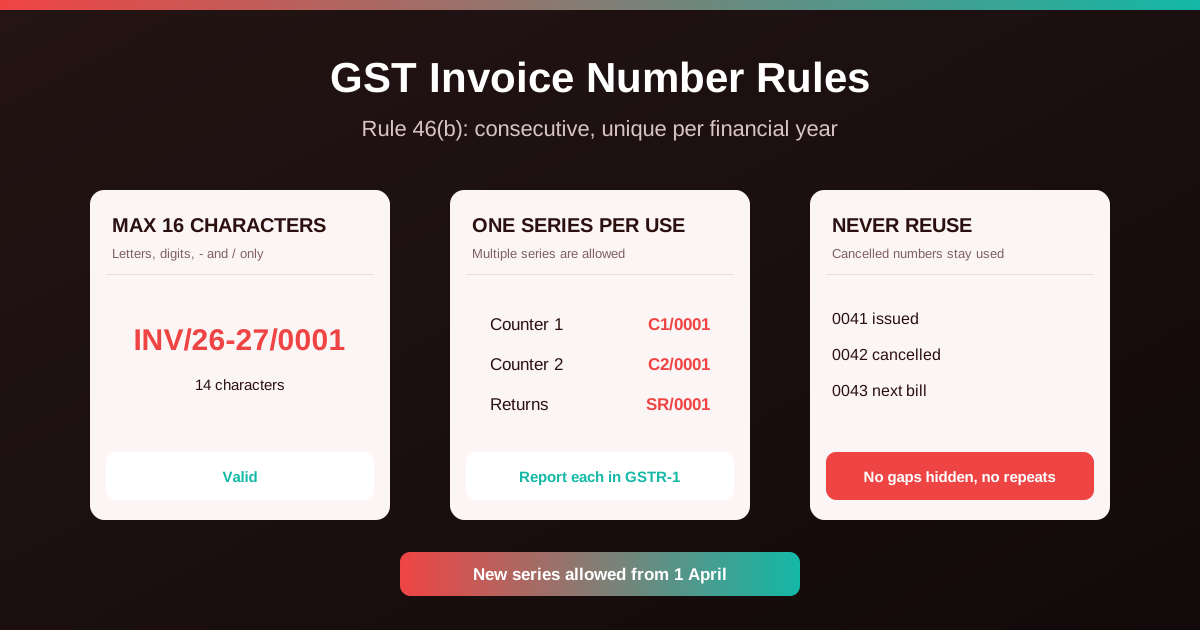
Yes. The three copies are one invoice. They share the invoice number, date, items, rates and totals; only the marking at the top changes. Never give a copy its own number. Under Rule 46, each invoice needs a unique consecutive serial number in the financial year, and a copy with a new number would look like a second sale with its own tax. For the numbering rules (16 characters, allowed symbols, a new series each April), see GST invoice number rules.
Counter sales with a thermal printer: do you need three prints?
Most retail sales are walk-in, B2C and paid on the spot. The customer takes the goods, so no transporter copy is involved. The customer gets the printed bill, and the seller needs a record of it.
The rule speaks of copies, not of paper. Section 35 of the CGST Act and Rule 57 of the CGST Rules allow accounts and records to be kept in electronic form, with a proper backup. When your billing software stores every bill with its number, that stored bill is commonly treated as your copy, and shops do not print a second slip for the drawer. If your CA or your state's practice expects a printed office copy, print one; it costs a few paise of thermal paper.
Whatever you choose, keep records for 72 months from the due date of the annual return for that year (Section 36). On a computer or cloud account that means backups, not just one laptop; see shop billing data backup and is cloud billing software safe.
When goods travel: the transporter copy matters
If you deliver goods by your own tempo, a courier or a transporter, the duplicate copy should travel with them. An officer checking a vehicle looks for the invoice (or a bill of supply or delivery challan) and, where the value needs it, an e-way bill. Rule 138A lists the documents a person in charge of a vehicle must carry. Hand the driver the transporter copy, not the customer's original.
The e-way bill limit and how to generate one are in e-way bill rules 2026. Large businesses on e-invoicing follow Rule 48(4), which applies notwithstanding the copy rules above: their invoice is the one registered on the Invoice Registration Portal with an IRN and QR code. Most small shops are below the e-invoicing limit; the details are in GST e-invoicing for retailers.
Delivery challan: also in triplicate
When goods move without a sale, for example on approval, for job work or to your own godown, you use a delivery challan instead of an invoice. Rule 55(2) asks for three copies of the challan too: original for the consignee, duplicate for the transporter, triplicate for the consigner. The format and when to use one are in delivery challan under GST, and you can make one free with the delivery challan format tool.
Customer lost the bill: issue a duplicate copy, not a new bill
Customers come back for a bill for warranty, an office expense claim or a loan file. The right way:
Find the original sale by date, customer name or amount.
Reprint or resend the same invoice: same number, same date, same amounts.
Mark it clearly, for example "Duplicate copy" or "Reprint", so nobody mistakes it for a fresh sale.
Never cut a new invoice for an old sale. A new number would show the sale twice in your GSTR-1 and you would pay tax on it twice.
If the original bill itself was wrong (wrong GSTIN, wrong rate), a copy will not fix it; you need a correction. See how to cancel or amend a GST invoice.
Setting up your bill book or software
Your setup
What to do
Pre-printed bill book
Order books with three copies per page, each marked Original / Duplicate / Triplicate, all carrying the same printed serial number
A4 printer, B2B sales with delivery
Print the original for the buyer and a transporter copy for the vehicle; keep your copy in the software or print a third
Thermal printer, walk-in B2C
One print for the customer; your record is the stored bill, backed up
Bill sent on WhatsApp or email
The PDF the buyer receives works as their copy; keep the bill in your software as yours
सामान के GST बिल की तीन कॉपी होती हैं: पहली "Original for Recipient" ग्राहक के लिए, दूसरी "Duplicate for Transporter" गाड़ी के साथ जाती है, और तीसरी "Triplicate for Supplier" आपके (बेचने वाले के) पास रहती है। तीनों पर एक ही बिल नंबर और तारीख होती है। सेवा के बिल की सिर्फ दो कॉपी: ग्राहक और आप।
Where RichBills fits
RichBills prints GST bills on 58 mm and 80 mm thermal printers and on A4, keeps every bill with its number in your account, and lets you share a bill on WhatsApp. A customer who lost a bill can be sent the same bill again instead of a new one, and your own copy is always the stored record. It does not generate e-invoices or e-way bills. Try it: 30 din free, phir ₹99/month pehle 3 mahine, phir ₹199/month ya ₹1,999/saal. Or make a one-off bill with the free GST invoice generator.
FAQ
Frequently asked questions
What is original, duplicate and triplicate in a GST invoice?
They are three copies of the same invoice for a supply of goods (Rule 48(1)): the original for the recipient (buyer), the duplicate for the transporter and the triplicate for the supplier (seller). All three carry the same invoice number, date and amounts.
Who keeps the triplicate copy of an invoice?
The supplier, meaning the business that issued the invoice. If you made the sale, the triplicate is your copy. When you buy from a distributor, the distributor keeps its triplicate and you receive the original.
How many copies of a service invoice are needed?
Two, under Rule 48(2): original for the recipient and duplicate for the supplier.
Is a thermal printer bill valid without three copies?
Yes, for a walk-in sale the customer needs only their copy, and Section 35 with Rule 57 allows the seller's records to be kept electronically with a backup. Print an extra office copy if your CA prefers it. The bill must still carry all the details GST requires.
Can I give a duplicate bill if the customer loses the original?
Yes. Reprint or resend the same invoice with the same number and date, marked as a duplicate copy or reprint. Do not issue a new invoice for an old sale.
Does a delivery challan also need three copies?
Yes. Rule 55(2) asks for a delivery challan in triplicate: original for the consignee, duplicate for the transporter and triplicate for the consigner.
How long must I keep my copy of the invoice?
For 72 months from the due date of the annual return for the year the invoice belongs to (Section 36 of the CGST Act), longer if there is an appeal or proceeding.
Bottom line: one invoice, one number, up to three copies: original to the buyer, duplicate with the goods, triplicate with you. For counter sales your stored, backed-up bill is your copy, and a lost bill is reprinted, never re-billed.
Founder, RichBills Software, Ahmedabad. We build RichBills for Indian shops and write these guides from what shop owners ask us every day. Facts on tax rates and prices are dated; confirm GST matters with your CA. Questions? WhatsApp us.
Make GST bills in seconds with RichBills
Billing, stock, WhatsApp bills and GST reports in one app. Free 30-day trial with no card, then ₹99/month for 3 months and ₹199/month after.